Context of the News
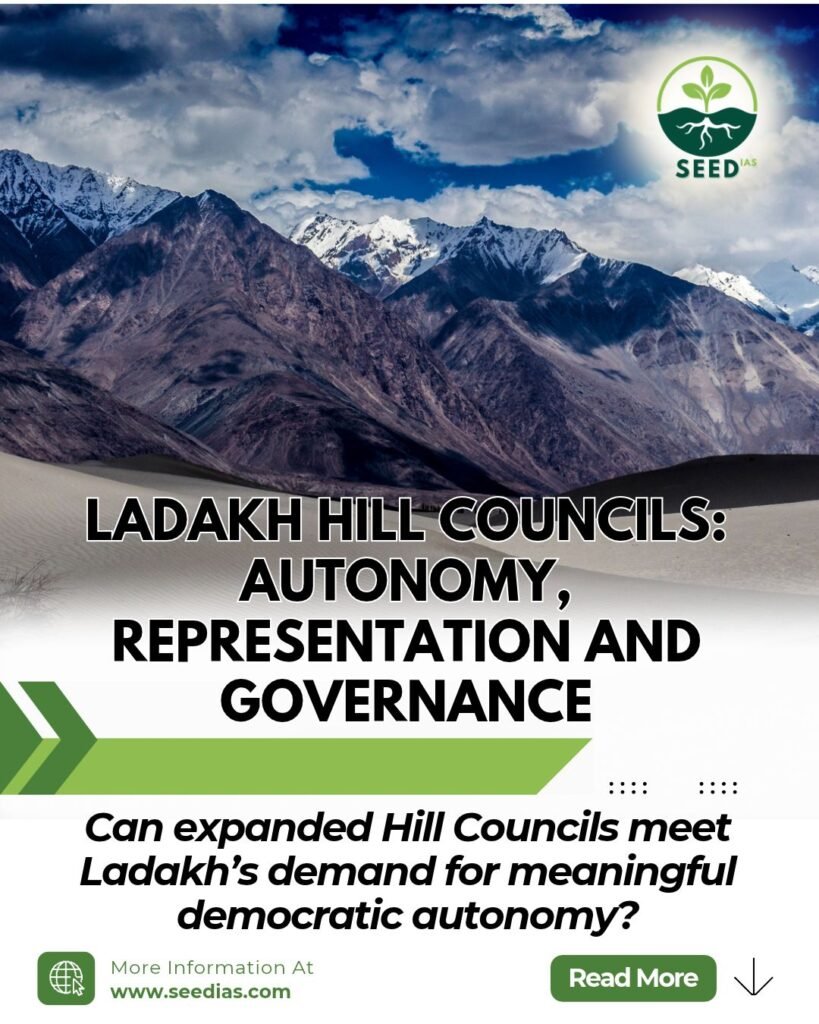
The President of India promulgated the Ladakh Autonomous Hill Development Councils (LAHDC) (Amendment) Regulation, 2026, expanding the Hill Council framework to all eight districts of Ladakh. Subsequently, 100 elected constituencies were notified across the eight councils.
At the same time, the Centre’s proposed framework for a Union Territory (UT)-level elected body has raised questions about the powers of the Lieutenant Governor (L-G) and the extent of democratic autonomy available to Ladakh.
The issue highlights a key governance challenge: how can local representation be expanded while ensuring meaningful decision-making powers for elected institutions?
Background: Ladakh’s Governance Structure
Ladakh became a separate Union Territory in 2019, following the reorganisation of the former State of Jammu and Kashmir. Its governance arrangements have since been debated in the context of local representation, protection of regional interests and demands for greater autonomy.
The Ladakh Autonomous Hill Development Councils (LAHDCs) are local representative institutions intended to address the developmental and administrative needs of different parts of the region.
The current debate has two interconnected dimensions:
- District-level decentralisation: Expanding Hill Councils and adjusting their representation to district-specific conditions.
- UT-level autonomy: Establishing an elected body for Ladakh and determining the extent of its legislative powers in relation to the L-G.
Ladakh’s broader demands include Statehood, inclusion under the Sixth Schedule, a dedicated Public Service Commission (PSC), and separate Lok Sabha seats for Leh and Kargil.
News Breakdown: Key Provisions of the 2026 Regulation
A. Hill Councils for All Eight Districts
The amended framework extends Hill Councils beyond the existing councils in Leh and Kargil to cover all eight districts:
- Leh
- Kargil
- Sankoo
- Changthang
- Nubra
- Sham
- Zanskar
- Drass
This expansion aims to widen the reach of local representation and provide district-specific institutional arrangements across Ladakh.
B. Rationalisation of Elected Seats
The earlier fixed structure of 26 seats per council has been amended. Under the new arrangement, the number of elected constituencies will range from 7 to 24 per council, depending on demographic and geographical conditions.
This recognises that districts differ in population distribution, settlement patterns and physical terrain.
C. Inclusive Representation
The regulation permits the nomination of up to four members from women and unrepresented communities, subject to a ceiling linked to one-sixth of the elected seats.
The provision seeks to improve representation for groups that may otherwise remain underrepresented in the elected composition of a council.
D. Administrative Powers
The councils are granted powers equivalent to district-level panchayats under the Jammu and Kashmir Panchayati Raj Act, 1989.
This establishes a connection between the Hill Councils and the decentralised local-government framework. However, district-level panchayat-equivalent powers should not automatically be interpreted as equivalent to the full legislative autonomy sought under the Sixth Schedule.
E. Conduct of Elections
The State Election Commission for the UT of Ladakh will exercise superintendence, direction and control over elections to the councils.
An independent election authority is important for the conduct of local elections and the orderly functioning of representative institutions.
The Proposed UT-Level Elected Body
The Centre’s proposed constitutional and statutory framework seeks to create an elected institution at the Union Territory level. However, important questions remain about its composition, powers and relationship with the L-G.
A. The Lieutenant Governor’s Assent
According to the Ministry of Home Affairs (MHA) draft described in the source material, laws or regulations passed by the proposed elected body would take effect only after receiving the L-G’s assent.
This has become a major point of contention.
- Supporters of the arrangement may emphasise the need for institutional oversight within the Union Territory’s administrative structure.
- Critics argue that a requirement for assent to every law could substantially restrict the elected body’s independent authority.
- Activists contend that such a body could become largely advisory if its decisions cannot take effect without the L-G’s approval.
The central question is whether the proposed institution would possess meaningful legislative authority or primarily provide a platform for consultation.
Article 371 and Article 240
The proposal refers to a constitutional arrangement under Article 371, alongside regulations under Article 240.
| Constitutional provision | Core significance |
| Article 371 | Provides special constitutional arrangements for specified states through individual provisions. The proposed Ladakh framework would require a clearly defined constitutional basis and scope. |
| Article 240 | Empowers the President to make regulations for the peace, progress and good government of specified Union Territories, including Ladakh. |
Important distinction: The proposed use of these provisions is part of the framework under discussion. It should not be confused with a statement that Ladakh has already been granted Sixth Schedule status or a fully autonomous legislature.
Unresolved Questions in the Draft
The MHA framework seeks views from civil society on several institutional choices.
| Issue | Options under discussion | Why it matters |
| Delimitation | Population-based or area-based | Determines how representation is distributed across districts and constituencies. |
| Women’s reservation | 33% or 50% | Determines the extent of women’s formal representation. |
| Method of election | Direct election or indirect election through LAHDCs | Determines whether voters elect UT-level representatives directly or through the Hill Councils. |
| L-G’s assent | Assent required for laws or regulations | Determines how much independent authority the elected body can exercise. |
These choices will shape the balance between representative democracy, regional equity and administrative oversight.
Why Is the Sixth Schedule Important to the Debate?
The Sixth Schedule of the Constitution provides for autonomous district and regional councils in specified tribal areas of Assam, Meghalaya, Tripura and Mizoram. These institutions exercise defined legislative, judicial and administrative powers within the constitutional framework.
Ladakh’s demand for Sixth Schedule status is linked to concerns about protecting local identity, land, culture and decision-making authority.
The key distinction is between decentralised administration and constitutionally protected autonomy:
- Decentralised administration transfers specified responsibilities to local institutions.
- Legislative autonomy allows institutions to make laws within constitutionally defined areas of competence.
- Constitutional safeguards can provide a more durable framework for protecting regional interests.
Therefore, extending Hill Councils and increasing representation may strengthen local governance, but these changes do not, by themselves, fulfil the demand for Sixth Schedule status.
Major Concerns and the Way Forward
Key concerns
- Limited legislative authority: The proposed assent requirement may constrain the UT-level body’s capacity to act independently.
- Representation versus power: More constituencies improve representation, but do not necessarily confer greater decision-making authority.
- Regional equity: Population-based delimitation may produce different outcomes from area-based delimitation in a geographically vast and sparsely populated region.
- Women’s participation: The choice between 33% and 50% reservation will influence the level of women’s representation.
- Unresolved political demands: The proposed framework does not, on the information provided, settle demands for Statehood, Sixth Schedule status, a dedicated PSC and separate Lok Sabha seats for Leh and Kargil.
Way forward
- Consultative lawmaking: Engage local communities, elected representatives and civil society before finalising the framework.
- Clear division of powers: Define the respective roles of the L-G, the proposed UT-level body and the LAHDCs.
- Effective representation: Adopt transparent delimitation criteria that consider population, geography and access to public services.
- Meaningful inclusion: Ensure women and underrepresented communities participate effectively in decision-making.
- Address foundational demands: Consider Ladakh’s wider political and constitutional demands through a transparent, constitutionally grounded process.
Prelims Focus: Important Facts
| Topic | Fact to remember |
| LAHDC Amendment Regulation | 2026 |
| Hill Council coverage | All eight districts of Ladakh |
| Elected constituencies | 100 across the eight councils, as stated in the news |
| Elected seats per council | 7–24, depending on district conditions |
| Nomination provision | Up to four members from women and unrepresented communities, subject to the stated ceiling |
| Election authority | State Election Commission for the UT of Ladakh |
| Panchayati Raj legislation referenced | Jammu and Kashmir Panchayati Raj Act, 1989 |
| Article 240 | Presidential regulation-making power for specified Union Territories |
| Sixth Schedule | Provides for autonomous district and regional councils in specified areas of four northeastern states |
| Broader demands in Ladakh | Statehood, Sixth Schedule status, dedicated PSC and separate Lok Sabha seats for Leh and Kargil |
Prelims caution: Article 371 contains special provisions for specified states; Article 240 concerns presidential regulations for specified Union Territories. Neither provision should be treated as synonymous with the Sixth Schedule.
Prelims Check: UPSC-Style MCQs
Q1. With reference to the LAHDC (Amendment) Regulation, 2026, consider the following statements:
- The amended framework extends Hill Councils to all eight districts of Ladakh.
- Every Hill Council must have exactly 26 elected members.
- The State Election Commission for the UT of Ladakh will supervise the council elections.
Which of the statements given above is/are correct?
(a) 1 only
(b) 1 and 3 only
(c) 2 and 3 only
(d) 1, 2 and 3
Q2. Consider the following pairs:
| Constitutional provision | Subject |
| 1. Article 240 | Presidential regulations for specified Union Territories |
| 2. Sixth Schedule | Autonomous district and regional councils in specified northeastern states |
| 3. Article 371 | Identical special provisions applicable uniformly to every state |
Which of the pairs given above are correctly matched?
(a) 1 and 2 only
(b) 2 and 3 only
(c) 1 and 3 only
(d) 1, 2 and 3
Q3. With reference to the proposed UT-level elected body for Ladakh, consider the following statements:
- The MHA draft described in the news makes the effectiveness of the body’s laws or regulations subject to the L-G’s assent.
- The proposal has already granted Ladakh full Statehood and Sixth Schedule status.
- The proposed framework raises questions about delimitation, women’s reservation and the method of electing members.
Which of the statements given above is/are correct?
(a) 1 and 2 only
(b) 2 and 3 only
(c) 1 and 3 only
(d) 1, 2 and 3
Hide Answers and Explanations
Answer Key with Explanations
Q1. Correct answer: (b) 1 and 3 only
- Statement 1 is correct: The amendment extends the Hill Council framework to all eight districts.
- Statement 2 is incorrect: The fixed 26-seat structure has been replaced by a range of 7–24 elected constituencies per council.
- Statement 3 is correct: The UT’s State Election Commission is assigned superintendence, direction and control over council elections.
Q2. Correct answer: (a) 1 and 2 only
- Pair 1 is correct: Article 240 empowers the President to make regulations for the peace, progress and good government of specified Union Territories.
- Pair 2 is correct: The Sixth Schedule provides for autonomous district and regional councils in specified tribal areas of Assam, Meghalaya, Tripura and Mizoram.
- Pair 3 is incorrect: Article 371 comprises special provisions for particular states; these are not identical provisions uniformly applicable to every state.
Q3. Correct answer: (c) 1 and 3 only
- Statement 1 is correct: According to the draft described in the supplied material, laws or regulations would require the L-G’s assent to take effect.
- Statement 2 is incorrect: Statehood and Sixth Schedule status remain among the demands identified in the news; the proposal does not establish that either has been granted.
- Statement 3 is correct: Delimitation, women’s reservation and direct versus indirect elections remain open questions in the proposed framework.
Conclusion
Ladakh’s expanded Hill Councils can strengthen local representation, but durable democratic autonomy requires clear powers, inclusive institutions and meaningful engagement with the region’s constitutional demands.
“Democracy grows stronger when representation is matched by responsibility, participation and meaningful power.”