Context of the News
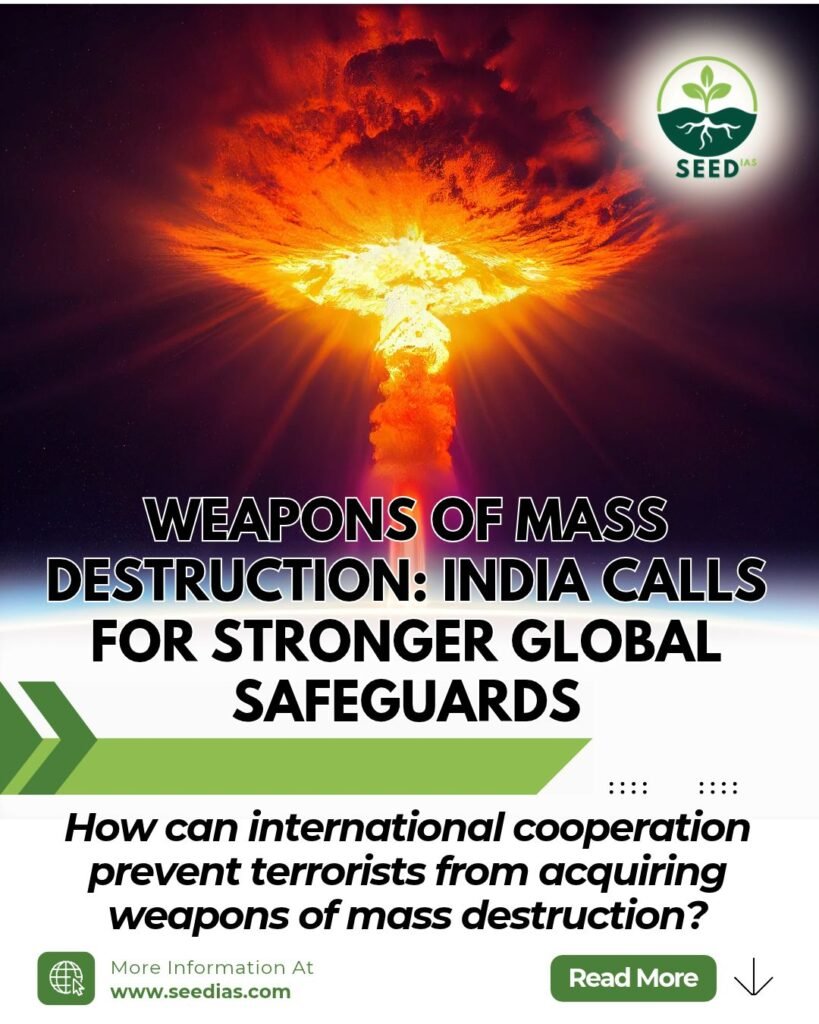
India has called for stronger safeguards against the proliferation of Weapons of Mass Destruction (WMDs) and the risk of terrorists acquiring sensitive technologies. The issue was discussed under “Other Weapons of Mass Destruction” in the United Nations General Assembly (UNGA) First Committee, which deals with disarmament and international security.
India emphasised effective implementation of international conventions, stronger national controls and cooperation to address emerging threats from scientific and technological advancements.
Background: Understanding Weapons of Mass Destruction
Weapons of Mass Destruction (WMDs) are weapons capable of causing extensive loss of life, widespread destruction or severe harm to human health and the environment.
The principal categories are:
- Nuclear weapons: Release enormous energy through nuclear fission or fusion.
- Chemical weapons: Use toxic chemicals to cause death, injury or incapacitation.
- Biological weapons: Use disease-causing organisms or biological toxins to harm humans, animals or plants.
- Radiological weapons: Disperse radioactive material to contaminate an area. These differ from nuclear weapons because they do not require a nuclear explosion.
The proliferation of WMDs becomes especially dangerous when states, terrorist organisations or other non-state actors obtain the materials, expertise or delivery systems needed to develop or use them.
News Breakdown: Key Developments
1. India’s Position on WMD Non-Proliferation
Non-proliferation refers to preventing the spread of weapons, related materials and technologies to additional states or non-state actors.
India has highlighted the need for stronger international safeguards to prevent the misuse of sensitive technologies.
Its position includes:
- Effective implementation of international conventions: India supports the full, effective and non-discriminatory implementation of the Chemical Weapons Convention (CWC) and the Biological Weapons Convention (BWC).
- International cooperation: Countries need to cooperate to address emerging threats associated with dangerous materials and technologies.
- Prevention of terrorist access: National laws and international safeguards should prevent terrorist organisations from acquiring WMDs and their delivery systems.
- Responsible technology management: Scientific progress must be accompanied by safeguards against misuse.
2. Dual-Use Technologies and Emerging Threats
Dual-use technology refers to technology, equipment, materials or knowledge that can serve both civilian and military purposes.
For example, technologies developed for legitimate scientific research or industrial applications may also have potential military or harmful applications.
Their dual-use nature creates challenges for governments because restrictions must prevent dangerous misuse without unnecessarily obstructing legitimate research, trade and technological development.
Key concerns include:
- Biotechnology: Research intended for public health or medical purposes may create risks if biological materials or techniques are deliberately misused.
- Chemical technology: Industrial chemicals and related equipment may have legitimate commercial uses but can also be diverted for prohibited purposes.
- Advanced scientific equipment: Sensitive equipment and technical expertise may contribute to prohibited weapons-related activities if transferred without appropriate safeguards.
- International trade: Effective export controls can help prevent sensitive materials and technologies from reaching unauthorised end users.
Key distinction: Dual-use technology is not inherently unlawful. The concern is its potential misuse or diversion towards prohibited weapons programmes or terrorist activities.
3. India-Sponsored United Nations Resolution
India has introduced the United Nations General Assembly resolution titled “Measures to prevent terrorists from acquiring weapons of mass destruction” since 2002.
The initiative seeks stronger national and international measures to prevent terrorists from obtaining WMDs and their delivery systems.
Its importance lies in recognising that preventing proliferation requires action beyond traditional state-to-state arms control.
The resolution highlights three broad priorities:
- Strengthening national legal and regulatory frameworks.
- Improving international cooperation and information-sharing.
- Preventing terrorist access to dangerous weapons, related materials and delivery systems.
4. India’s Domestic Legal Safeguards
India has established domestic legislation and export-control mechanisms to prevent unlawful activities involving WMDs and related technologies.
The principal legislation highlighted in this context is the Weapons of Mass Destruction and their Delivery Systems (Prohibition of Unlawful Activities) Act, 2005.
Its relevance includes:
- Legal safeguards: Prohibiting unlawful activities involving WMDs and their delivery systems.
- Export controls: Regulating sensitive materials, equipment and technologies to prevent unauthorised transfers.
- Non-proliferation: Supporting India’s international commitments through domestic legal mechanisms.
- Prevention of diversion: Helping reduce the risk that legitimate trade or transfers will contribute to prohibited weapons-related activities.
The Weapons of Mass Destruction and their Delivery Systems (Prohibition of Unlawful Activities) Amendment Act, 2022 strengthened the legal framework, including provisions addressing the financing of prohibited activities involving WMDs and their delivery systems.
5. Chemical Weapons Convention (CWC)
The Chemical Weapons Convention (CWC) is an international treaty that seeks to eliminate chemical weapons and prevent their development, production, acquisition, stockpiling, retention, transfer and use.
- Entry into force: April 1997.
- India’s status: India is a State Party and ratified the Convention in 1996.
- Implementing organisation: The Organisation for the Prohibition of Chemical Weapons (OPCW) oversees implementation of the Convention.
- Core objective: Achieving a world free of chemical weapons through prohibition, destruction obligations, verification and international cooperation.
The CWC is significant because it combines a comprehensive prohibition on chemical weapons with a system for monitoring compliance.
6. Biological Weapons Convention (BWC)
The Biological Weapons Convention (BWC) prohibits the development, production, acquisition, stockpiling, retention and transfer of biological and toxin weapons.
- Entry into force: March 1975.
- India’s status: India is a State Party and ratified the Convention in 1974.
- Core objective: Excluding biological and toxin weapons from use as instruments of warfare.
The Convention is particularly important as advances in biotechnology can create new challenges for biological security.
Important distinction: Unlike the CWC, the BWC does not have an equivalent international organisation with a comprehensive verification system. This remains an important issue in discussions on strengthening biological disarmament and compliance.
7. United Nations Security Council Resolution 1540
United Nations Security Council Resolution 1540 (2004) is a key international instrument aimed at preventing non-state actors from acquiring nuclear, chemical and biological weapons and their delivery systems.
Adopted under Chapter VII of the United Nations Charter, it requires states to establish effective domestic controls against proliferation.
Its principal requirements include:
- Legislation: States must establish appropriate laws prohibiting non-state actors from acquiring or developing these weapons.
- Security of materials: States must maintain effective measures to secure relevant materials.
- Export and border controls: States must establish suitable controls to prevent illicit trafficking and unauthorised transfers.
- International implementation: Countries are expected to implement the resolution through national measures.
UPSC distinction: The CWC and BWC are international treaties, whereas UNSC Resolution 1540 is a Security Council resolution imposing obligations on UN member states under Chapter VII.
8. Role of the UN General Assembly First Committee
The First Committee of the United Nations General Assembly, also known as the Disarmament and International Security Committee, addresses matters relating to international peace and security through disarmament and arms-control discussions.
Its work includes:
- Nuclear disarmament and non-proliferation.
- Chemical and biological weapons.
- Prevention of an arms race and regulation of conventional weapons.
- Emerging security threats associated with scientific and technological developments.
- International cooperation on disarmament-related issues.
The First Committee discusses issues and adopts draft resolutions for consideration by the General Assembly. It is not a law-enforcement agency and does not itself conduct weapons inspections.
Why Are Stronger WMD Safeguards Important?
Stronger safeguards can address security threats that cross national borders and exploit gaps in regulation.
| Challenge | Significance of stronger safeguards |
| Terrorism | Reduces the risk of non-state actors acquiring WMDs. |
| Dual-use technologies | Helps prevent diversion of sensitive materials and equipment. |
| Weak domestic controls | Encourages stronger legislation, export controls and enforcement. |
| International coordination | Improves cooperation in addressing cross-border proliferation risks. |
| Emerging technologies | Supports the development of safeguards that respond to changing scientific capabilities. |
The central challenge is to balance international security, non-proliferation obligations and peaceful scientific progress.
Prelims Focus: High-Value Facts
| Instrument | Key facts for UPSC |
| Chemical Weapons Convention (CWC) | Entered into force in 1997; implementation overseen by the OPCW. |
| Biological Weapons Convention (BWC) | Entered into force in 1975; prohibits biological and toxin weapons. |
| UNSC Resolution 1540 | Adopted in 2004 under Chapter VII of the UN Charter. |
| India’s WMD Act | The 2005 Act provides India’s domestic legal framework against unlawful WMD-related activities. |
| WMD Amendment Act | The 2022 amendment strengthened provisions, including those addressing financing of prohibited activities. |
| UNGA First Committee | Also called the Disarmament and International Security Committee. |
| India’s UN resolution | “Measures to prevent terrorists from acquiring weapons of mass destruction”, introduced since 2002. |
| Dual-use technology | Can have both civilian and military applications. |
Conclusion and Way Forward
India should strengthen domestic enforcement, international cooperation and responsible technology governance to prevent WMD proliferation while protecting peaceful scientific research.
Prelims Check: UPSC-Style Practice Questions
Question 1
With reference to international instruments relating to weapons of mass destruction, consider the following pairs:
| Instrument | Primary objective |
| 1. Chemical Weapons Convention | Prohibition and elimination of chemical weapons |
| 2. Biological Weapons Convention | Prohibition of biological and toxin weapons |
| 3. UNSC Resolution 1540 | Preventing non-state actors from acquiring nuclear, chemical and biological weapons |
| 4. UNGA First Committee | Conducting international inspections of chemical weapons facilities |
Which of the pairs given above are correctly matched?
(a) 1 and 2 only
(b) 1, 2 and 3 only
(c) 2, 3 and 4 only
(d) 1, 2, 3 and 4
Question 2
Consider the following statements regarding the Chemical Weapons Convention (CWC) and the Biological Weapons Convention (BWC):
- The CWC entered into force before the BWC.
- The Organisation for the Prohibition of Chemical Weapons is associated with the implementation of the CWC.
- The BWC has a verification system equivalent to the OPCW’s comprehensive inspection system under the CWC.
- India is a State Party to both conventions.
Which of the statements given above are correct?
(a) 1 and 2 only
(b) 1, 2 and 4 only
(c) 2 and 3 only
(d) 1, 2, 3 and 4
Question 3
With reference to the non-proliferation of weapons of mass destruction, consider the following statements:
- Dual-use technologies may have both civilian and military applications.
- UNSC Resolution 1540 was adopted under Chapter VII of the UN Charter.
- The UN General Assembly First Committee is primarily responsible for enforcing domestic export-control laws in member states.
- India’s Weapons of Mass Destruction and their Delivery Systems (Prohibition of Unlawful Activities) Act was enacted in 2005.
Which of the statements given above are correct?
(a) 1 and 2 only
(b) 1, 2 and 4 only
(c) 2, 3 and 4 only
(d) 1, 2, 3 and 4
Answers and Explanations
Question 1 — Answer: (b)
- Pair 1 is correct: The CWC prohibits chemical weapons and establishes obligations for their elimination.
- Pair 2 is correct: The BWC prohibits biological and toxin weapons.
- Pair 3 is correct: Resolution 1540 requires states to take measures to prevent non-state actors from acquiring nuclear, chemical and biological weapons and their delivery systems.
- Pair 4 is incorrect: The UNGA First Committee deliberates on disarmament and international security. Chemical weapons inspections are associated with the OPCW.
Question 2 — Answer: (b)
- Statement 1 is correct: The BWC entered into force in March 1975, before the CWC entered into force in April 1997.
- Statement 2 is correct: The OPCW oversees implementation of the CWC.
- Statement 3 is incorrect: The BWC does not have a verification system equivalent to the CWC’s comprehensive inspection framework.
- Statement 4 is correct: India is a State Party to both conventions.
Question 3 — Answer: (b)
- Statement 1 is correct: Dual-use technologies can serve civilian as well as military purposes.
- Statement 2 is correct: UNSC Resolution 1540 was adopted under Chapter VII of the UN Charter in 2004.
- Statement 3 is incorrect: The First Committee discusses disarmament and international security; it does not enforce domestic export-control laws.
- Statement 4 is correct: India’s WMD Act was enacted in 2005.
“Peace is strengthened when scientific progress is guided by responsibility, international cooperation and a shared commitment to humanity.”