Context of the News
On 28 October 2026, the Union Cabinet approved the Pradhan Mantri Viksit Gram Swaraj Yojana (PM VGSY), a Centrally Sponsored Scheme aimed at strengthening Panchayati Raj Institutions (PRIs) and grassroots governance across India.
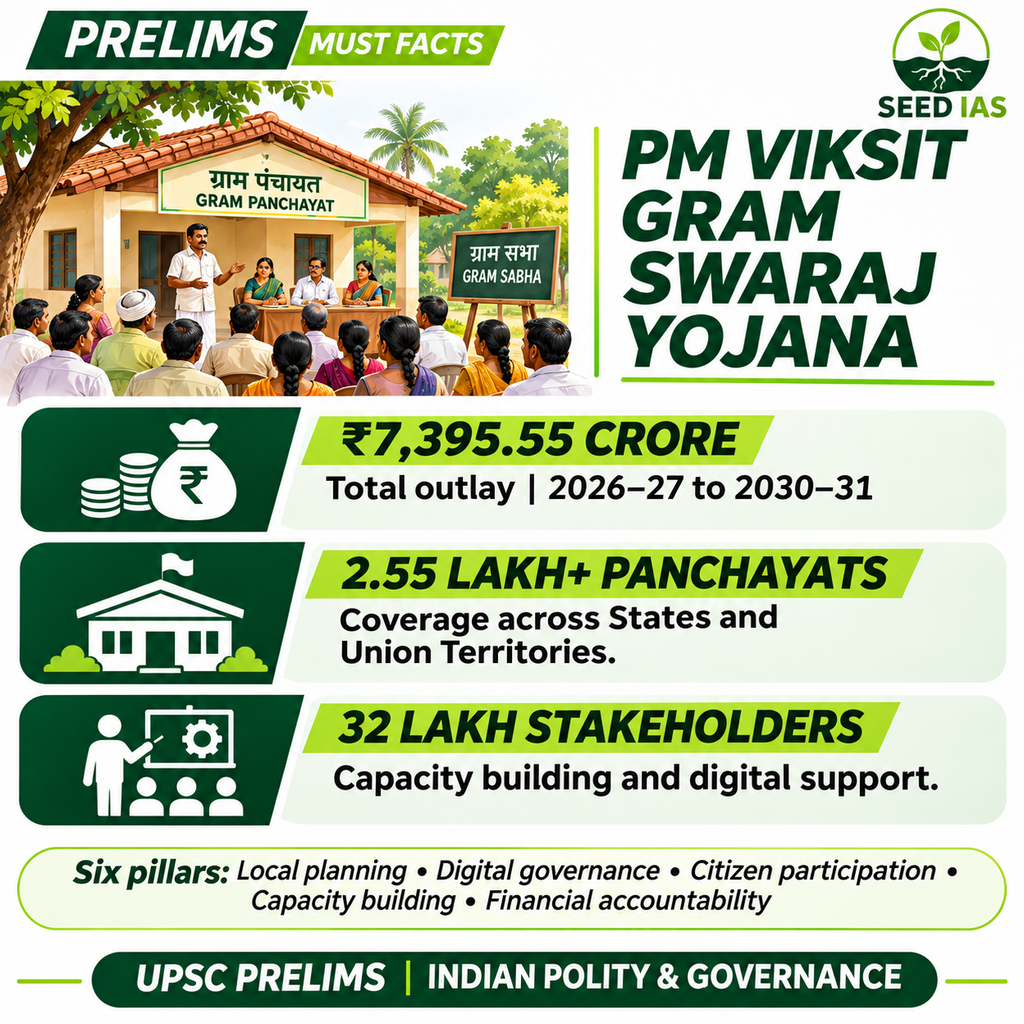
The scheme has a total financial outlay of ₹7,395.55 crore and will be implemented during 2026–27 to 2030–31.
It seeks to transform Gram Panchayats into empowered, self-reliant, accountable and high-performing institutions through integrated planning, digital governance and capacity building. Press Information Bureau+1
Background: Why Strengthen Panchayati Raj Institutions?
India’s rural development depends significantly on the effectiveness of local self-government institutions.
The 73rd Constitutional Amendment Act, 1992 gave constitutional status to Panchayati Raj Institutions and strengthened democratic decentralisation in rural areas.
However, Panchayats continue to face challenges such as:
- Inadequate technical and administrative capacity.
- Limited financial autonomy and dependence on government grants.
- Weak coordination between government departments.
- Inadequate citizen participation in local planning.
- Delays and gaps in accounting and auditing.
- Uneven digital infrastructure and governance capabilities.
The PM VGSY seeks to address these institutional weaknesses and improve the ability of Panchayats to plan and implement local development programmes.
What are the Key Facts About PM VGSY?
1. Nature and Objectives of the Scheme
Pradhan Mantri Viksit Gram Swaraj Yojana is a Centrally Sponsored Scheme (CSS) under the Ministry of Panchayati Raj.
Its primary objective is to strengthen Panchayats as effective institutions of local self-government.
The scheme focuses on:
- Empowered Panchayats: Strengthening the decision-making capacity of elected local representatives.
- Self-reliant Panchayats: Improving the ability to mobilise and manage financial resources.
- Accountable Panchayats: Promoting transparency through digital accounting and auditing.
- High-performing Panchayats: Improving local development planning and service delivery.
2. Implementation Period and Financial Outlay
The scheme will operate for five financial years, coinciding with the Sixteenth Finance Commission period.
| Particulars | Details |
|---|---|
| Scheme | PM VGSY |
| Implementation period | 2026–27 to 2030–31 |
| Total financial outlay | ₹7,395.55 crore |
| Central Government share | ₹4,869.48 crore |
| State Government share | ₹2,526.07 crore |
| Nodal Ministry | Ministry of Panchayati Raj |
| Nature | Centrally Sponsored Scheme |
The financial contribution is shared between the Centre and States, reflecting the collaborative nature of rural governance.
3. Institutional Coverage and Beneficiaries
The scheme has a broad institutional coverage across India.
- It covers over 2.55 lakh Panchayats and traditional local bodies.
- It extends to all States and Union Territories.
- It includes eligible traditional rural local government institutions in areas where Panchayats under Part IX of the Constitution do not exist.
- Around 32 lakh elected representatives, Panchayat functionaries and other stakeholders are expected to benefit through capacity building and technical support.
4. Linkage with the Sixteenth Finance Commission
An important feature of PM VGSY is its alignment with the Sixteenth Finance Commission (2026–31).
The Sixteenth Finance Commission has recommended approximately ₹4.35 lakh crore in grants for Rural Local Bodies during this period.
These grants are intended to strengthen local governments financially.
However, providing funds alone is not sufficient. Panchayats also need the administrative and technical capacity to prepare development plans and utilise available resources effectively.
PM VGSY seeks to bridge this gap by strengthening:
- Financial planning and management.
- Online accounting and auditing.
- Resource mobilisation.
- Utilisation of Finance Commission grants.
- Institutional accountability.
5. Implementation Mechanism
The scheme will be implemented through existing government institutions rather than creating an entirely new administrative structure.
Its implementation mechanism includes:
- Annual Action Plans: States and Union Territories will submit annual plans identifying their activities, priorities and requirements.
- Central Empowered Committee: The committee will appraise and approve the submitted plans.
- Technical Support: Need-based contractual personnel may be engaged at State, District and Block levels.
- No Permanent Posts: The scheme does not provide for the creation of permanent government posts.
This approach seeks to strengthen existing institutional arrangements while avoiding unnecessary administrative expansion. Prime Minister of India+1
What are the Six Pillars of PM VGSY?
The scheme is built around six major pillars designed to transform Panchayats from basic administrative institutions into centres of participatory development.
1. Gram Panchayats as Hubs of Local Governance
Gram Panchayat: The lowest tier of rural local self-government, responsible for local administration and development within its jurisdiction.
The scheme places Gram Panchayats at the centre of village-level development planning.
- Panchayats will coordinate village priorities, government schemes and available financial resources.
- They will act as a link between national development priorities and local aspirations.
- Local development decisions will be based on the needs and requirements of individual villages.
2. Holistic Planning at Gram Panchayat Level
Holistic Planning: An integrated approach that brings together different development activities, resources and government interventions to achieve common objectives.
The scheme seeks to integrate the planning processes of Central Ministries, State Governments and local institutions through a common digital platform.
Its major objectives include:
- Preparation of comprehensive Gram Panchayat Development Plans (GPDPs).
- Identification of gaps in local development.
- Coordination between different government departments.
- Better utilisation of available financial resources, including Finance Commission grants.
Existing departmental arrangements for implementing individual schemes will continue.
3. Digital Governance
Digital Governance: The use of digital technologies and platforms to improve government administration, service delivery, transparency and citizen participation.
PM VGSY builds on existing digital systems, particularly eGramSwaraj and other e-Panchayat platforms.
These systems will help consolidate information relating to:
- Government schemes and their beneficiaries.
- Benefits received by households.
- Community assets and infrastructure.
- Available financial resources.
- Development activities and their progress.
This will improve local planning, coordination, monitoring and decision-making.
4. Connecting National Priorities with Local Needs
The scheme seeks to ensure that national development initiatives are understood and implemented according to local requirements.
Jan Bhagidari: A governance approach based on active participation of citizens in public decision-making and development activities.
The major mechanisms include:
- Strengthening Gram Sabhas and Panchayat-level forums.
- Encouraging public discussions on government schemes.
- Using digital communication platforms for citizen awareness.
- Improving communication between Panchayat institutions and local communities.
PANCHAM (Panchayat Assistance and Messaging Chatbot):
- An Artificial Intelligence (AI)-enabled communication platform.
- Supports multilingual and two-way communication.
- Operates in 17 Indian languages.
- Helps explain government schemes and national initiatives in simple language.
5. Capacity Building
Capacity Building: The process of developing the knowledge, skills and institutional capabilities required to perform responsibilities effectively.
The scheme focuses on improving the administrative and technical capabilities of elected representatives and Panchayat functionaries.
Training and digital support will cover:
- Digital governance and the use of online platforms.
- Preparation of development plans.
- Financial and resource management.
- Communication with citizens.
- Implementation and monitoring of development programmes.
- Progress towards locally relevant Sustainable Development Goals (SDGs).
6. Transparent and Efficient Resource Utilisation
The scheme seeks to make Panchayats financially accountable and more self-reliant.
Own Source Revenue (OSR): Revenue generated directly by Panchayats through their own taxation and non-tax revenue sources, as permitted by applicable laws.
Examples include:
- Property or house taxes.
- Fees for local services.
- Licence fees.
- Rent from Panchayat-owned assets.
- Other permissible local revenue sources.
The scheme promotes:
- Effective utilisation of Finance Commission grants.
- Improved mobilisation of OSR.
- Online accounting and auditing.
- Public disclosure of financial information.
- Greater accountability in the utilisation of public funds.
Source: Government of India, Cabinet announcement dated 28 October 2026. Prime Minister of India
What are the Key Targets of PM VGSY?
The scheme has measurable annual targets to improve local planning, citizen participation, institutional capacity and financial accountability.
| Target Area | Annual Target |
|---|---|
| Gram Panchayat Development Plans | 2.55 lakh |
| Citizen awareness | At least 1 crore citizens per awareness exercise |
| Capacity building | Around 32 lakh stakeholders |
| Online audit plans | At least 2.55 lakh |
Why are these targets important?
- GPDPs ensure that development planning is undertaken at the grassroots level.
- Citizen awareness encourages informed participation in governance.
- Capacity building improves the quality of local administration.
- Online audit plans strengthen transparency and financial accountability.
How Will Digital Platforms Strengthen Panchayat Governance?
PM VGSY builds upon existing digital infrastructure rather than creating an entirely separate governance system.
| Digital Platform | Major Function |
|---|---|
| eGramSwaraj | Panchayat planning, budgeting, accounting, monitoring and asset management |
| PANCHAM | AI-enabled multilingual, two-way communication in 17 Indian languages |
| AuditOnline | Online auditing of Panchayat accounts and improvement of financial transparency |
1. eGramSwaraj
eGramSwaraj is an online platform developed by the Ministry of Panchayati Raj to improve transparency and accountability in Panchayat operations.
It supports:
- Gram Panchayat Development Plans.
- Budget preparation and accounting.
- Monitoring of development activities.
- Asset management.
- Online payments and financial reporting.
2. PANCHAM
PANCHAM uses Artificial Intelligence to improve communication between citizens and Panchayat institutions.
Its multilingual capabilities can help citizens access information about government schemes and local development initiatives.
3. AuditOnline
AuditOnline facilitates online auditing of Panchayati Raj Institutions.
It supports:
- Preparation and management of audit plans.
- Monitoring of audit processes.
- Improved financial accountability.
- Transparency in the utilisation of public funds.
Constitutional Framework of Panchayati Raj: Important for UPSC
To understand PM VGSY, it is important to understand the constitutional foundation of Panchayati Raj Institutions.
1. 73rd Constitutional Amendment Act, 1992
The 73rd Constitutional Amendment Act, 1992 introduced Part IX into the Indian Constitution and gave constitutional status to Panchayati Raj Institutions.
It came into effect on 24 April 1993, celebrated as National Panchayati Raj Day.
2. Important Constitutional Provisions
| Article | Constitutional Provision |
|---|---|
| Article 243 | Definitions relating to Panchayats |
| Article 243A | Gram Sabha |
| Article 243B | Constitution of Panchayats |
| Article 243C | Composition of Panchayats |
| Article 243D | Reservation of seats |
| Article 243E | Duration of Panchayats |
| Article 243G | Powers, authority and responsibilities of Panchayats |
| Article 243H | Powers to impose taxes and constitution of funds |
| Article 243I | State Finance Commission |
| Article 243K | Elections to Panchayats |
| Article 243M | Exceptions to the application of Part IX |
3. Three-Tier Structure of Panchayati Raj
The Constitution provides for a three-tier Panchayati Raj system.
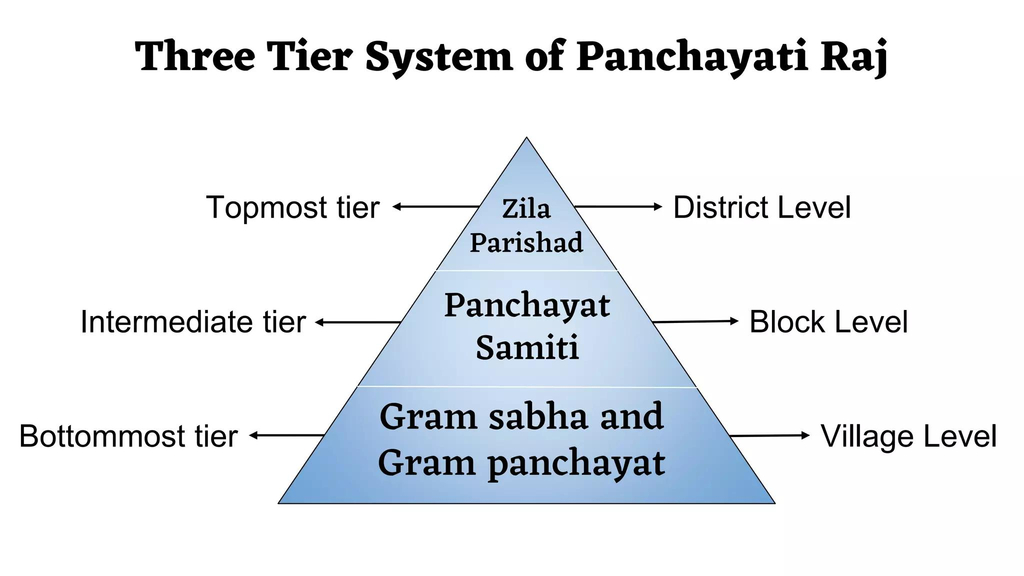
| Level | Institution | Administrative Area |
|---|---|---|
| Village | Gram Panchayat | Village |
| Intermediate | Panchayat Samiti / Block Panchayat | Block or intermediate level |
| District | Zila Parishad | District |
Important: States having a population not exceeding 20 lakh may not constitute Panchayats at the intermediate level.
4. Eleventh Schedule of the Constitution
The Eleventh Schedule, added by the 73rd Constitutional Amendment, contains 29 subjects that may be devolved to Panchayats.
Some important subjects include:
- Agriculture and agricultural extension.
- Land improvement and land reforms.
- Minor irrigation and water management.
- Animal husbandry and fisheries.
- Rural housing.
- Drinking water.
- Roads and rural connectivity.
- Poverty alleviation programmes.
- Education.
- Health and sanitation.
- Women and child development.
- Social welfare.
- Public distribution system.
UPSC connection: Article 243G provides the constitutional framework for devolving powers and responsibilities to Panchayats in relation to these subjects.
Prelims Focus: Must-Know Facts
High-value Revision
- Nodal Ministry: Ministry of Panchayati Raj.
- Nature: Centrally Sponsored Scheme.
- Implementation: 2026–27 to 2030–31.
- Total outlay: ₹7,395.55 crore.
- Central share: ₹4,869.48 crore.
- State share: ₹2,526.07 crore.
- Coverage: Over 2.55 lakh Panchayats and traditional local bodies.
- Beneficiaries: Around 32 lakh elected representatives and other stakeholders.
- Finance Commission linkage: Sixteenth Finance Commission.
- Rural Local Body grants: Approximately ₹4.35 lakh crore recommended by the Sixteenth Finance Commission.
- GPDP target: 2.55 lakh annually.
- Online audit plans: At least 2.55 lakh annually.
- PANCHAM: AI-enabled, multilingual communication platform supporting 17 Indian languages.
- eGramSwaraj: Digital platform for Panchayat planning and financial management.
- AuditOnline: Online auditing of Panchayat accounts.
Important Distinction: Three Types of Local Government
| Institution | Constitutional Amendment | Constitutional Part |
|---|---|---|
| Panchayats | 73rd Amendment | Part IX |
| Municipalities | 74th Amendment | Part IX-A |
| Gram Sabha | 73rd Amendment | Article 243A |
Remember: The 73rd Amendment relates to rural local government, whereas the 74th Amendment relates to urban local government.
Conclusion / Way Forward
Strengthening Panchayats through financial autonomy, digital governance and participatory planning is essential for deepening democracy and achieving Viksit Bharat @2047.
Prelims Check: Test Your Understanding
Three UPSC CSE-style questions designed around constitutional provisions, institutional mechanisms and application-based understanding.
Question 1
With reference to the Pradhan Mantri Viksit Gram Swaraj Yojana, consider the following statements:
- It is a Central Sector Scheme implemented entirely through the Central Government.
- Its implementation period coincides with the Sixteenth Finance Commission period.
- It seeks to strengthen the capacity of Panchayats to utilise Finance Commission grants and mobilise their own-source revenue.
- It provides for the creation of permanent administrative posts at the State, District and Block levels.
Which of the statements given above are correct?
(a) 1 and 2 only
(b) 2 and 3 only
(c) 1, 3 and 4 only
(d) 2, 3 and 4 only
Question 2
Consider the following pairs:
| Digital Platform | Function |
|---|---|
| 1. eGramSwaraj | Panchayat planning and financial management |
| 2. AuditOnline | Online auditing of Panchayat accounts |
| 3. PANCHAM | AI-enabled multilingual communication |
| 4. Gram Sabha | Preparation of online financial audit reports |
How many of the above pairs are correctly matched?
(a) Only one
(b) Only two
(c) Only three
(d) All four
Question 3
With reference to the constitutional provisions relating to Panchayati Raj Institutions in India, consider the following statements:
- The 73rd Constitutional Amendment Act introduced Part IX into the Constitution.
- The Eleventh Schedule contains 29 subjects that may be devolved to Panchayats.
- The Constitution mandates the establishment of a three-tier Panchayati Raj system in every State without exception.
- The State Finance Commission is constituted under Article 243I.
Which of the statements given above are correct?
(a) 1 and 2 only
(b) 1, 2 and 4 only
(c) 2, 3 and 4 only
(d) 1, 2, 3 and 4
Answers and Explanations
Question 1: (b) 2 and 3 only
- Statement 1 is incorrect: PM VGSY is a Centrally Sponsored Scheme, not a Central Sector Scheme.
- Statement 2 is correct: Its implementation period, 2026–27 to 2030–31, coincides with the Sixteenth Finance Commission period.
- Statement 3 is correct: The scheme promotes effective utilisation of Finance Commission grants and mobilisation of Own Source Revenue.
- Statement 4 is incorrect: No permanent posts will be created. Need-based contractual personnel may be engaged.
Question 2: (c) Only three
- Pair 1 is correct: eGramSwaraj supports Panchayat planning, budgeting, accounting and monitoring.
- Pair 2 is correct: AuditOnline facilitates online auditing of Panchayat accounts.
- Pair 3 is correct: PANCHAM is an AI-enabled multilingual communication platform.
- Pair 4 is incorrect: Gram Sabha is a constitutional institution comprising persons registered in the electoral rolls of a village-level Panchayat area. It is not a digital audit-reporting platform.
Question 3: (b) 1, 2 and 4 only
- Statement 1 is correct: The 73rd Constitutional Amendment introduced Part IX.
- Statement 2 is correct: The Eleventh Schedule contains 29 subjects relating to Panchayat functions.
- Statement 3 is incorrect: States having a population not exceeding 20 lakh are not required to constitute Panchayats at the intermediate level.
- Statement 4 is correct: Article 243I provides for the constitution of a State Finance Commission.
A Thought to Remember
“True democracy begins where people participate in decisions that shape their own villages.”
Official References for Further Reading
- Prime Minister’s Office – Cabinet Approval of PM VGSY
- PIB – PM Viksit Gram Swaraj Yojana Explained
- Ministry of Panchayati Raj
- Constitution of India – Legislative Department
SEED IAS | PRELIMS MUST FACTS
Ministry of Panchayati Raj, Government of India (@mopr_goi) on X