Why in News?
The World Bank released the India Poverty and Equity Brief (October 2026), highlighting that India has achieved one of the fastest poverty reduction rates globally.
- However, while absolute monetary poverty has declined, critical macroeconomic vulnerabilities and structural inequalities threaten to undermine this progress.
Summary
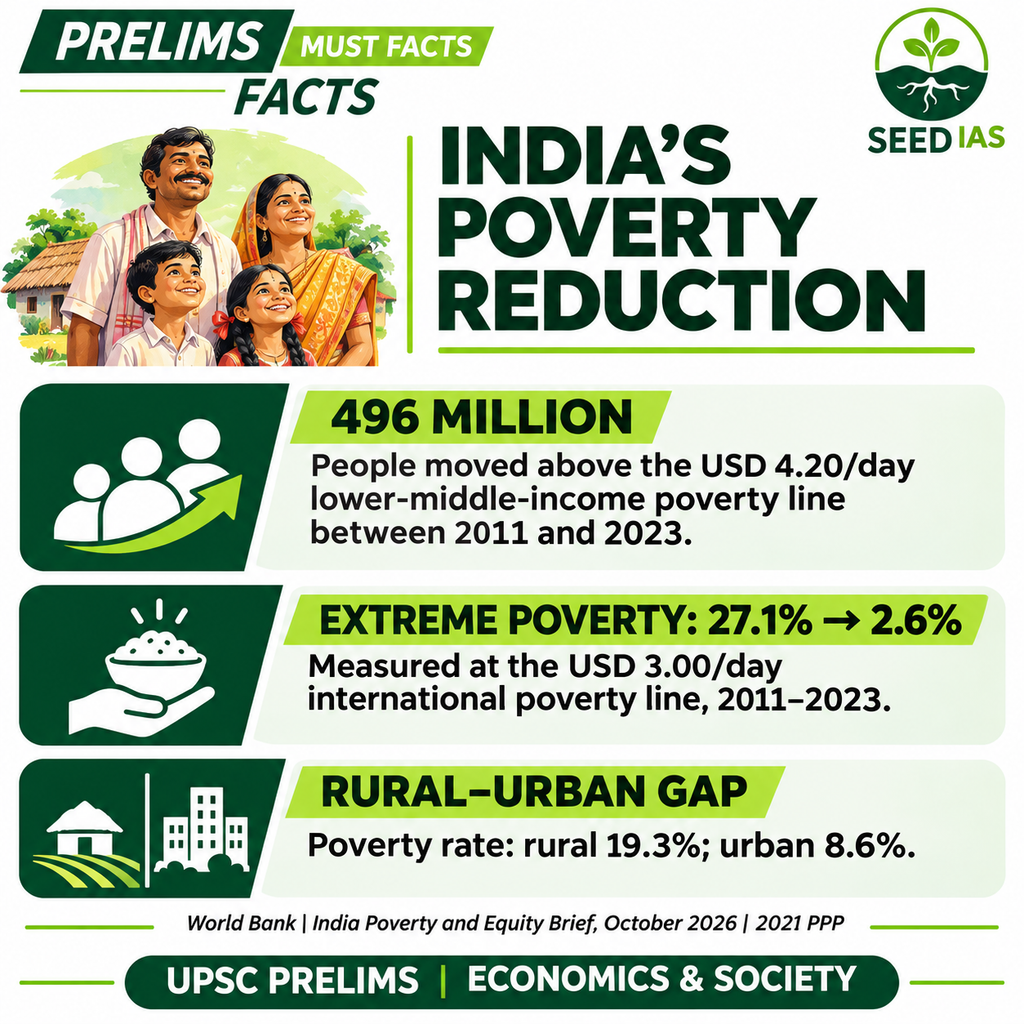
- India has made significant progress, with 496 million people lifted out of poverty between 2011 and 2023, driven by economic growth, rising employment and social welfare schemes.
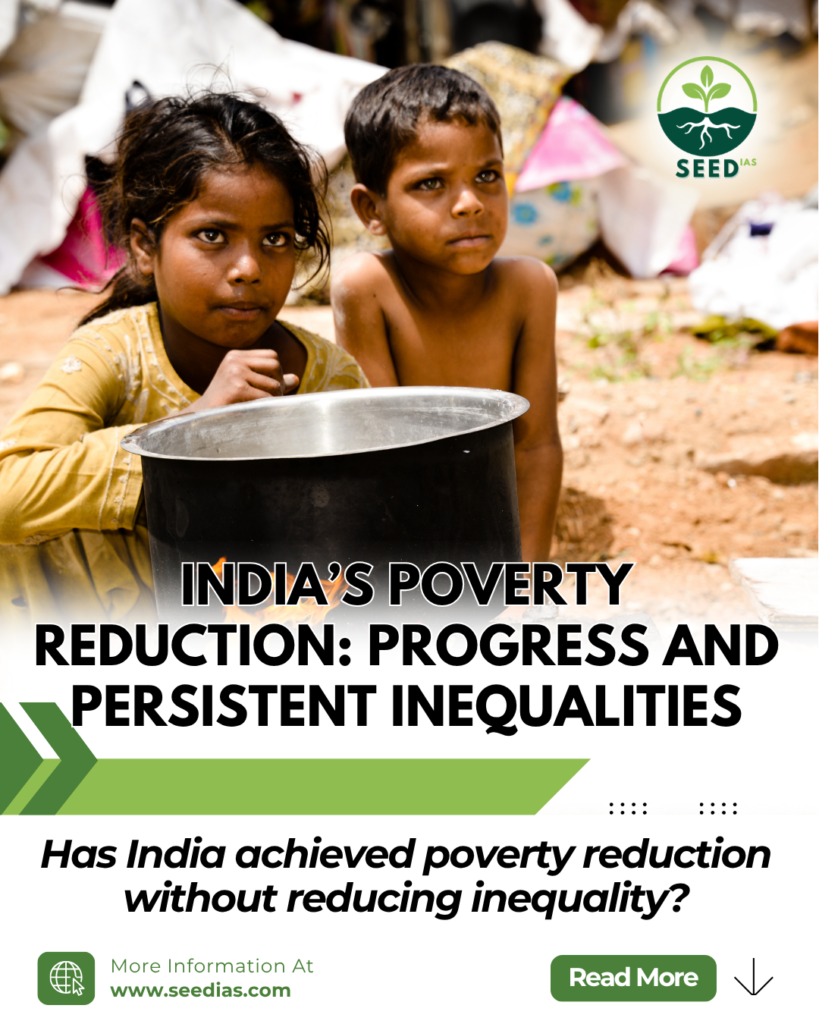
- Inequality, unemployment, agrarian distress and social exclusion continue to hinder poverty eradication, requiring inclusive growth, better human capital and equitable wealth distribution.
What are the Key Findings of the India Poverty and Equity Brief?
- Absolute Reduction in Poverty: Between 2011 and 2023, the share of the population below the Lower Middle-Income poverty line ( USD 4.20/day) fell drastically from 57.7% to 16.1%, successfully lifting an estimated 496 million people out of poverty.
- Poverty decline is expected to slow down, with projections indicating a drop from 14.2% in 2026 to 12.1% by 2028 (at the USD 4.20 line).
- Decline in Extreme Poverty: Extreme poverty (measured at USD 3.00/day) plummeted from 27.1% to 2.6%, leaving roughly 75.2 million people in extreme poverty by 2023.
- Non-Monetary/Multidimensional Improvements: According to the Oxford Poverty and Human Development Initiative (OPHI), India’s Multidimensional Poverty Index (MPI) poverty rate declined from 53.8% (2005–06) to 16.4% (2019–21).
- The World Bank’s MPI estimated it at 15.5% in 2022–23.
- Regional Concentration: A contiguous belt of states stretching from Uttar Pradesh to West Bengal accounts for about 57% of India’s remaining poor.
- National poverty eradication heavily depends on generating productive employment in this specific region.
- Rural-Urban Divide: Most of the poor remain in rural areas, where poverty sits at 19.3% compared to 8.6% in urban areas, largely due to a lack of non-farm job opportunities and low productivity.
- Demographic Vulnerabilities: Poverty is highest among children aged 0–14 (21.8%), followed by females (16.6%).
- Poverty affects 21.3% of those with no education, but only 7.4% of those with tertiary education.
- Severe Wage Inequality: The report highlights a stark wage disparity, with the median earnings of the top 10% of workers being 13 times that of the bottom 10%. The Gini index stands at 23.0 (2023).
- Drivers of Alleviation: Progress was primarily driven by strong domestic consumption growth, rising employment (particularly among rural women), and expanded government social transfers like food subsidies.
What is Poverty?
- Poverty: The World Bank defines poverty as a pronounced deprivation in well-being, where individuals lack sufficient income or consumption to meet a minimum standard of living.
- It extends beyond income deprivation to include inadequate access to food, healthcare, education, housing and other basic necessities, as well as a lack of essential capabilities, dignity, empowerment and political freedom required to participate fully in society.
- Measurement Categories: Poverty is measured objectively (monetary vs. non-monetary/basic needs/anthropometric) or subjectively (direct surveys).
- Monetary Poverty Calculation: Involves three steps: estimating a poverty line (absolute or relative), selecting a welfare aggregate (income or expenditure), and calculating the population share below this threshold.
- Absolute Poverty: Defined as lacking the monetary resources to afford a socially accepted minimum consumption basket.
- Relative Poverty: It refers to a condition in which individuals have significantly lower income or resources than the average or median income of the society.
- It highlights economic inequality and relative deprivation, even when basic needs are met.
- Poverty Estimation in India:NITI Aayog oversees poverty estimation using household consumption expenditure data collected by the National Sample Survey Office (NSSO) under the Ministry of Statistics and Programme Implementation (MoSPI).
- The Ministry of Rural Development conducts the BPL Census to identify poor households for specific welfare schemes.
- Post-Independence: The Planning Commission (1962) initiated official poverty estimation. The Alagh Committee (1979) and Lakdawala Committee (1993) refined the methodology using consumption expenditure and calorie norms.
- Tendulkar Committee (2009): Shifted away from calorie-based norms, adopted a uniform all-India Poverty Line Basket (PLB) and MRP data.
- It estimated the 2011–12 poverty line at Rs 816 (rural) and Rs 1,000 (urban) per capita per month.
- Rangarajan Committee (2014): Recommended separate rural and urban PLBs, estimating poverty lines at Rs 972 (rural) and Rs 1,407 (urban) per capita per month. Its recommendations were not officially adopted by the government.
What are the Major Challenges Hindering Poverty Reduction in India?
- Increasing Inequality: The World Inequality Lab (2024) highlights that India’s top 1% controls over 40% of national wealth, indicating a systemic failure to fulfil Article 39(c) of the Constitution, which mandates the State to prevent the concentration of wealth.
- Informalization and the ‘Gig’ Trap: Neoliberal labor deregulation strips over 80% of the workforce of social security and job permanence.
- This precariousness ensures that a single medical or economic shock instantly plunges vulnerable families back into destitution.
- Jobless Growth: Because India’s GDP growth is highly capital-intensive, it fails to absorb surplus agricultural labor.
- With youth comprising 83% of the unemployed (ILO, 2024), this structural bottleneck locks the poor out of high-productivity manufacturing, ensuring real wages remain permanently suppressed.
- The Agrarian Debt Cycle: Agriculture absorbs 45% of the workforce but yields only 18% of GDP.
- Fragmented landholdings, unpredictable monsoons, and market volatility trap farmers in inescapable cycles of debt and disguised unemployment, keeping rural incomes fundamentally stagnant.
- Sociological Poverty Traps: Poverty is continuously reproduced along caste lines through systemic marginalization, historical land alienation, and geographic displacement of Scheduled Castes (SCs) and Scheduled Tribes (STs) (as noted by the Xaxa Committee), structurally barring them from accumulating generational wealth.
- The Feminization of Poverty: Relegating women strictly tounpaid care work or low-paying informal agricultural labor drastically suppresses total household earning potential.
- This systemic exclusion denies women financial autonomy and ensures poverty is passed down to the next generation.
- Biological Traps: Despite caloric sufficiency, rampant micronutrient deficiencies evidenced by over 50%anemiain women and high child stunting rates (NFHS-5) permanently impair the cognitive and physical development of the next generation, severely limiting their future earning capacity.
- Out-of-Pocket Expenditure (OOPE) on healthcare accounts for roughly 47.1% to 48.2% of India’s total health expenditure, continuing to drive an estimated 55 million people into poverty each year.
- Climate-Induced Economic Resets: The poor live in highly exposed geographies. Frequent climate disasters (floods, heatwaves) act as a relentless “reset button,” repeatedly wiping out the fragile physical assets, livestock, and rudimentary housing of marginal farmers and urban slum dwellers.
- Human Capital Deficit: Chronically low public expenditure on health (1.3% of GDP) and education (2.9%) ensures the massive working-age population remains unskilled.
- This deficit traps the youth in obsolete, low-end jobs, turning a potential demographic dividend into a cycle of poverty in an AI-driven economy.
- Inflation as a Regressive Tax: Persistent and volatile food inflation constantly erodes the already fragile purchasing power of low-income households.
- It continuously nullifies any nominal wage gains, acting as an invisible tax that keeps vulnerable populations hovering just below or at the poverty line.
- The Eldercare Financial Drain: By 2050, over 20% of India’s population will be elderly.
- Without universal pension coverage and with the breakdown of joint families, the financial burden of eldercare will fall squarely on impoverished youth, draining their meagre resources and deepening the household poverty trap.
What Measures Can Strengthen Poverty Reduction in India?
To systematically address and strengthen poverty reduction in India, policymakers must adopt the EMPOWER framework: Employment, Marginalized Empowerment, Progressive Taxation, Overhauling Agriculture, Welfare, Education & Health, and Resilience.
- Employment-Linked Incentives & Skilling: Move beyond basic rural subsistence schemes like VB-G RAM G , 2025 by integrating them with mandatory skilling initiatives (PM Kaushal Vikas Yojana) to create productive, climate-resilient assets.
- Implement Employment-Linked Incentives (ELI) schemes to subsidize formal hiring in labor-intensive sectors (textiles, toys, food processing) and mandate corporate apprenticeships to tackle youth ‘jobless growth’.
- Marginalized & Women Empowerment: Go beyond micro-credit by aggressively onboarding Self-Help Groups (SHGs) onto the Open Network for Digital Commerce (ONDC), eliminating middlemen and expanding market access to achieve the government’s target of creating 3 crore ‘Lakhpati Didis’.
- Rapidly deploy the planned 17,000 creches under the National Creche Scheme. Unburdening women from unpaid care work is a strict prerequisite to pushing India’s Female Labor Force Participation Rate (FLFPR) past its current structural ceiling.
- Strictly enforce the 4% employment reservation under the RPwD Act, 2016, incentivise inclusive hiring, and strengthen the Accessible India Campaign to ensure the economic participation of PwDs.
- Progressive Taxation: Introduce progressive wealth and inheritance taxes on the ultra-rich to curb extreme wealth concentration, fulfilling the constitutional mandate of Article 39(c).
- Use augmented direct tax revenues to statutorily increase public health spending to 2.5% of GDP.
- Overhauling Agriculture: Implement universal Kisan e-IDs linked to land records and Aadhaar. This Digital Public Infrastructure (DPI) will enable instant, collateral-free credit via theKisan Credit Card (KCC), breaking the reliance on exploitative informal moneylenders.
- Shift procurement incentives away from water-guzzling crops (paddy/wheat) toward Shree Anna (millets) and pulses. This stabilizes incomes for dryland/marginal farmers who are most vulnerable to climate shocks.
- Welfare Universalization: Strengthen implementation of the Code on Social Security, 2020 by levying a 1–2% cess on aggregator platform revenues (e.g., Zomato, Uber) to fund a dedicated social security net (health, pension) for the 15+ million unorganized gig workers, mirroring the Rajasthan Gig Workers Act, 2023.
- Under the National Programme for Health Care of the Elderly (NPHCE), shift focus from hospital-based care to funding localized, community-led day-care centers and at-home palliative care for the elderly, reducing the indirect wage-loss burden on working-age family members.
- Education & Eradicating ‘Hidden Hunger’: Execute the NEP 2020 target to expose 100% of learners to vocational education by 2030, bridging the massive skills gap that drives youth unemployment.
- Shift Targeted Public Distribution System (TPDS) towards a nutrition-centric model by including pulses, edible oils and bio-fortified millets (Shree Anna) to combat anaemia and stunting through dietary diversification.
- Resilience: Adopt parametric weather insurance for instant, weather-triggered payouts and establish a dedicated fund to reskill coal-dependent informal workers in Jharkhand, Chhattisgarh and West Bengal during the transition towards India’s 2070 Net-Zero target.
Conclusion
While lifting half a billion Indians out of extreme poverty is a historic achievement, true poverty eradication requires moving beyond basic subsistence towards equitable wealth distribution and human capital development. From Antyodaya to Sarvodaya, India must advance SDG 1 (No Poverty), SDG 8 (Decent Work) and SDG 10 (Reduced Inequalities) while upholding the Supreme Court’s Olga Tellis judgment (1985), which recognises the Right to Livelihood.