Context of the News
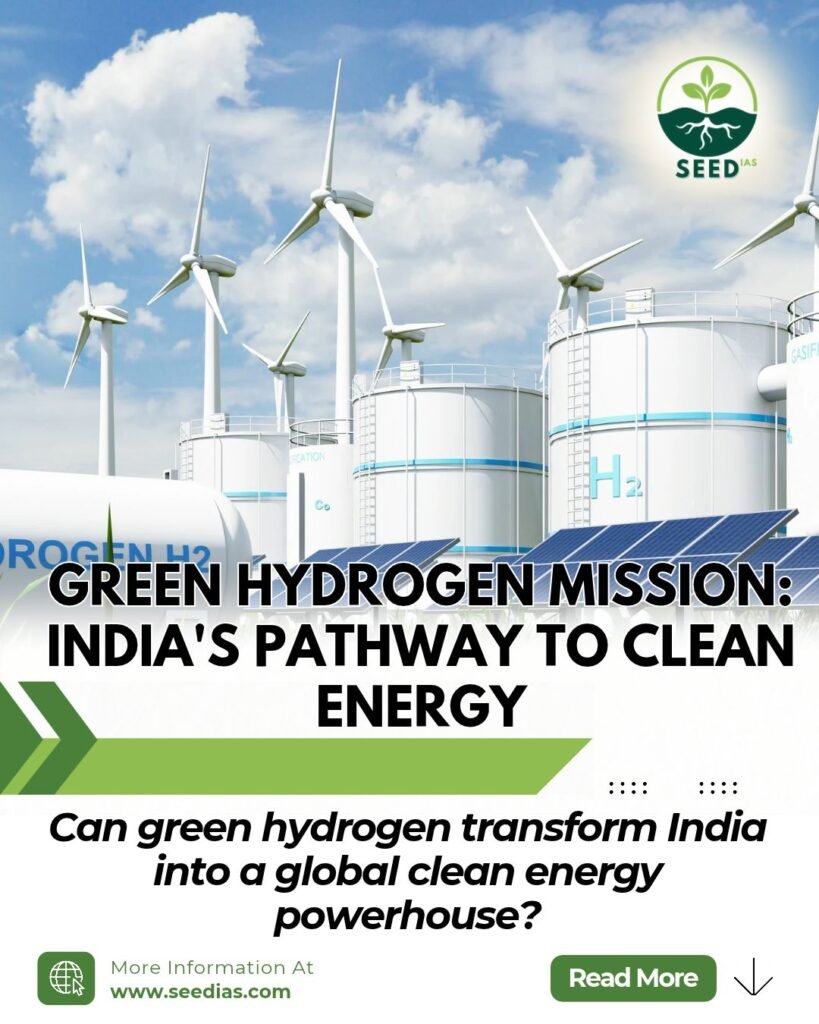
India is accelerating the implementation of its National Green Hydrogen Mission (NGHM) through domestic electrolyser manufacturing, green hydrogen production, industrial pilot projects and certification mechanisms.
The Mission aims to achieve 5 million metric tonnes (MMT) of annual green hydrogen production by 2030 and support India’s commitment to achieving Net Zero emissions by 2070.
Recent initiatives include hydrogen-powered transportation, green hydrogen hubs, indigenous manufacturing and international partnerships to strengthen India’s emerging hydrogen economy.
Background: Understanding Green Hydrogen
Green Hydrogen is hydrogen produced using renewable electricity, primarily through the electrolysis of water using solar or wind energy.
Unlike conventional hydrogen production based on fossil fuels, green hydrogen can be produced with substantially lower greenhouse gas emissions.
Hydrogen is not a primary energy source like coal or sunlight. It is an energy carrier, which means it can store, transport and deliver energy for different applications.
Why is Green Hydrogen Important?
- It can reduce carbon emissions in industries where direct electrification is difficult.
- It can replace fossil-fuel-based hydrogen in fertiliser production and petroleum refineries.
- It can support cleaner steel production and heavy-duty transportation.
- It can store surplus renewable electricity for future use.
- It can reduce India’s dependence on imported fossil fuels.
News Breakdown
1. How is Green Hydrogen Produced?
The rise of green hydrogen in Latin America | Popular Science
The most common method of producing green hydrogen is water electrolysis.
Electrolysis is a chemical process in which electricity is used to split water into hydrogen and oxygen.
The process involves the following steps:
Step 1: Renewable Electricity Generation
- Electricity is generated using renewable sources such as solar and wind energy.
- This electricity is supplied to an electrolyser.
Step 2: Water Electrolysis
- Purified water is supplied to the electrolyser.
- An electric current splits water molecules into hydrogen and oxygen.
Chemical Reaction:
\[ 2H_2O \rightarrow 2H_2 + O_2 \]
Step 3: Separation of Gases
An electrolyser contains two electrodes:
- Cathode (Negative Electrode): Hydrogen is produced at the cathode.
- Anode (Positive Electrode): Oxygen is produced at the anode.
A membrane or diaphragm separates the two gases while allowing the required movement of ions.
Step 4: Hydrogen Processing
- The hydrogen produced is dried and purified.
- It is then compressed for storage, transportation or industrial applications.
Important Fact: Approximately 9 litres of water are theoretically required to produce 1 kg of hydrogen. Actual water consumption may be higher due to purification and operational requirements.
2. What is India’s National Green Hydrogen Mission?
NLC India selects Ohmium and InSolare for 4 MW green hydrogen project in Tamil Nadu
The National Green Hydrogen Mission (NGHM) is India’s flagship initiative to establish the country as a global hub for green hydrogen production, utilisation and exports.
It aims to promote domestic manufacturing, reduce emissions and strengthen India’s energy security.
Key Features of the Mission
| Particulars | Details |
|---|---|
| Approval | January 2023 |
| Implementing Ministry | Ministry of New and Renewable Energy (MNRE) |
| Total outlay | ₹19,744 crore |
| Production target by 2030 | At least 5 MMT annually |
| Potential expansion | 10 MMT, depending on export demand |
| Major objective | Make India a global green hydrogen hub |
Major Objectives
- Develop domestic green hydrogen production capacity.
- Promote indigenous electrolyser manufacturing.
- Reduce dependence on imported fossil fuels.
- Decarbonise industries such as steel, fertilisers and petroleum refining.
- Develop infrastructure for hydrogen storage, transportation and distribution.
- Encourage research, innovation and skill development.
3. Strategic Interventions for Green Hydrogen Transition (SIGHT)
SIGHT is a major financial incentive programme under the National Green Hydrogen Mission.
It aims to strengthen India’s domestic manufacturing capabilities and encourage large-scale green hydrogen production.
Important Features:
- Total allocation of ₹17,490 crore up to 2029–30.
- Provides incentives for domestic electrolyser manufacturing.
- Supports green hydrogen production.
- Incentives have been awarded to 15 companies for electrolyser manufacturing capacity of 3,000 MW per annum.
- Incentives have also been awarded for 8.62 lakh tonnes per annum of green hydrogen production capacity.
- Approximately 8,000 tonnes per annum of the incentivised production capacity had been commissioned by February 2026.
Why is SIGHT Important?
India currently needs to strengthen its domestic electrolyser manufacturing ecosystem.
SIGHT seeks to:
- Reduce dependence on imported electrolysers.
- Encourage private-sector investment.
- Improve domestic technological capabilities.
- Reduce the cost of green hydrogen production.
4. Sector-Specific Pilot Projects under NGHM
The Mission supports pilot projects to test the commercial viability of green hydrogen across industries where reducing carbon emissions is particularly challenging.
A. Green Hydrogen in the Steel Industry
- The steel sector is a major source of industrial carbon emissions.
- Conventional steel production largely depends on coal and coke.
- Green hydrogen can replace fossil-fuel-based reducing agents in certain steelmaking processes.
- The Mission has allocated ₹455 crore up to 2029–30 for steel-sector pilot projects.
- Five pilot projects have been sanctioned, including ₹84 crore for testing 100% hydrogen injection.
B. Green Hydrogen in Transportation
Hydrogen can be used as a fuel in heavy-duty vehicles through hydrogen fuel cells.
- 12 pilot projects cover 70 hydrogen-powered vehicles.
- These include 27 buses and 43 trucks.
- 16 hydrogen refuelling stations are being developed across 21 routes.
C. Green Hydrogen in Shipping
- Hydrogen can be converted into green ammonia and green methanol.
- These fuels can support the decarbonisation of maritime transportation.
- V.O. Chidambaranar Port Authority has awarded a ₹38.12 crore green methanol bunkering and refuelling project.
- The project includes an MNRE grant of ₹35 crore.
5. Green Hydrogen Hubs and Hydrogen Valley Innovation Clusters
Green Hydrogen Hubs are geographically concentrated areas where hydrogen production, storage, transportation and consumption facilities are developed together.
Their purpose is to reduce infrastructure costs and create economies of scale.
Major Green Hydrogen Hubs in India
Deendayal Port Invites Bids for New Cargo Terminal
- Deendayal Port: Gujarat.
- V.O. Chidambaranar Port: Tamil Nadu.
- Paradip Port: Odisha.
An indigenous 1 MW green hydrogen plant was commissioned at Kandla Port in July 2025.
Hydrogen Valley Innovation Clusters (HVICs)
- These clusters bring together research institutions, industries, technology developers and hydrogen users.
- They promote innovation across the hydrogen value chain.
- They help develop shared infrastructure and encourage commercial applications.
Four Hydrogen Valley Innovation Clusters have been awarded in:
- Jodhpur
- Odisha
- Pune
- Kerala
6. Enabling Policy Framework for Green Hydrogen
India has introduced several policy incentives to reduce the cost of green hydrogen production and encourage private investment.
A. Inter-State Transmission System (ISTS) Charge Waiver
- Eligible green hydrogen and green ammonia projects commissioned by 31 December 2030 receive a 25-year waiver of ISTS charges.
- This reduces the cost of transmitting renewable electricity across state boundaries.
- The waiver is subject to applicable conditions.
B. Open Access and Energy Banking
- Open Access allows eligible electricity consumers to purchase electricity from generators other than their local distribution company.
- The Green Hydrogen and Green Ammonia Policy provides for open access within 15 days, subject to applicable regulations.
- Energy Banking allows surplus renewable electricity to be stored as an accounting credit and used later.
- The policy provides for banking of surplus renewable electricity for up to 30 days, subject to regulations.
C. Infrastructure Support
The government is using existing renewable energy infrastructure to support hydrogen development.
Important initiatives include:
- Green Energy Corridor Scheme.
- Solar Parks.
- Manufacturing Zones.
- Special Economic Zones (SEZs).
D. Environmental Regulatory Incentives
- Eligible standalone green hydrogen and green ammonia plants are exempt from obtaining prior Environmental Clearance under the specified provisions of the Environmental Impact Assessment (EIA) Notification, 2006.
- Certain renewable energy projects in Special Economic Zones and Export-Oriented Units (EOUs) receive specified equipment-related exemptions and duty benefits.
7. Green Hydrogen Standards and Certification
One of the major challenges in the green hydrogen economy is ensuring that hydrogen labelled as green actually meets prescribed emissions standards.
For this purpose, India has introduced standards and certification mechanisms.
A. Green Hydrogen Standard, 2023
The standard defines green hydrogen based on its greenhouse gas emissions intensity.
- The maximum permitted emissions intensity is 2 kg of CO₂ equivalent per kg of hydrogen.
- This is calculated on a well-to-gate basis.
- The emissions intensity is averaged over a period of 12 months.
- Eligible biomass-based production pathways are also covered, subject to the prescribed threshold.
What is Well-to-Gate Emissions Intensity?
It refers to the total greenhouse gas emissions associated with producing hydrogen up to the point where it leaves the production facility.
It considers emissions from relevant stages of the production process.
B. Green Hydrogen Certification Scheme, 2025
- It provides a framework for monitoring, verification and certification of green hydrogen.
- The Bureau of Energy Efficiency (BEE) is responsible for accrediting verification agencies.
- A dedicated digital certification portal became operational in June 2026.
C. Green Ammonia and Green Methanol Standards
- These standards establish emissions thresholds and eligibility conditions.
- They support transparent production and certification.
- They can facilitate international trade in low-emission hydrogen derivatives.
8. World Hydrogen and Fuel Cell Day 2026
World Hydrogen and Fuel Cell Day is observed on 8 October.
On 8 October 2026, the Ministry of New and Renewable Energy organised a stakeholder consultation in New Delhi.
The consultation focused on strengthening hydrogen safety standards, testing protocols and institutional coordination.
Major Highlights
- Discussion on the safe production, storage, transportation and utilisation of hydrogen.
- Strengthening safety regulations and testing procedures.
- Improving coordination among government institutions and industry stakeholders.
- Addressing regulatory gaps in India’s hydrogen ecosystem.
Important Report Released
The report titled “India’s Hydrogen Standards: Gap Assessment and Preliminary Action Framework” was released.
- It was prepared in collaboration with Boston Consulting Group (BCG).
- It identifies gaps in existing hydrogen standards.
- It recommends measures for the safe deployment of hydrogen technologies.
9. Research and Development under NGHM
Research and Development (R&D) is essential for making green hydrogen affordable, efficient, safe and commercially viable.
Strategic Hydrogen Innovation Partnership (SHIP)
- SHIP is a public-private partnership framework under the National Green Hydrogen Mission.
- It encourages collaboration between government institutions and private industries.
- It supports innovation in hydrogen production, storage, transportation and safety technologies.
Financial Support for R&D
- R&D guidelines were notified in March 2024.
- A total allocation of ₹400 crore was provided.
- As of June 2026, an initial ₹113-crore R&D roadmap supports projects related to hydrogen production, storage and safety.
10. Employment Generation, Skill Development and Start-ups
Green hydrogen can create employment opportunities across manufacturing, renewable energy, infrastructure and industrial applications.
A. Employment Potential
- The Mission aims to generate more than 6 lakh jobs by 2030.
- Employment opportunities may emerge in electrolyser manufacturing, hydrogen production, transportation, storage and maintenance.
B. Skill Development
- 8,149 candidates have been trained.
- 7,248 candidates have been certified.
- Training has covered 14 States and Union Territories.
- Major areas include electrolysers, electrolysis, hydrogen storage, transportation, safety, steel, mobility and refining.
C. Start-up Support
- ₹100 crore has been allocated for green hydrogen technology start-ups.
- The first nine start-ups have been approved for funding of ₹22 crore.
11. International Cooperation in Green Hydrogen
India is developing international partnerships to access advanced technologies, promote investment and strengthen the global hydrogen supply chain.
Major Bilateral Partnerships
MNRE, directly or through the National Institute of Solar Energy, has signed MoUs, Letters of Intent or Joint Declarations of Intent with:
- Australia
- Finland
- France
- Germany
- Saudi Arabia
- United Arab Emirates
- Uzbekistan
Other Important Partnerships
| Partnership | Significance |
|---|---|
| India–Netherlands | Cooperation through an MoU on renewable energy |
| India–US Hydrogen Task Force | Promotes hydrogen cooperation under the Strategic Clean Energy Partnership |
| RETAP | Includes green hydrogen as a focus area under the India–US New and Emerging Renewable Energy Technology Action Platform |
These partnerships can support technology transfer, research, investment and international trade.
12. State-Level Green Hydrogen Initiatives
State governments play an important role in developing renewable energy infrastructure, attracting investment and facilitating industrial projects.
India’s green hydrogen policy landscape includes the following states:
| Category | States |
|---|---|
| Dedicated green hydrogen policies notified | Gujarat, Andhra Pradesh, Maharashtra, Uttar Pradesh, Rajasthan and West Bengal |
| Dedicated policies being finalised | Haryana, Punjab, Bihar and Kerala |
| Hydrogen integrated into existing industrial and renewable energy frameworks | Himachal Pradesh, Madhya Pradesh, Odisha, Telangana and Chhattisgarh |
Why are State Policies Important?
- They help attract private-sector investment.
- They facilitate land and infrastructure development.
- They encourage renewable electricity generation.
- They support industrial clusters and hydrogen hubs.
- They help generate employment and regional economic opportunities.
13. Major Applications of Green Hydrogen
Green hydrogen has the potential to transform several industries, particularly those where direct electrification is difficult.
Green Steel Market Trends (2026): Germany Grants €1.3B Aid
Hyundai bringt Wasserstoff-Lkw Xcient nach Deutschland
Shanghai Green Fuel Plan: 2030 Bunkering Outlook
7
A. Fertiliser Industry
- Hydrogen is an essential raw material for producing ammonia.
- Conventional ammonia production largely depends on fossil-fuel-based hydrogen.
- Green hydrogen can replace conventional hydrogen in ammonia production.
- This enables the production of green ammonia, which can be used in nitrogen-based fertilisers such as urea.
B. Petroleum Refineries
Hydrogen is widely used in petroleum refining.
Two important processes are:
- Desulphurisation: Removes sulphur compounds from petroleum products.
- Hydrocracking: Uses hydrogen to convert heavier petroleum fractions into lighter products.
Replacing conventional hydrogen with green hydrogen can reduce emissions from refinery operations.
C. Iron and Steel Industry
- Conventional steelmaking depends heavily on coal and coke.
- Green hydrogen can act as a reducing agent in Direct Reduced Iron (DRI) production.
- It helps remove oxygen from iron ore.
- In hydrogen-based reduction, water vapour is produced instead of carbon dioxide during the reduction reaction.
This can significantly reduce emissions from iron production.
D. City Gas Distribution
- Green hydrogen can be blended with natural gas in limited proportions.
- The blended gas can be used for domestic, commercial and industrial applications.
- However, blending requires suitable pipeline infrastructure, safety standards and technical compatibility.
E. Road and Rail Transportation
Hydrogen can be used in Fuel Cell Electric Vehicles (FCEVs).
- A fuel cell combines hydrogen with oxygen.
- It generates electricity to power an electric motor.
- Water and heat are the direct by-products.
- Hydrogen vehicles can be useful for heavy-duty transportation where long driving ranges and quick refuelling are important.
Important Development: According to the supplied material, India’s first indigenous hydrogen-powered train was inaugurated on 17 July 2026 on the Jind–Sonipat section in Haryana.
F. Shipping
- Green hydrogen can be converted into green ammonia and green methanol.
- These can serve as alternative marine fuels.
- They offer opportunities to reduce emissions from maritime transportation.
- Their adoption requires compatible vessels, safety systems and port infrastructure.
G. Energy Storage
- Solar and wind energy are intermittent sources of electricity.
- Surplus renewable electricity can be used to produce hydrogen.
- The hydrogen can be stored and converted back into electricity or used in industries when required.
- This supports long-duration energy storage and renewable energy integration.
Prelims Focus: High-Value Facts
These are important facts to remember for UPSC CSE Prelims.
| Topic | Important fact |
|---|---|
| National Green Hydrogen Mission | Approved in January 2023 |
| Implementing Ministry | Ministry of New and Renewable Energy |
| Total Mission outlay | ₹19,744 crore |
| Green hydrogen target | 5 MMT annually by 2030 |
| SIGHT allocation | ₹17,490 crore |
| SIGHT implementation period | Up to 2029–30 |
| Green Hydrogen Standard | Notified in 2023 |
| Maximum emissions intensity | 2 kg CO₂ equivalent/kg hydrogen |
| Emissions measurement | Well-to-gate basis, averaged over 12 months |
| Certification Scheme | 2025 |
| Verification agency accreditation | Bureau of Energy Efficiency |
| R&D allocation | ₹400 crore |
| SHIP | Strategic Hydrogen Innovation Partnership |
| Hydrogen Valley Clusters | Jodhpur, Odisha, Pune and Kerala |
| Green Hydrogen Hubs | Deendayal, V.O. Chidambaranar and Paradip Ports |
| World Hydrogen and Fuel Cell Day | 8 October |
| Theoretical water requirement | 9 litres per kg of hydrogen |
| Net Zero target of India | 2070 |
Important Prelims Concept: Different Types of Hydrogen
Hydrogen is classified into different categories based on its production method and associated emissions.
| Type | Production method |
|---|---|
| Green Hydrogen | Renewable electricity-based water electrolysis |
| Grey Hydrogen | Fossil fuels, generally natural gas, without carbon capture |
| Blue Hydrogen | Fossil fuels with carbon capture and storage |
| Brown/Black Hydrogen | Coal-based hydrogen production |
Remember: The colour classification is an industry convention. The actual environmental impact depends on the production pathway and its lifecycle emissions.
Important Chemical Reactions
1. Water Electrolysis
\[ 2H_2O \rightarrow 2H_2 + O_2 \]
2. Hydrogen Fuel Cell
\[ 2H_2 + O_2 \rightarrow 2H_2O + Energy \]
3. Hydrogen-Based Iron Reduction
\[ Fe_2O_3 + 3H_2 \rightarrow 2Fe + 3H_2O \]
Prelims Check
Test your understanding through UPSC CSE Prelims-style questions.
Question 1
With reference to green hydrogen, consider the following statements:
- Green hydrogen is primarily produced through electrolysis of water using renewable electricity.
- Approximately 9 litres of water are theoretically required to produce 1 kg of hydrogen.
- Hydrogen produced through electrolysis always qualifies as green hydrogen, irrespective of the electricity source.
- In a hydrogen fuel cell, water and heat are produced as direct by-products.
Which of the statements given above are correct?
(a) 1 and 2 only
(b) 1, 2 and 4 only
(c) 2, 3 and 4 only
(d) 1, 2, 3 and 4
Question 2
With reference to India’s National Green Hydrogen Mission, consider the following statements:
- The Mission was approved by the Union Cabinet in January 2023.
- The Ministry of New and Renewable Energy is responsible for its implementation.
- The Mission has a target of producing at least 5 million metric tonnes of green hydrogen annually by 2030.
- The Strategic Interventions for Green Hydrogen Transition programme supports only domestic electrolyser manufacturing and does not provide incentives for hydrogen production.
Which of the statements given above are correct?
(a) 1 and 2 only
(b) 1, 2 and 3 only
(c) 2, 3 and 4 only
(d) 1, 2, 3 and 4
Question 3
Consider the following applications of green hydrogen:
- Production of ammonia for fertilisers.
- Direct Reduced Iron production in the steel industry.
- Desulphurisation in petroleum refineries.
- Long-duration energy storage.
- Decarbonisation of maritime transportation through green methanol and green ammonia.
How many of the above are potential applications of green hydrogen?
(a) Only two
(b) Only three
(c) Only four
(d) All five
Answers and Explanations
Answer Key
| Question | Correct answer |
|---|---|
| 1 | (b) |
| 2 | (b) |
| 3 | (d) |
Question 1 – Answer (b): 1, 2 and 4 only
- Green hydrogen is produced primarily through renewable electricity-powered electrolysis.
- The theoretical water requirement is approximately 9 litres per kg of hydrogen.
- Incorrect. The electricity source determines whether the hydrogen qualifies as green.
- Hydrogen fuel cells produce water and heat as direct by-products while generating electricity.
Question 2 – Answer (b): 1, 2 and 3 only
- The Union Cabinet approved NGHM in January 2023.
- MNRE is the implementing ministry.
- The target is at least 5 MMT of annual green hydrogen production by 2030.
- Incorrect. SIGHT provides incentives for both domestic electrolyser manufacturing and green hydrogen production.
Question 3 – Answer (d): All five
- Green hydrogen can be used to manufacture green ammonia for fertilisers.
- It can replace fossil-fuel-based reducing agents in Direct Reduced Iron production.
- It can be used in petroleum refining, including desulphurisation.
- Surplus renewable electricity can be converted into hydrogen for long-duration storage.
- Green hydrogen derivatives such as green methanol and green ammonia can support cleaner maritime transportation.
Conclusion: Way Forward
India must reduce hydrogen production costs, strengthen indigenous technology, develop infrastructure and create reliable demand to achieve its green hydrogen ambitions.
A Thought to Remember
“The energy transition is not just about changing how we produce energy; it is about building a sustainable future for generations to come.”