
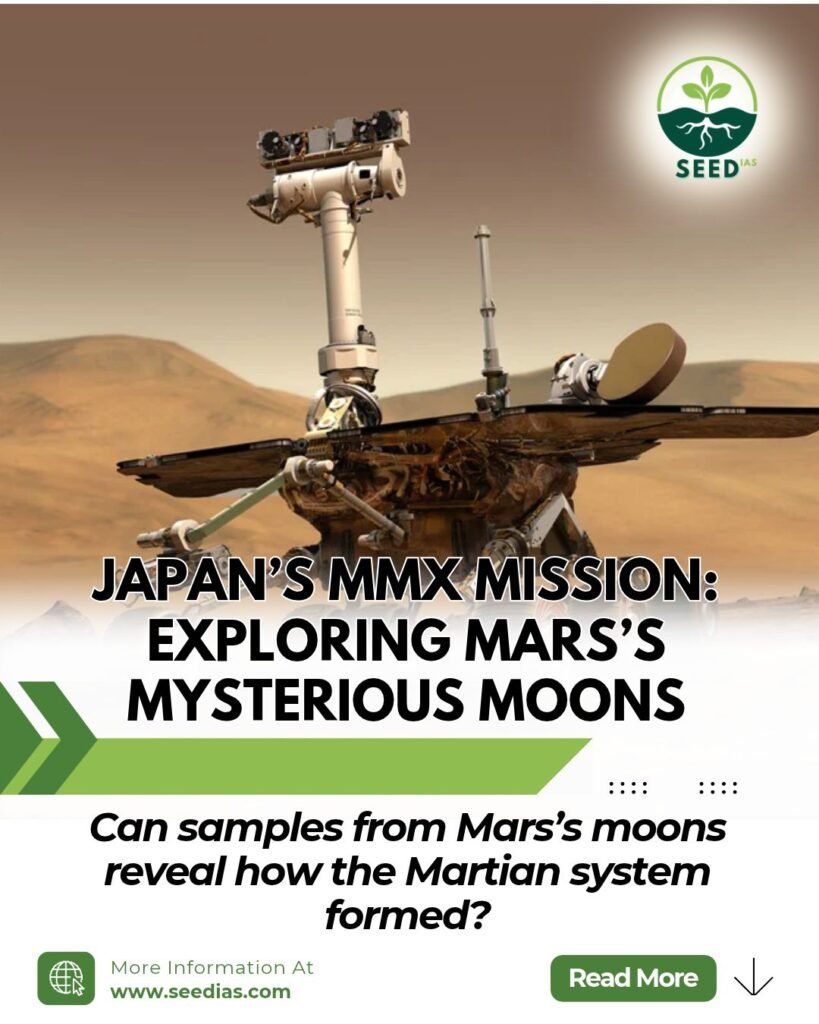
Context of the News
Japan’s Martian Moons eXploration (MMX) mission, led by the Japan Aerospace Exploration Agency (JAXA), aims to investigate Mars’s two natural satellites, Phobos and Deimos, and return samples from Phobos to Earth.
The mission is designed to help scientists understand the origin and evolution of the Martian moons and the early history of the Solar System.
Background: Mars and Its Two Moons

Phobos
The larger and closer of Mars’s two moons. MMX plans to collect surface material from it.

Deimos
The smaller and more distant moon. MMX will observe it to improve understanding of the Martian system.
Mars has two natural satellites, Phobos and Deimos. Their origin remains an important scientific question. Studying their composition and structure can help researchers test theories about how these moons formed.
MMX builds on Japan’s experience with the Hayabusa and Hayabusa2 asteroid sample-return missions, which developed technologies for navigating to small celestial bodies, collecting material and returning it to Earth.
News Breakdown: Key Features of the MMX Mission
1. Scientific objectives
The mission will study several important properties of Phobos:
- Origin: Investigate how Phobos formed and whether its material offers clues about its history.
- Composition: Examine the substances that make up the moon.
- Gravity: Measure its weak gravitational environment.
- Internal structure: Improve understanding of its interior.
- Surface: Analyse surface features and physical conditions.
MMX will also observe Deimos, allowing scientists to compare the two moons.
2. Sample-return mission
One of the mission’s most important goals is to collect regolith from Phobos.
Regolith is the loose layer of dust, soil and fragmented rock covering a celestial body’s surface.
Returning these samples to Earth would allow scientists to use advanced laboratory instruments to investigate their composition and origin. The mission is intended to achieve the first sample return from the Martian system.
3. IDEFIX: The French-German rover

The mission includes IDEFIX, a small rover developed through French-German cooperation.
Its role includes:
- Examining the surface of Phobos in its extremely low-gravity environment.
- Assessing the terrain and surface conditions.
- Helping scientists understand the challenges involved in collecting samples.
The rover’s observations will contribute to planning and evaluating surface operations.
4. Technological significance
MMX builds on the experience gained through JAXA’s asteroid missions, particularly Hayabusa and Hayabusa2.
These missions provide a foundation for key capabilities such as:
- Navigation around small celestial bodies.
- Landing and surface operations.
- Collecting small quantities of material.
- Returning samples to Earth in a dedicated capsule.
A successful MMX mission would extend Japan’s sample-return expertise from asteroids to the Martian moons.
Major Mars Exploration Missions Around the World
Mars exploration involves orbiters, landers, rovers and atmospheric probes. These missions investigate the planet’s geology, climate, water history and potential habitability.
Current update: JAXA’s MMX spacecraft successfully launched aboard the H3 rocket on 20 October 2026. It is expected to reach the Martian system in 2027 and return Phobos samples to Earth in 2031.
| Space agency | Mission | Key achievement or objective |
|---|---|---|
| NASA (USA) | Viking 1 and 2 | Successfully landed on Mars in 1976 and conducted experiments on the Martian surface. |
| NASA | Mars Pathfinder | Landed in 1997 and deployed Sojourner, NASA’s first Mars rover. |
| NASA | Curiosity | Studies Martian geology and whether ancient Mars had conditions suitable for microbial life. |
| NASA | Perseverance | Investigates ancient environments and searches for signs of past microbial life; collects samples for possible future return. |
| NASA | Ingenuity | Achieved the first powered, controlled flight on another planet. |
| NASA | Mars Odyssey | Studies Mars’s surface and subsurface, including the distribution of hydrogen that can indicate water ice. |
| NASA | Mars Reconnaissance Orbiter (MRO) | Examines Martian terrain, minerals and atmospheric conditions, and supports communications with surface missions. |
| CNSA (China) | Tianwen-1 and Zhurong | Tianwen-1 reached Mars orbit and deployed the Zhurong rover to study the surface, geology and evidence relevant to water. |
| ISRO (India) | Mars Orbiter Mission (MOM), or Mangalyaan | Launched in 2013; India became the first country to reach Mars orbit on its first attempt. |
| ESA (Europe) | Mars Express | Studies the Martian surface, atmosphere and subsurface. |
| ESA and international partners | ExoMars Trace Gas Orbiter (TGO) | Analyses trace gases in the Martian atmosphere, including methane, and supports communications with surface missions. |
| UAE Space Agency | Emirates Mars Mission (Hope Probe) | Launched in 2020 and studies Martian weather and atmospheric dynamics. |
NASA’s ongoing Mars programme includes robotic orbiters, landers and rovers, while international missions contribute complementary observations of Mars and its environment.
Why Is the MMX Mission Important?
- Planetary science: It may help determine whether Phobos and Deimos formed from material ejected by a major impact on Mars or were asteroids captured by Mars’s gravity.
- Sample analysis: Material returned to Earth can be examined with laboratory instruments that cannot be carried aboard a spacecraft.
- International cooperation: The mission combines Japanese spacecraft technology with international contributions, including the IDEFIX rover developed by France’s CNES and Germany’s DLR.
DLR+1
- Future exploration: MMX will test technologies for operating around small celestial bodies and travelling to and from the Martian system.
Prelims Focus
| Fact | Remember for UPSC |
|---|---|
| Space agency leading MMX | JAXA — Japan |
| Launch vehicle | H3 |
| Launch date | 20 October 2026 |
| Primary sample target | Phobos |
| Other moon to be observed | Deimos |
| Sample to be returned | At least 10 grams of Phobos material |
| Expected sample return | 2031 |
| IDEFIX rover | Jointly developed by CNES (France) and DLR (Germany) |
| India’s Mars mission | Mars Orbiter Mission (Mangalyaan) |
| First powered, controlled flight on another planet | Ingenuity on Mars |
Official mission information confirms MMX’s launch, Phobos sample-return objective and planned 2031 return.
Conclusion and Way Forward
MMX marks a major step in planetary exploration. International cooperation and sample-return missions can deepen our understanding of Mars, its moons and the origins of the Solar System.
Prelims Check: UPSC-Style Questions
Question 1
Consider the following statements about the Martian Moons eXploration (MMX) mission:
- It is led by the Japan Aerospace Exploration Agency.
- It aims to collect samples from both Phobos and Deimos and return them to Earth.
- It builds on Japan’s experience with the Hayabusa asteroid sample-return missions.
Which of the statements given above is/are correct?
A. 1 only
B. 1 and 2 only
C. 1 and 3 only
D. 1, 2 and 3
Question 2
Consider the following pairs of Mars missions and their objectives:
| Mission | Objective or achievement |
|---|---|
| 1. Ingenuity | First powered, controlled flight on another planet |
| 2. Hope Probe | Study of Martian weather and atmospheric dynamics |
| 3. ExoMars Trace Gas Orbiter | Analysis of trace gases in the Martian atmosphere |
| 4. Mars Odyssey | Deployment of the Sojourner rover |
How many pairs are correctly matched?
A. Only one
B. Only two
C. Only three
D. All four
Question 3
With reference to India’s Mars Orbiter Mission (Mangalyaan), consider the following statements:
- India became the first country to reach Mars orbit on its maiden attempt.
- The mission was led by the Japan Aerospace Exploration Agency.
- The mission was launched in 2013.
Which of the statements given above is/are correct?
A. 1 only
B. 1 and 3 only
C. 2 and 3 only
D. 1, 2 and 3
Answer Key and Explanations
Question 1 — C. 1 and 3 only
- Statement 1 is correct: MMX is led by JAXA, Japan’s national space agency.
- Statement 2 is incorrect: The mission will collect samples from Phobos. It will observe Deimos but is not designed to return samples from both moons.
- Statement 3 is correct: MMX draws on the experience gained through Japan’s Hayabusa and Hayabusa2 asteroid sample-return missions.
ISAS+1
Question 2 — C. Only three
- Pairs 1, 2 and 3 are correct: Ingenuity demonstrated powered flight on Mars; the Hope Probe studies the Martian atmosphere; and the Trace Gas Orbiter analyses atmospheric trace gases.
- Pair 4 is incorrect: Mars Odyssey is an orbiter that studies Mars. The Mars Pathfinder mission deployed the Sojourner rover in 1997.
- Therefore, three pairs are correctly matched.
NASA Science+1
Question 3 — B. 1 and 3 only
- Statement 1 is correct: India became the first country to reach Mars orbit on its first attempt.
- Statement 2 is incorrect: Mangalyaan was an Indian Space Research Organisation (ISRO) mission, not a JAXA mission.
- Statement 3 is correct: India launched the Mars Orbiter Mission in 2013.
“Great things are done by a series of small things brought together.” — Vincent van Gogh