Context of the News
The Ministry of Jal Shakti has highlighted the role of innovative wastewater treatment technologies under the Namami Gange Programme (NGP). These technologies aim to improve sewage management, increase treatment efficiency, reduce land and energy requirements, and promote the reuse of treated wastewater.
Background: Namami Gange Programme
The Namami Gange Programme is an integrated conservation mission launched by the Government of India in June 2014. Its primary objective is to reduce pollution and conserve and rejuvenate the River Ganga.
The programme recognises that river rejuvenation requires more than cleaning the river surface. It also requires effective sewage treatment, industrial pollution control, ecological restoration and public participation.
Key facts about the programme include:
- Implementing agency: National Mission for Clean Ganga (NMCG), under the Ministry of Jal Shakti.
- Phase I: Implemented up to March 2021, with an outlay of ₹20,000 crore.
- Phase II: Extended up to March 2026, with an outlay of ₹22,500 crore, as stated in the source material.
- Major focus areas: Sewage treatment infrastructure, riverfront development, biodiversity conservation, afforestation, industrial effluent monitoring, public awareness and Ganga Gram.
The programme follows a technology-neutral approach, selecting treatment technologies according to local geography, land availability, wastewater characteristics and treatment requirements.
News Breakdown: Major Wastewater Treatment Technologies
1. Conventional Sewage Treatment Technologies
Sewage Treatment Plant (STP): An STP is a facility that removes contaminants from domestic wastewater before it is discharged into the environment or reused.
The programme uses conventional technologies alongside newer treatment methods. The choice depends on the volume and composition of sewage, available land, operating costs and the required quality of treated water.
| Technology | How it works | Key feature |
| Activated Sludge Process (ASP) | Uses microorganisms suspended in wastewater to break down organic matter. | Conventional biological treatment |
| Sequential Batch Reactor (SBR) | Performs biological treatment and settling in a sequence of timed steps within a reactor. | Batch-based treatment |
| Upflow Anaerobic Sludge Blanket (UASB) | Uses microorganisms in the absence of oxygen to break down organic matter. | Anaerobic treatment |
| Moving Bed Biofilm Reactor (MBBR) | Uses microorganisms growing on moving carrier media. | Compact biological treatment |
These technologies help reduce the organic pollution load entering rivers. However, their performance depends on plant design, operation, maintenance and the quality of incoming sewage.
2. Advanced Biological Treatment Technologies
Biological wastewater treatment uses microorganisms to break down pollutants in sewage. Advanced systems improve the efficiency of this process through specialised microbial growth, reactor design or additional treatment media.
Food Chain Reactor (FCR)
The Food Chain Reactor is an advanced biological treatment system that combines activated sludge, fixed artificial media and plant roots.
- Working principle: Microorganisms break down organic pollutants, while the additional media and plant-root environment support treatment processes.
- Advantages: It can reduce land requirements and power consumption while improving nutrient removal.
- Operational examples: Five FCR-based sewage treatment plants (STPs) are reported as operational in Bhatpara, West Bengal (two) and Prayagraj, Uttar Pradesh (three). Another plant is under construction at Bhagalpur, Bihar.
NEREDA Technology
NEREDA is a biological sewage treatment technology that uses aerobic granular sludge. This sludge contains compact microbial granules that settle efficiently.
- Working principle: Microorganisms form dense granules that support biological treatment and allow efficient separation of treated water from sludge.
- Advantages: Good settling properties can reduce the space required for treatment and improve process efficiency.
- Significance: The technology offers an alternative to conventional activated sludge systems, particularly where land and energy efficiency matter.
The source material reports power savings of approximately 50% compared with the Activated Sludge Process and 20% compared with Sequential Batch Reactor technology. These are reported comparative figures, not universal savings for every plant.
3. Electrochemical and Advanced Oxidation Technologies
These technologies use electricity or oxidation reactions to remove pollutants. They can complement conventional biological treatment, depending on the wastewater and the treatment objective.
Electrocoagulation
Electrocoagulation is a wastewater treatment process that uses an electric current and metal electrodes to destabilise suspended and emulsified pollutants, allowing them to aggregate and be removed.
Its key applications include:
- Treating wastewater in hilly and mountainous regions.
- Providing treatment options where conventional sewerage infrastructure is difficult to establish.
- Supporting treatment in locations with limited land availability.
The source reports 17 installations in Uttarakhand, including locations such as Badrinath and Chamoli.
Advanced Oxidation Process (AOP)
Advanced Oxidation Processes use highly reactive chemical species, particularly hydroxyl radicals in many systems, to break down difficult-to-treat pollutants.
- They can help remove certain organic contaminants that are resistant to conventional biological treatment.
- Some systems can be deployed close to the wastewater source, reducing dependence on extensive sewer networks.
- Their effectiveness depends on the pollutant, the selected oxidation method, energy requirements and operating costs.
4. Nature-Based and Decentralised Treatment Systems
Nature-based wastewater treatment uses natural processes involving plants, soil and microorganisms to remove pollutants. Decentralised treatment treats wastewater close to where it is generated instead of relying entirely on a centralised sewer network.
These approaches can be particularly useful for small settlements, remote locations and areas with limited infrastructure.
Constructed Wetlands
A constructed wetland is an engineered system that uses plants, substrates, microorganisms and physical and chemical processes to treat wastewater.
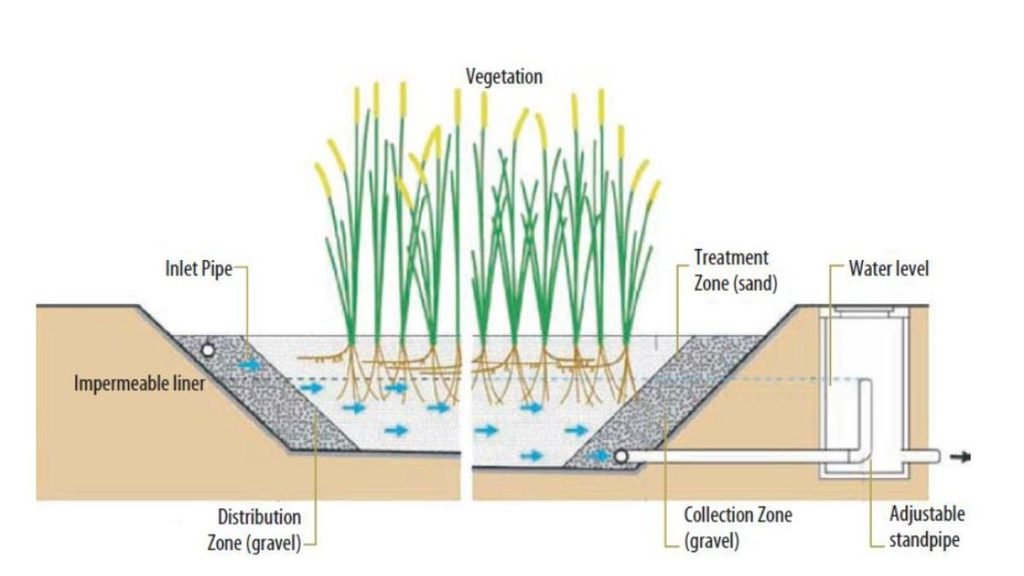
Constructed wetlands use vegetation, growing media and microbial activity to treat wastewater.
- Working principle: Wastewater passes through engineered wetland beds, where filtration, settling, adsorption and microbial processes help remove pollutants.
- Advantages: They can offer relatively low-energy treatment and provide ecological benefits when properly designed and maintained.
- Bithoor example: The source reports six constructed wetlands treating approximately 2 million litres per day (2 MLD), with biochemical oxygen demand reduced from around 75 mg/L to below 10 mg/L.
Biochemical Oxygen Demand (BOD) measures the oxygen consumed by microorganisms while decomposing biodegradable organic matter in water. A high BOD generally indicates a higher organic pollution load.
Soil Biotechnology (SBT)
Soil Biotechnology is a nature-based treatment process that combines filtration, sedimentation, infiltration and microbial decomposition.
- It uses a biologically active soil-based medium to help remove pollutants.
- It can provide an alternative where land, local conditions and wastewater characteristics are suitable.
- Its performance depends on the design of the treatment bed, hydraulic loading and maintenance.
Johkasou Technology
Johkasou is a compact, prefabricated, decentralised wastewater treatment system that integrates multiple treatment stages within a single unit.
- Treatment stages: Biological treatment, settling, disinfection and filtration, depending on the system configuration.
- Suitable locations: Small settlements, hilly regions and places without conventional sewerage networks.
- Reported application: The source records six installations in Uttarakhand.
5. Space-Efficient and On-Site Sanitation Solutions
Multi-Storey Sewage Treatment Plants
A multi-storey STP uses vertical infrastructure to accommodate treatment equipment on multiple levels, reducing the land footprint.
- It is useful in densely populated urban areas and locations where land is expensive or scarce.
- The source identifies the municipal STP at Muni Ki Reti, Uttarakhand, as India’s first four-storey municipal STP, with a capacity of 7.5 MLD.
Faecal Sludge and Septage Management (FSSM)
Faecal Sludge and Septage Management refers to the collection, transportation, treatment and safe disposal or reuse of waste removed from septic tanks and other on-site sanitation systems.
- It extends sanitation services to areas that lack underground sewer networks.
- It reduces the risk of untreated faecal waste contaminating rivers, soil and groundwater.
- The source reports that a 10 kilolitres per day (KLD) faecal sludge treatment plant pilot was sanctioned at Chunar, Uttar Pradesh.
FSSM is important because not all households are connected to centralised sewerage systems. Effective sanitation therefore requires both sewer-based and non-sewer-based solutions.
Why Does the Technology-Neutral Approach Matter?
A technology-neutral approach means choosing the treatment method according to local needs rather than relying on a single technology everywhere.
| Local challenge | Potentially suitable approach |
| Large volumes of urban sewage | Conventional or advanced biological STPs |
| Limited land availability | Compact systems such as NEREDA or multi-storey STPs |
| Small or remote settlements | Johkasou and other decentralised systems |
| Suitable sites with space for natural treatment | Constructed wetlands or Soil Biotechnology |
| Difficult-to-treat pollutants | Electrocoagulation or Advanced Oxidation Processes, where appropriate |
| Areas without underground sewerage | FSSM and decentralised wastewater treatment |
The choice must also consider treatment standards, electricity requirements, sludge management, lifecycle costs and the capacity of local authorities to operate and maintain the infrastructure.
Progress of Sewerage Infrastructure
Official figures change as projects are sanctioned and completed. The following figures illustrate the programme’s progress as reported by the government.
Official update: August 2026
219
Sewerage infrastructure projects sanctioned
147
Sewerage projects completed
6,603 MLD
Treatment capacity covered by sanctioned projects
4,339 MLD
Treatment capacity created by completed projects
Source: Government of India update on the Namami Gange Programme, reporting status as of August 2026.
These figures show why infrastructure creation and operational performance must be assessed together. Building treatment capacity is an important step, but its environmental benefits depend on sewage actually reaching treatment plants and the plants consistently meeting prescribed discharge standards.
Prelims Focus: High-Value Facts for UPSC CSE
The following facts are drawn from official government sources and are relevant to the Environment and Ecology and Science and Technology sections of Prelims.
| Topic | Important fact |
| Namami Gange Programme | Launched in June 2014 |
| Implementing agency | National Mission for Clean Ganga (NMCG) |
| Nodal ministry | Ministry of Jal Shakti |
| Phase I | Extended implementation up to March 2021 |
| Phase II | Sanctioned up to March 2026 |
| MLD | Million litres per day; a measure of treatment capacity |
| BOD | Indicates the oxygen consumed during microbial decomposition of biodegradable organic matter |
| UASB | Upflow Anaerobic Sludge Blanket; an anaerobic biological treatment process |
| SBR | Sequential Batch Reactor; a cyclic biological treatment process |
| MBBR | Moving Bed Biofilm Reactor; uses microorganisms attached to moving carrier media |
| NEREDA | Uses aerobic granular sludge |
| FSSM | Manages faecal sludge and septage from on-site sanitation systems |
| Constructed wetlands | Use engineered natural processes involving plants, substrates and microorganisms |
Sources: National Mission for Clean Ganga and Central Pollution Control Board.
Conclusion and Way Forward
India must combine context-specific wastewater technologies, reliable operation and maintenance, treated-water reuse, and strict pollution monitoring to achieve sustainable river rejuvenation.
Prelims Check: UPSC-Style Practice Questions
Question 1
With reference to wastewater treatment technologies, consider the following pairs:
| Technology | Principle |
| 1. NEREDA | Aerobic granular sludge |
| 2. Upflow Anaerobic Sludge Blanket | Anaerobic biological treatment |
| 3. Electrocoagulation | Use of electric current and electrodes |
| 4. Constructed wetlands | Treatment exclusively through chemical oxidation |
Which of the pairs given above are correctly matched?
(a) 1 and 2 only
(b) 1, 2 and 3 only
(c) 2, 3 and 4 only
(d) 1, 2, 3 and 4
Question 2
With reference to the Namami Gange Programme, consider the following statements:
- The National Mission for Clean Ganga implements the programme under the Ministry of Jal Shakti.
- The programme focuses exclusively on removing floating waste from the surface of the river.
- A technology-neutral approach allows sewage treatment technologies to be selected according to local conditions.
Which of the statements given above are correct?
(a) 1 and 2 only
(b) 2 and 3 only
(c) 1 and 3 only
(d) 1, 2 and 3
Question 3
Consider the following statements regarding decentralised wastewater management:
- Johkasou systems can provide sewage treatment in locations without conventional sewerage networks.
- Faecal Sludge and Septage Management addresses waste from septic tanks and other on-site sanitation systems.
- Constructed wetlands use plants, substrates and microorganisms to assist in wastewater treatment.
- Multi-storey sewage treatment plants primarily aim to increase the horizontal land footprint of treatment infrastructure.
How many of the statements given above are correct?
(a) Only one
(b) Only two
(c) Only three
(d) All four
Answers and Explanations
Attempt all three questions before checking the answers.
Question 1 — Answer: (b)
- Pair 1 is correct: NEREDA uses aerobic granular sludge.
- Pair 2 is correct: UASB uses anaerobic microorganisms to break down organic matter.
- Pair 3 is correct: Electrocoagulation uses electric current and electrodes to destabilise pollutants. Pair 4 is incorrect because constructed wetlands rely on several physical, chemical and biological processes, not exclusively chemical oxidation.
Question 2 — Answer: (c)
- Statement 1 is correct: NMCG implements the programme under the Ministry of Jal Shakti.
- Statement 2 is incorrect: The programme also covers sewage treatment, industrial pollution control, biodiversity conservation, afforestation and public participation.
- Statement 3 is correct: The technology-neutral approach considers geography, land availability, sewage characteristics and treatment requirements.
Question 3 — Answer: (c)
- Statement 1 is correct: Johkasou systems are suitable for decentralised treatment in areas without conventional sewer networks.
- Statement 2 is correct: FSSM addresses the collection and treatment of faecal sludge and septage from on-site sanitation.
- Statement 3 is correct: Constructed wetlands use plants, substrates and microorganisms to help remove pollutants.
- Statement 4 is incorrect: Multi-storey STPs use vertical infrastructure to reduce land requirements, rather than increase the horizontal footprint.
“Great rivers are renewed not by one intervention, but by the sustained efforts of science, society and responsible governance.”