Context of the News
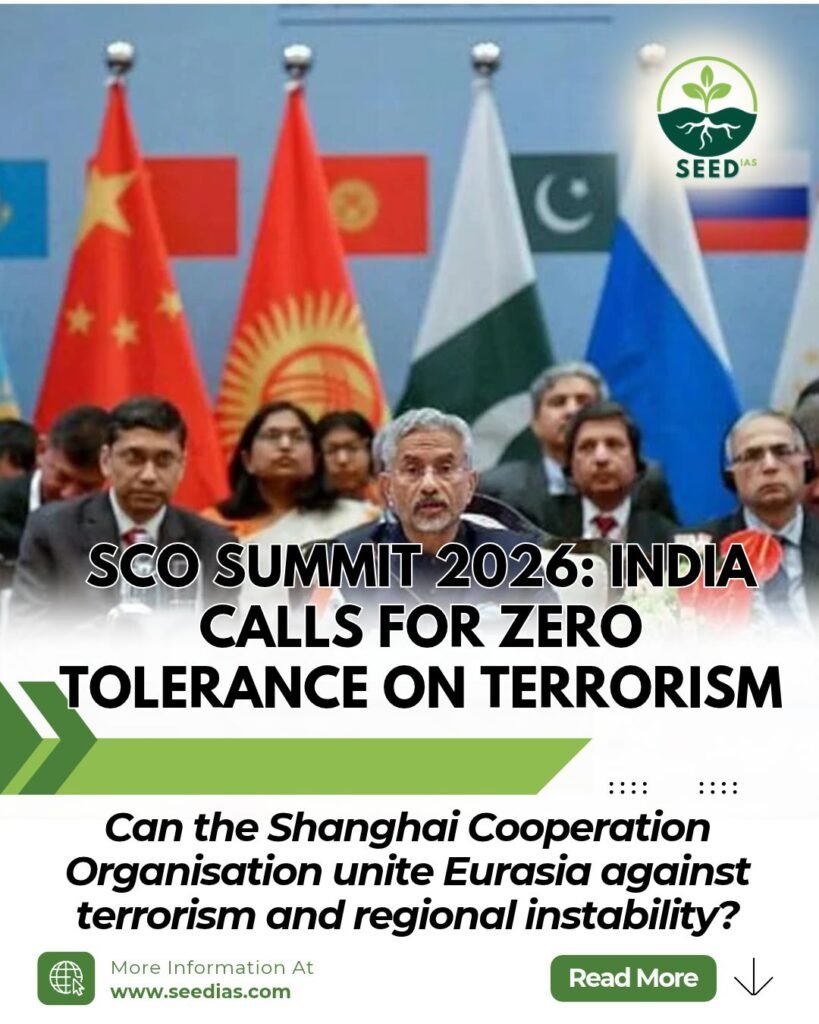
India’s Defence Minister addressed the 25th meeting of the SCO Council of Heads of Government (CHG) in Dushanbe, Tajikistan. India called for a united fight against terrorism and stressed that countries must avoid double standards in dealing with terrorist groups.
The meeting also highlighted regional trade, civilisational exchanges, sustainable energy and the importance of respecting national sovereignty in connectivity projects.
Background
The Shanghai Cooperation Organisation (SCO) was established in 2001 to strengthen cooperation among Eurasian countries, particularly in regional security, political relations and economic development.
India became a full member in 2017. The organisation is important for India because it provides a platform to engage with China, Russia, Central Asian countries, Iran and other regional partners.
However, differences among member states, cross-border terrorism and competing geopolitical interests continue to challenge the organisation’s effectiveness.
News Breakdown
1. India Calls for Zero Tolerance on Terrorism
Zero tolerance for terrorism means refusing to justify, support or overlook terrorist activities, regardless of the perpetrators or their political objectives.
India urged SCO members to adopt a united approach against terrorism and dismantle the entire ecosystem that enables terrorist organisations to operate.
Key points include:
- Terror financing: India called for action against the financial networks that provide money to terrorist organisations.
- Recruitment: Countries must prevent terrorist groups from recruiting and radicalising vulnerable individuals, particularly young people.
- Safe havens: Terrorist groups should not be allowed to use any territory as a base for planning or carrying out attacks.
- Intelligence sharing: Greater cooperation among national security agencies can improve the identification and prevention of terrorist threats.
- No double standards: India argued that terrorism must be opposed consistently, without distinguishing between terrorist groups based on political convenience.
India also highlighted the social and economic consequences of terrorism. It deprives young people of opportunities, discourages investment and undermines regional stability.
Why is this important for India?
India faces security challenges associated with cross-border terrorism. Cooperation through the SCO can help improve intelligence sharing and strengthen regional counter-terrorism efforts. However, political differences among members can limit collective action.
2. India to Host the SCO Civilisational Dialogue Forum
Civilisational dialogue refers to exchanges among societies to understand their historical traditions, cultural heritage, values and experiences.
India announced its intention to host the first SCO Civilisational Dialogue Forum by the end of 2026, according to the supplied news material.
The initiative was proposed by India at the 2025 SCO summit in Tianjin, China.
Its key objectives are:
- Cultural cooperation: Encourage member countries to share their historical and cultural heritage.
- People-to-people ties: Promote interaction among students, scholars, researchers and cultural institutions.
- Mutual understanding: Reduce misunderstandings by highlighting shared historical experiences and cultural connections.
- Soft power: Strengthen India’s international influence through its civilisational heritage, educational exchanges and cultural diplomacy.
UPSC relevance: The initiative illustrates how cultural diplomacy can complement conventional diplomacy and contribute to regional cooperation.
3. Economic Cooperation and Trade
India reaffirmed its support for the adoption of the 2026–2030 Action Plan under the Programme for Multilateral Trade and Economic Cooperation (PMTEC).
The initiative seeks to strengthen economic cooperation among SCO members.
The major areas of focus include:
- Resilient supply chains: Build reliable networks for the production, transportation and distribution of goods.
- Technology cooperation: Use technological development to address emerging economic challenges.
- Regional trade: Improve economic links among member states and explore opportunities for cross-border commerce.
- Reducing economic divides: Promote cooperation that enables countries to benefit from technological and economic progress.
Why does this matter?
The SCO connects major economies, energy producers and important Eurasian markets. Better economic cooperation can support trade diversification and improve regional economic resilience.
However, differences in economic priorities, geopolitical tensions and connectivity constraints can affect implementation.
4. Sovereignty and Regional Connectivity
Regional connectivity refers to transport, energy, trade and communication networks that link countries and markets.
India reiterated that connectivity projects must follow the principles of consultation, mutual respect and territorial integrity.
These principles are particularly relevant to China’s Belt and Road Initiative (BRI) and the China–Pakistan Economic Corridor (CPEC).
- Belt and Road Initiative (BRI): A Chinese-led initiative to develop international infrastructure and connectivity networks, including transport and energy projects.
- China–Pakistan Economic Corridor (CPEC): A network of proposed and ongoing infrastructure, transport and energy projects linking China with Pakistan, including routes towards the Arabian Sea.
- Territorial integrity: The principle that a state’s territory and political independence must be respected.
India opposes CPEC because it passes through Pakistan-occupied Kashmir (PoK), territory claimed by India.
India’s position is that connectivity initiatives must respect sovereignty and territorial integrity and should not proceed without appropriate consultation.
This reflects India’s broader approach to international cooperation: infrastructure development should support regional integration without compromising national sovereignty.
5. Climate Action and Clean Energy Cooperation
India encouraged SCO members to cooperate through international platforms that promote renewable energy, disaster resilience and cleaner fuels.
Three important initiatives are relevant.
International Solar Alliance (ISA)
The ISA is an international organisation that promotes solar energy deployment and cooperation, particularly among solar-resource-rich countries.
- It seeks to mobilise investment in solar energy.
- It promotes cooperation in solar technologies and capacity building.
- It supports efforts to expand access to clean and affordable energy.
Coalition for Disaster Resilient Infrastructure (CDRI)
The CDRI is an international coalition that promotes infrastructure capable of withstanding natural disasters and climate-related risks.
- It supports disaster-resilient infrastructure planning.
- It encourages knowledge sharing and technical cooperation.
- It seeks to reduce infrastructure damage and service disruptions caused by disasters.
Global Biofuel Alliance (GBA)
The GBA is an international initiative intended to promote the development and wider adoption of sustainable biofuels.
- It encourages international cooperation on biofuel development.
- It seeks to facilitate knowledge sharing and technology cooperation.
- It supports efforts to diversify energy sources and reduce dependence on fossil fuels.
Cooperation through these initiatives can complement the SCO’s economic and environmental objectives.
Key Facts About the Shanghai Cooperation Organisation (SCO)
1. Origin and Membership
The Shanghai Cooperation Organisation is a Eurasian intergovernmental organisation established on 15 June 2001.
Its predecessor, the Shanghai Five, emerged in 1996 to address border-related confidence-building and security concerns among China, Russia and three Central Asian states.
The six founding members of the SCO in 2001 were:
- China
- Kazakhstan
- Kyrgyzstan
- Russia
- Tajikistan
- Uzbekistan
Subsequent expansion brought India and Pakistan into the organisation in 2017, Iran in 2023, and Belarus in 2024.
The organisation’s membership has expanded its geographical reach and increased the diversity of its security and economic interests.
2. Core Objectives of the SCO
The SCO promotes cooperation in security, politics, economics and cultural affairs.
Its principal areas of work include:
- Counter-terrorism: Cooperation against terrorism and related security threats.
- Combating separatism: Addressing movements that seek separation from an existing state, within the organisation’s security framework.
- Combating extremism: Coordinating responses to threats that member states classify as extremism.
- Economic cooperation: Promoting trade, investment, transport and energy cooperation.
- Cultural exchanges: Supporting educational, cultural and people-to-people interaction.
The organisation often describes terrorism, separatism and extremism as the “three evils.”
3. Institutional Structure of the SCO
The SCO has several important bodies with different responsibilities.
| Institution | Headquarters / Role | Key Function |
|---|---|---|
| Council of Heads of State (HSC) | Supreme decision-making body | Determines major priorities and strategic directions |
| Council of Heads of Government (CHG) | Second-highest council | Focuses on economic cooperation, budgets and related matters |
| SCO Secretariat | Beijing, China | Coordinates the organisation’s administrative and day-to-day work |
| Regional Anti-Terrorist Structure (RATS) | Tashkent, Uzbekistan | Facilitates cooperation against terrorism, separatism and extremism |
The Council of Heads of Government deals primarily with economic and practical cooperation. It should not be confused with the Council of Heads of State, which is the organisation’s supreme decision-making body.
4. Regional Anti-Terrorist Structure (RATS)
The Regional Anti-Terrorist Structure (RATS) is a permanent SCO body based in Tashkent, Uzbekistan.
Its role includes facilitating cooperation among member states against security threats.
Key functions include:
- Coordinating information exchange among competent authorities.
- Supporting cooperation against terrorist organisations and related threats.
- Maintaining relevant information and databases in accordance with its mandate.
- Facilitating joint activities and cooperation among member states’ security agencies.
For India, RATS offers a regional mechanism for counter-terrorism engagement. Its effectiveness, however, depends on the willingness of member states to share information and cooperate meaningfully.
Significance of the SCO for India
1. Counter-Terrorism Cooperation
The SCO provides India with a platform to engage regional partners on terrorism and security threats.
Cooperation through RATS can support information exchange and coordinated security efforts. However, differing national interests can complicate consensus on particular terrorist groups and security challenges.
2. Strengthening Engagement with Central Asia
Central Asia forms an important part of India’s extended neighbourhood.
The SCO helps India maintain political and economic engagement with Central Asian countries and explore opportunities in trade, energy and transport.
Two important connectivity initiatives are:
- International North–South Transport Corridor (INSTC): A multimodal transport network intended to connect India, Iran, Russia and other participating countries through coordinated maritime, rail and road routes.
- Chabahar Port: An Iranian port that offers India a potential route to Afghanistan and Central Asia that does not depend on transit through Pakistan.
These initiatives can help India diversify its trade routes and improve access to regional markets.
3. Strategic Autonomy and Geopolitical Balancing
Strategic autonomy refers to a country’s ability to make independent foreign policy decisions based on its national interests.
SCO membership enables India to maintain dialogue with Russia, China, Iran and Central Asian countries while continuing cooperation with partners through other groupings, including the Quad.
India’s participation does not require it to agree with every position taken by other SCO members.
Instead, the organisation offers a platform for cooperation on shared interests while India continues to protect its independent foreign policy priorities.
4. Energy Security and Economic Opportunities
SCO members include major energy producers and important consumer markets.
Cooperation can create opportunities in energy trade, transport infrastructure, regional investment and technological development.
India can use these engagements to explore diversified energy supplies and stronger commercial links.
However, sanctions, geopolitical tensions, payment difficulties and inadequate transport connectivity can limit the realisation of these opportunities.
5. Challenges to SCO Effectiveness
Despite its broad agenda, the SCO faces several challenges.
- India–China tensions: Border disputes and strategic competition affect mutual trust.
- India–Pakistan rivalry: Political and security tensions can obstruct cooperation.
- Different national interests: Member states do not always share the same priorities on security and regional affairs.
- Implementation gaps: Agreements may not translate into effective action without adequate institutional coordination.
- Connectivity concerns: Disagreements over sovereignty, routes and infrastructure financing can limit regional integration.
For India, the challenge is to use the SCO constructively without compromising its national security, territorial integrity or strategic autonomy.
Prelims Focus: High-Value Facts
- Established: 15 June 2001.
- Predecessor: Shanghai Five, formed in 1996.
- Founding members: China, Kazakhstan, Kyrgyzstan, Russia, Tajikistan and Uzbekistan.
- India and Pakistan: Became full members in 2017.
- Iran: Became a full member in 2023.
- Belarus: Became a full member in 2024.
- SCO Secretariat: Beijing, China.
- Regional Anti-Terrorist Structure (RATS): Tashkent, Uzbekistan.
- Council of Heads of State: The supreme decision-making body.
- Council of Heads of Government: Focuses primarily on economic and related cooperation.
- Three evils: Terrorism, separatism and extremism.
- CPEC: India opposes the corridor because it passes through Pakistan-occupied Kashmir.
- INSTC: A multimodal transport corridor intended to improve connectivity between India, Iran, Russia and participating countries.
- ISA: Promotes international cooperation in solar energy.
- CDRI: Promotes disaster-resilient infrastructure.
- GBA: Promotes international cooperation on sustainable biofuels.
For examination preparation, verify current membership, summit outcomes and institutional details against official SCO and Government of India sources, particularly when using the latest developments.
Conclusion / Way Forward
India should use the SCO to strengthen counter-terrorism cooperation, expand Eurasian connectivity and promote sustainable development while firmly upholding sovereignty and strategic autonomy.
Prelims Check
Question 1
With reference to the Shanghai Cooperation Organisation (SCO), consider the following statements:
- The SCO was established in 2001, succeeding the Shanghai Five grouping.
- The Council of Heads of State is the supreme decision-making body of the SCO.
- The Regional Anti-Terrorist Structure is headquartered in Beijing, China.
Which of the statements given above are correct?
(a) 1 and 2 only
(b) 2 and 3 only
(c) 1 and 3 only
(d) 1, 2 and 3
Question 2
Consider the following pairs:
| Initiative | Primary objective |
|---|---|
| 1. International Solar Alliance | Promoting solar energy cooperation |
| 2. Coalition for Disaster Resilient Infrastructure | Strengthening infrastructure resilience against disasters |
| 3. Global Biofuel Alliance | Promoting international cooperation on biofuels |
| 4. Regional Anti-Terrorist Structure | Coordinating regional economic and trade negotiations |
How many of the above pairs are correctly matched?
(a) Only one
(b) Only two
(c) Only three
(d) All four
Question 3
Consider the following statements regarding India’s approach to regional connectivity:
Statement I: India opposes the China–Pakistan Economic Corridor because it passes through territory claimed by India as part of Jammu and Kashmir.
Statement II: India maintains that connectivity initiatives should respect sovereignty and territorial integrity.
Which one of the following is correct?
(a) Both Statement I and Statement II are correct, and Statement II explains Statement I.
(b) Both Statement I and Statement II are correct, but Statement II does not explain Statement I.
(c) Statement I is correct, but Statement II is incorrect.
(d) Statement I is incorrect, but Statement II is correct.
Answers and Explanations
Question 1 — Answer: (a) 1 and 2 only
- Statement 1 is correct: The SCO was established in 2001 and developed from the earlier Shanghai Five process.
- Statement 2 is correct: The Council of Heads of State is the SCO’s supreme decision-making body.
- Statement 3 is incorrect: RATS is headquartered in Tashkent, Uzbekistan, while the SCO Secretariat is in Beijing, China.
Question 2 — Answer: (c) Only three
- Pair 1 is correct: The ISA promotes solar energy deployment and international cooperation.
- Pairs 2 and 3 are correct: The CDRI focuses on disaster-resilient infrastructure, while the GBA promotes cooperation on biofuels.
- Pair 4 is incorrect: RATS is a security-related body that facilitates cooperation against terrorism and related threats; it is not responsible for regional trade negotiations.
Question 3 — Answer: (a)
- Statement I is correct: India objects to CPEC because it traverses Pakistan-occupied Kashmir, which India claims as its territory.
- Statement II is correct: Respect for sovereignty and territorial integrity is a central principle of India’s stated approach to international connectivity.
- Statement II explains Statement I: India’s objection to CPEC is directly linked to its position that connectivity projects must respect territorial integrity.
“Great achievements begin with curiosity, grow through discipline, and succeed through perseverance.”