Context of the News
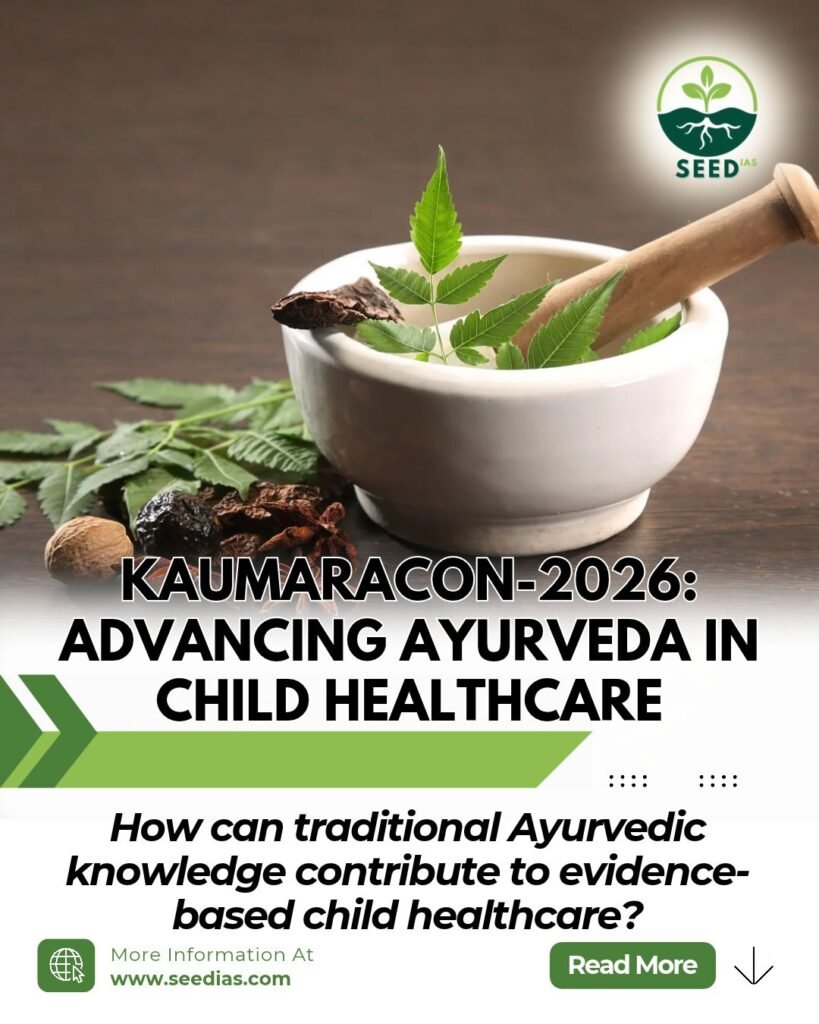
The Vice-President inaugurated the 3rd International Conference on Kaumarabhritya, KAUMARACON-2026, organised by the All India Institute of Ayurveda (AIIA).
The conference focused on integrating traditional Ayurvedic knowledge with modern scientific research to strengthen evidence-based healthcare, promote innovations in child health and enhance Ayurveda’s global acceptance.
Background: Understanding Ayurveda
Ayurveda is one of the oldest traditional systems of medicine. It emphasises health and well-being through approaches that include diet, lifestyle and therapeutic practices.
Its three principal classical texts, collectively known as the Brihat Trayi, are:
- Charaka Samhita: Primarily associated with Ayurveda’s principles of medicine and internal healthcare.
- Sushruta Samhita: Known for its contributions to surgery and surgical practices.
- Ashtanga Hridayam: A systematic presentation of Ayurvedic principles and practices.
News Breakdown
1. KAUMARACON-2026: Key Highlights
The conference theme was “Shaping the Future of Child Health: Global Perspectives, Research Innovations, and Clinical Frontiers in Kaumarabhritya.”
Key objectives included:
- Promoting scientific research into traditional Ayurvedic knowledge.
- Strengthening evidence-based approaches to healthcare.
- Encouraging research innovations and clinical advancements in child health.
- Improving the international recognition and acceptance of Ayurveda.
2. Digital and Innovation Initiatives Launched
The event witnessed the launch of several digital platforms and innovation initiatives aimed at supporting the AYUSH ecosystem.
| Initiative | Broad significance |
| AYUSH Start-up Portal | Supports visibility and development of start-ups in the AYUSH ecosystem. |
| AIIA-iCAINE website | A digital platform associated with AIIA’s innovation ecosystem. |
| AyuDIVA | The Ayurveda Digital Innovation and Venture Acceleration Facility, focused on innovation and venture acceleration. |
| Vamana App | A digital application named after a traditional Ayurvedic therapeutic procedure. |
| Panchakarma Assessment App | A digital tool associated with the assessment of Panchakarma. |
UPSC relevance: These initiatives highlight the role of digital technology, innovation and entrepreneurship in developing traditional systems of medicine.
3. What Is Kaumarabhritya?
Kaumarabhritya is the branch of Ayurveda concerned with child healthcare, including nutrition, growth, development and disease prevention.
The term combines two concepts:
- Kaumara: Derived from Kumara, referring to a child. The supplied source associates this stage with the period from birth up to 16 years of age.
- Bhritya: Derived from the Sanskrit root Bhri, meaning nourishment, upbringing, support, maintenance and protection.
Thus, Kaumarabhritya broadly focuses on nurturing and maintaining children’s health.
4. What Is Panchakarma?
Traditional Ayurvedic therapeutic system
Panchakarma means “five actions” in Sanskrit. It is an Ayurvedic treatment system traditionally intended to remove Ama, balance the three doshas and support overall well-being.
Key concepts include:
- Ama: A concept in Ayurveda associated with improperly processed or accumulated substances.
- Vata: Traditionally associated with movement and bodily functions involving motion.
- Pitta: Traditionally associated with transformation, digestion and metabolism.
- Kapha: Traditionally associated with structure, stability and lubrication.
The three doshas—Vata, Pitta and Kapha—are central concepts in Ayurvedic theory.
Scientific perspective: Traditional Ayurvedic explanations should be distinguished from established biomedical mechanisms. Claims about detoxification, disease prevention or treatment require appropriate scientific evidence and clinical evaluation.
5. Ministry of AYUSH and Major Initiatives
The Ministry of AYUSH, established in 2014, promotes traditional systems of medicine, including Ayurveda, Yoga and Naturopathy, Unani, Siddha, Sowa-Rigpa and Homoeopathy.
Major initiatives mentioned in the supplied material include:
- WHO Global Traditional Medicine Centre: Established in Jamnagar to support work on traditional medicine globally.
- International Classification of Diseases (ICD-11): Traditional medicine classifications have been incorporated into the World Health Organization’s classification framework.
- Traditional Knowledge Digital Library (TKDL): Documents traditional knowledge to help prevent its misappropriation, including through inappropriate patent claims.
- National AYUSH Mission (NAM): Supports the development and promotion of AYUSH healthcare services and related infrastructure.
These initiatives demonstrate efforts to strengthen traditional medicine through institutional support, documentation, international cooperation and healthcare development.
Prelims Focus
| Topic | Key fact to remember |
| KAUMARACON-2026 | 3rd International Conference on Kaumarabhritya |
| Organiser | All India Institute of Ayurveda (AIIA) |
| Kaumarabhritya | Ayurvedic branch concerned with child healthcare |
| Brihat Trayi | Charaka Samhita, Sushruta Samhita and Ashtanga Hridayam |
| Panchakarma | Literally means “five actions” |
| Three doshas | Vata, Pitta and Kapha |
| Ministry of AYUSH | Established in 2014 |
| NAM | National AYUSH Mission |
| TKDL | Traditional Knowledge Digital Library |
| ICD-11 | International Classification of Diseases, 11th Revision |
Conclusion / Way Forward
Integrating traditional knowledge with rigorous scientific research, digital innovation and evidence-based clinical evaluation can strengthen child healthcare and the responsible global development of Ayurveda.
UPSC Prelims Practice Questions
Question 1
With reference to Ayurveda, consider the following pairs:
| Classical text | Associated area |
| 1. Charaka Samhita | Medicine and internal healthcare |
| 2. Sushruta Samhita | Surgery |
| 3. Ashtanga Hridayam | Ayurvedic principles and practices |
Which of the pairs given above are correctly matched?
(a) 1 and 2 only
(b) 2 and 3 only
(c) 1 and 3 only
(d) 1, 2 and 3
Question 2
Consider the following statements regarding Kaumarabhritya:
- It is a branch of Ayurveda concerned with child healthcare.
- It includes aspects such as nutrition, growth and development.
- It is primarily concerned with surgical procedures in adults.
Which of the statements given above is/are correct?
(a) 1 only
(b) 1 and 2 only
(c) 2 and 3 only
(d) 1, 2 and 3
Question 3
With reference to initiatives associated with traditional systems of medicine in India, consider the following pairs:
| Initiative | Purpose or association |
| 1. Traditional Knowledge Digital Library | Documentation of traditional knowledge |
| 2. National AYUSH Mission | Promotion and development of AYUSH systems |
| 3. WHO Global Traditional Medicine Centre | Jamnagar |
Which of the pairs given above are correctly matched?
(a) 1 and 2 only
(b) 2 and 3 only
(c) 1 and 3 only
(d) 1, 2 and 3
Answers and Explanations
1. Correct answer: (d) 1, 2 and 3
- Charaka Samhita is associated primarily with Ayurvedic medicine and internal healthcare.
- Sushruta Samhita is renowned for its treatment of surgery and surgical knowledge.
- Ashtanga Hridayam presents Ayurvedic principles and practices in a systematic form.
2. Correct answer: (b) 1 and 2 only
- Kaumarabhritya is the Ayurvedic branch concerned with child healthcare.
- Its scope includes nutrition, growth, development and disease prevention.
- Adult surgery is not its defining focus; surgery is more closely associated with the Ayurvedic tradition represented by Sushruta.
3. Correct answer: (d) 1, 2 and 3
- The TKDL documents traditional knowledge and helps address concerns relating to its misappropriation.
- The National AYUSH Mission supports the development and promotion of AYUSH systems.
- The WHO Global Traditional Medicine Centre is located in Jamnagar, Gujarat.
“Knowledge becomes progress when tradition is strengthened by evidence, innovation and a commitment to human well-being.”