Context of the News
The Indian Council of Agricultural Research (ICAR)–Central Potato Research Institute (CPRI) has highlighted Kufri Jamunia, a biofortified purple potato variety released in 2024, for its potential to improve nutritional security.
The variety combines enhanced nutritional properties with good yield potential and culinary versatility. It could help address hidden hunger, promote dietary diversity and support India’s efforts to improve nutrition through agricultural innovation.
Background: Understanding Biofortification
Biofortification is the process of increasing the nutritional content of crops through plant breeding and related agricultural techniques.
It aims to improve the intake of essential vitamins and minerals through commonly consumed foods.
Hidden hunger refers to micronutrient deficiencies that can occur even when a person consumes enough calories. Deficiencies in iron, zinc and vitamins can affect health, growth and overall well-being.
Biofortified crops can help address this problem by improving the nutritional quality of food consumed regularly.
News Breakdown: Key Facts About Kufri Jamunia
1. What Is Kufri Jamunia?
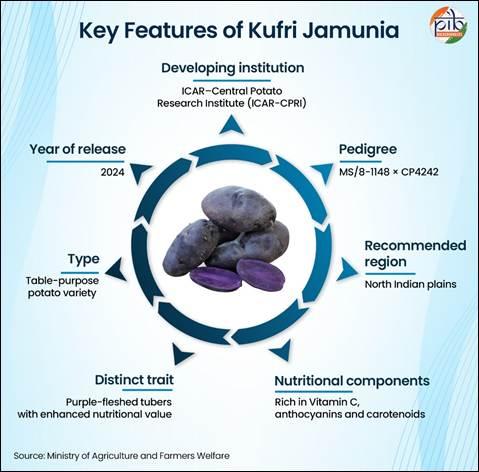
Kufri Jamunia is a biofortified purple potato variety developed by the ICAR–Central Potato Research Institute (ICAR-CPRI) and officially released in 2024.
It is notable for combining nutritional value, marketable yield and suitability for different culinary applications.
Its major characteristics include:
- Colour: Dark purple skin and purple flesh.
- Tubers: Oblong tubers with shallow eyes.
- Maturity: Medium-maturing variety.
- Texture: Mealy texture, making it suitable for traditional dishes and processed foods.
- Tubers per plant: Approximately 10–12 medium to large tubers.
- Storage: A dormancy period of 6–8 weeks, along with good storage quality.
These characteristics make Kufri Jamunia a potential option for farmers, food processors and consumers seeking nutritionally enriched potato varieties.
2. Yield and Agricultural Performance
Crop yield refers to the quantity of agricultural produce harvested per unit of cultivated land.
Kufri Jamunia has demonstrated promising yield performance under recommended cultivation practices.
| Parameter | Kufri Jamunia |
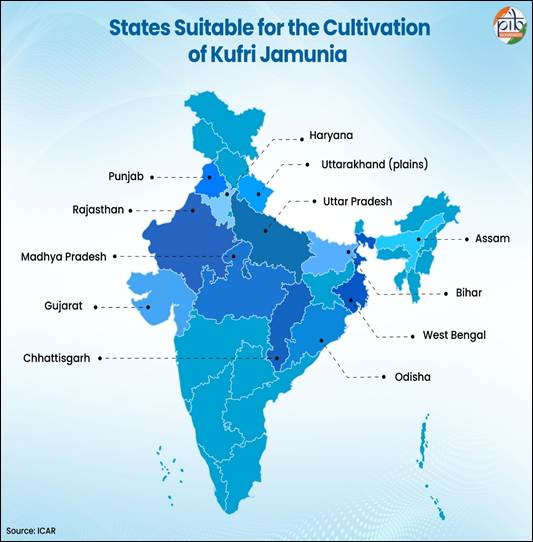
| Recommended cultivation region | North Indian plains |
| Average yield under recommended practices | 32–35 tonnes per hectare |
| Yield in station trials | Up to 49 tonnes per hectare over 90 days |
| Marketable yield in trials | Nearly 90% of total yield |
| Dormancy period | 6–8 weeks |
| Trial performance | Stable performance in multi-location trials |
The variety’s yield potential and marketable tubers could make it commercially attractive. However, actual productivity depends on climatic conditions, soil quality, crop management and other local factors.
Its recommended cultivation in the North Indian plains reflects the suitability of the region’s agricultural conditions for potato cultivation.
3. Nutritional Value of Kufri Jamunia
Nutritional security means ensuring access to food that provides the essential nutrients required for healthy living.
Kufri Jamunia is significant because it contains several important nutrients and naturally occurring plant compounds.
- Vitamin C: Supports normal immune function and helps the body absorb non-haem iron from plant foods.
- Anthocyanins: Natural pigments responsible for the purple colour of the potato. They possess antioxidant properties.
- Carotenoids: Plant pigments with important roles in human nutrition, depending on the specific compounds present.
- Iron: Essential for haemoglobin formation and oxygen transport in the body.
- Zinc: Supports immune function, growth and several metabolic processes.
According to the supplied material, Kufri Jamunia has higher levels of Vitamin C, anthocyanins and carotenoids than earlier coloured potato varieties such as Kufri Neelkanth and Kufri Manik.
Its nutritional profile may help diversify diets and improve the nutritional quality of commonly consumed foods. However, the presence of these nutrients alone does not establish that the potato can independently eliminate micronutrient deficiencies.
4. Why Are Anthocyanins Important?
Anthocyanins are naturally occurring water-soluble pigments belonging to the flavonoid group. They give many plants and plant products their red, purple and blue colours.
They are important in coloured potatoes for two main reasons:
- Colour: They contribute to the distinctive purple flesh and skin of Kufri Jamunia.
- Antioxidant properties: They can help neutralise certain reactive molecules under appropriate conditions.
Anthocyanins are also found in foods such as berries, purple cabbage and other deeply coloured plant products.
Including a variety of such foods in a balanced diet can contribute to dietary diversity. The health benefits of individual foods depend on their overall nutritional composition, preparation and consumption patterns.
5. Culinary Uses of Kufri Jamunia
Kufri Jamunia’s purple flesh and mealy texture make it suitable for several traditional and modern food applications.
Potential uses include:
- Traditional dishes: Parathas and puris.
- Snacks: Potato-based snack products.
- Bakery products: Preparations incorporating purple potato.
- Processed foods: Products that use its distinctive colour and nutritional properties.
- Potato flour: Production of anthocyanin-rich potato flour.
Its versatility could create opportunities for value addition in food processing and specialty agricultural markets.
Value addition refers to processing or improving a raw agricultural product to increase its usefulness, market appeal or economic value.
For farmers, processors and food entrepreneurs, specialty potato varieties may offer opportunities to develop differentiated products. Actual commercial success will depend on consumer acceptance, processing costs, market demand and supply-chain efficiency.
6. Other Potato Varieties Developed by ICAR-CPRI
ICAR-CPRI has developed coloured potato varieties with distinct characteristics and agricultural uses.
| Feature | Kufri Neelkanth | Kufri Manik | Kufri Jamunia |
| Release year | 2018 | 2021 | 2024 |
| Appearance | Purple skin | Deep red, round tubers with yellow flesh | Dark purple skin and purple flesh |
| Nutritional features highlighted | High antioxidant content | Anthocyanins, zinc and iron | Vitamin C, anthocyanins, carotenoids, iron and zinc |
| Cultivation information | Punjab, Haryana, Uttar Pradesh, Uttarakhand, Bihar, Madhya Pradesh and Chhattisgarh | Not specified in the supplied material | Recommended for the North Indian plains |
Kufri Neelkanth was developed as a specialty potato variety with purple skin and high antioxidant content.
Kufri Manik is known for its deep red, round tubers, yellow flesh and nutritional properties.
Kufri Jamunia adds another option, with purple flesh, enhanced nutritional characteristics and promising yield performance.
These varieties illustrate how agricultural research can develop crops with different nutritional, visual and commercial characteristics.
7. How Can Kufri Jamunia Help Address Hidden Hunger?
Kufri Jamunia has potential significance beyond its distinctive colour. It illustrates how crop improvement can contribute to public health and agricultural development.
Its contribution can be understood through four key areas:
- Improved dietary quality: Nutrient-enriched crops can increase the nutritional value of commonly consumed foods.
- Dietary diversification: Coloured potatoes provide another option for introducing diverse plant compounds and nutrients into diets.
- Agricultural innovation: Crop breeding can combine nutritional traits with desirable farming and storage characteristics.
- Value addition: Specialty potatoes may support processed-food products and new market opportunities for farmers and entrepreneurs.
However, biofortified crops should complement broader nutrition strategies, including dietary diversity, public health interventions, food fortification where appropriate and access to balanced diets.
Prelims Focus: High-Value Facts
| Topic | Important fact |
| ICAR | Indian Council of Agricultural Research |
| CPRI | Central Potato Research Institute |
| Kufri Jamunia | Biofortified purple potato variety |
| Release year | 2024 |
| Biofortification | Improving crop nutritional content through breeding and related techniques |
| Hidden hunger | Micronutrient deficiencies despite adequate calorie intake |
| Anthocyanins | Natural pigments responsible for purple colour; possess antioxidant properties |
| Kufri Neelkanth | Released in 2018 |
| Kufri Manik | Released in 2021 |
| Kufri Jamunia’s recommended region | North Indian plains |
| Yield under recommended practices | 32–35 tonnes per hectare |
| Yield in station trials | Up to 49 tonnes per hectare over 90 days |
Prelims Concepts to Remember
- Biofortification and food fortification are different. Biofortification improves the nutrient content of crops during production, while food fortification generally involves adding nutrients during food processing.
- Anthocyanins are pigments, not vitamins. They belong to the flavonoid group of plant compounds.
- Iron and zinc are minerals. Vitamin C is a vitamin and can improve the absorption of non-haem iron from plant-based foods.
- Crop yield and nutritional quality are separate parameters. A high-yielding crop is not necessarily more nutritious, making varieties that combine both characteristics significant.
Conclusion and Way Forward
Promoting biofortified crops such as Kufri Jamunia, alongside dietary diversification and agricultural research, can strengthen India’s efforts towards sustainable food and nutritional security.
Prelims Check: UPSC-Style Practice Questions
Question 1
With reference to biofortification, consider the following statements:
- It aims to improve the nutritional content of crops through plant breeding and related techniques.
- It is identical to food fortification because both processes involve adding nutrients to food during industrial processing.
- It can contribute to addressing micronutrient deficiencies among populations consuming adequate calories.
Which of the statements given above is/are correct?
(a) 1 only
(b) 1 and 2 only
(c) 1 and 3 only
(d) 1, 2 and 3
Question 2
Consider the following pairs:
| Potato variety | Characteristic |
| 1. Kufri Neelkanth | Purple-skinned specialty potato |
| 2. Kufri Manik | Deep red, round tubers with yellow flesh |
| 3. Kufri Jamunia | Purple flesh and anthocyanins |
How many of the above pairs are correctly matched?
(a) Only one
(b) Only two
(c) All three
(d) None
Question 3
With reference to anthocyanins and human nutrition, consider the following statements:
- Anthocyanins are natural pigments belonging to the flavonoid group.
- Anthocyanins are responsible for the purple colour of Kufri Jamunia.
- Anthocyanins are minerals essential for haemoglobin formation.
- Vitamin C can enhance the absorption of non-haem iron from plant-based foods.
Which of the statements given above are correct?
(a) 1 and 2 only
(b) 1, 2 and 4 only
(c) 2, 3 and 4 only
(d) 1, 2, 3 and 4
Answers and Explanations
Question 1 — (c) 1 and 3 only
- Statement 1 is correct: Biofortification aims to improve the nutritional composition of crops through breeding and related agricultural techniques.
- Statement 2 is incorrect: Biofortification improves nutritional traits during crop development, whereas conventional food fortification generally adds nutrients during food processing.
- Statement 3 is correct: Biofortified crops can help improve micronutrient intake even when calorie consumption is adequate.
Question 2 — (c) All three
- Pair 1 is correct: Kufri Neelkanth is a purple-skinned specialty potato variety released in 2018.
- Pair 2 is correct: Kufri Manik, released in 2021, produces deep red, round tubers with yellow flesh.
- Pair 3 is correct: Kufri Jamunia is a purple-fleshed potato variety containing anthocyanins and other nutrients.
Question 3 — (b) 1, 2 and 4 only
- Statement 1 is correct: Anthocyanins are naturally occurring pigments belonging to the flavonoid group.
- Statement 2 is correct: These pigments contribute to Kufri Jamunia’s distinctive purple colour.
- Statement 3 is incorrect: Anthocyanins are plant compounds, not minerals. Iron is essential for haemoglobin formation.
- Statement 4 is correct: Vitamin C enhances the absorption of non-haem iron from plant-based foods.
“Great progress begins with small innovations; nourishing a nation begins with strengthening the food that reaches every plate.”