
Can India achieve self-sufficiency in pulses by 2030–31?
UPSC Subject: Economics
Context of the News
The Mission for Aatmanirbharta in Pulses completed its first year on 11 October 2026. The Mission aims to achieve self-sufficiency in pulses by 2030–31 by increasing domestic production, reducing import dependence and improving farmers’ incomes.
Background: India’s Journey Towards Pulses Self-Sufficiency
Pulses are the edible dry seeds of leguminous plants, such as gram, pigeon pea, lentils and black gram. They are an important source of plant-based protein and contribute to India’s nutritional security.
India has introduced several programmes over the decades to improve pulses production.
| Period | Major initiative |
|---|---|
| 1966 | All India Coordinated Pulse Improvement Project |
| 1969–74 | Pulses Development Scheme |
| 1985–90 | National Pulses Development Project; Special Food Grain Production Programme on Pulses (1988–89) |
| 1990s | Technology Mission on Oilseeds, Pulses and Maize |
| 2004–10 | Integrated Scheme of Oilseeds, Pulses, Oil Palm and Maize |
| 2007–12 | National Food Security Mission – Pulses |
| 2010–14 | Accelerated Pulses Production Programme (A3P) |
| 2025 | Mission for Aatmanirbharta in Pulses |
The National Food Security Mission has subsequently been renamed the National Food Security and Nutrition Mission (NFSNM).
Despite these initiatives, India continues to depend on imports to meet part of its domestic demand for pulses.
News Breakdown
1. What is the Mission for Aatmanirbharta in Pulses?
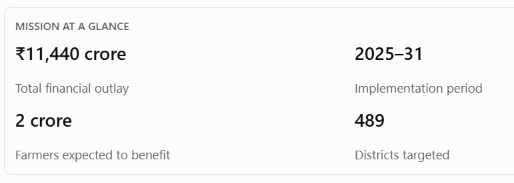
The Mission for Aatmanirbharta in Pulses is a Central Government initiative launched on 11 October 2025 to strengthen India’s domestic pulses production.
Its major objectives are:
- Achieve self-sufficiency in pulses by 2030–31.
- Reduce India’s dependence on imported pulses.
- Increase agricultural productivity through improved seeds and modern farming practices.
- Ensure better prices and market access for farmers.
- Promote climate-resilient and pest-resistant pulse varieties.
- Strengthen processing, storage and marketing infrastructure.
2. Production Targets for 2030–31
The Mission has established measurable targets to increase pulses production, productivity and cultivation area.
| Indicator | Target by 2030–31 |
|---|---|
| Total pulses production | 350 lakh tonnes |
| Productivity | 1,130 kg/hectare |
| Cultivation area | 310 lakh hectares |
| Additional area under cultivation | 35 lakh hectares |
The Mission gives special attention to three important pulses:
- Tur (Pigeon Pea/Arhar): A major pulse used in Indian households.
- Urad (Black Gram): Used in various food preparations, including idli and dosa.
- Masur (Lentil): An important protein-rich pulse grown mainly during the Rabi season.
The Government will promote high-yielding, pest-resistant and climate-resilient seed varieties to improve productivity.
3. Seed Distribution and Support
Certified seeds are seeds that meet prescribed standards of genetic purity, physical purity and germination after undergoing an official certification process.
The Mission aims to improve farmers’ access to quality seeds through:
- Distribution of 87.5 lakh free seed kits over six years.
- Supply of 126 lakh quintals of certified seeds.
- Promotion of improved varieties suited to different climatic conditions.
- Digital monitoring of seed production, certification and distribution.
The Seed Authentication, Traceability and Holistic Inventory (SATHI) Portal will help track seeds throughout the supply chain.
4. Assured Procurement at Minimum Support Price
Minimum Support Price (MSP) is the price announced by the Government to protect farmers against a sharp fall in market prices.
Under the Mission, the Government provides an assured procurement mechanism for Tur, Urad and Masur.
- National Agricultural Cooperative Marketing Federation of India (NAFED) and National Cooperative Consumers’ Federation of India (NCCF) are responsible for procurement.
- The agencies will undertake 100% procurement of produce offered by registered and willing farmers in participating States, subject to the scheme’s conditions.
- Procurement will take place at MSP under the Pradhan Mantri Annadata Aay Sanrakshan Abhiyan (PM-AASHA).
- The arrangement covers four years, from 2025–26 to 2028–29.
This mechanism aims to reduce market uncertainty and encourage farmers to cultivate more pulses.
5. Cluster-Based Agricultural Development
A cluster-based approach involves concentrating agricultural support and resources in selected geographical areas with similar farming conditions.
The Mission covers 489 districts and promotes region-specific agricultural interventions.
Important strategies include:
- Rice-fallow cultivation: Growing pulses on agricultural land left uncultivated after rice harvesting.
- Intercropping: Growing two or more crops simultaneously on the same field in a planned arrangement.
- Crop diversification: Shifting from dependence on a limited number of crops towards a wider variety of crops.
These practices can improve land utilisation, reduce agricultural risks and support soil health.
6. Strengthening Processing Infrastructure
Value addition refers to increasing the economic value of agricultural products through activities such as cleaning, grading, processing and packaging.
The Mission aims to establish 1,000 processing and packaging units.
- Financial assistance of up to ₹25 lakh per unit will be provided.
- The units will strengthen local processing infrastructure.
- They are expected to create employment opportunities in rural areas.
- Better processing and packaging can improve market access and farmers’ returns.
Additionally, under the Creation and Expansion of Food Processing and Preservation Capacities (CEFPPC) component of the Pradhan Mantri Kisan SAMPADA Yojana (PMKSY):
- 23 pulse-processing units have been approved.
- 18 units have been completed, according to the supplied update.
7. Digital Monitoring and Seed Traceability
The Mission uses digital technologies to improve transparency, monitoring and agricultural planning.
| Digital initiative | Major function |
|---|---|
| Krishi Mapper | Geo-fencing, land geo-tagging and monitoring crop demonstrations |
| SATHI Portal | Seed authentication, certification and supply-chain traceability |
| AgriStack | Digital agricultural infrastructure and farmer-related databases |
| Digital Crop Survey | Plot-level crop information and agricultural monitoring |
| E-Samriddhi | Farmer registration, procurement support and direct payments |
| Vistaar | Digital agricultural advisory and information support |
Geo-tagging means attaching geographical location information to a field, asset or activity.
Geo-fencing refers to creating a virtual geographical boundary using location-based technology.
The Mission also uses a three-tier monitoring mechanism at the national, State and district levels.
Implementation support is provided through the Indian Council of Agricultural Research (ICAR), Krishi Vigyan Kendras (KVKs) and State agricultural departments.
India’s Pulses Sector: Key Trends
India’s pulses sector has shown improvements in production, cultivation area and productivity.
Pulses Production in India
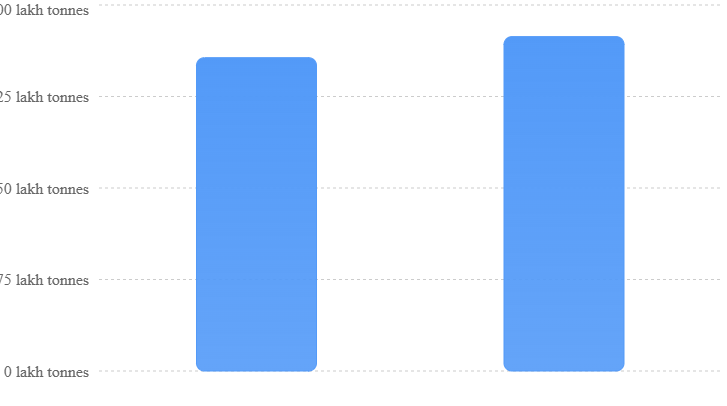
Figures supplied for 2025–26 are labelled as Third Advance Estimates and should be verified against the official release.
Production figures from the supplied material, subject to official verification.
| Indicator | 2024–25 | 2025–26 |
|---|---|---|
| Production | 256.83 lakh tonnes | 274.09 lakh tonnes |
| Cultivation area | 277.20 lakh hectares | 286.46 lakh hectares |
| Productivity | 926 kg/ha | 957 kg/ha |
According to the supplied data:
- Pulses import value declined by 31.52% in 2025–26.
- Pulses export value increased by 13.40% during the same period.
These trade figures describe changes in value, not necessarily changes in the physical quantity of pulses traded.
Major pulse-growing States include Madhya Pradesh, Maharashtra, Rajasthan, Uttar Pradesh, Gujarat, Andhra Pradesh, Karnataka, Jharkhand, Odisha and West Bengal.
Important export destinations mentioned in the source include China, United Arab Emirates (UAE), Bangladesh, United States of America (USA) and Sri Lanka.
Prelims Focus
1. Pulses and Soil Fertility
- Pulses belong to the legume family (Fabaceae).
- Many leguminous plants form a symbiotic relationship with Rhizobium bacteria in root nodules.
- These bacteria help convert atmospheric nitrogen into forms that plants can utilise.
- This process is called biological nitrogen fixation.
- Pulses can therefore contribute to soil fertility and sustainable agriculture.
2. Kharif and Rabi Pulses
| Kharif pulses | Rabi pulses |
|---|---|
| Tur (Arhar) | Gram (Chickpea) |
| Urad (Black Gram) | Masur (Lentil) |
| Moong (Green Gram) | Field Pea |
Some pulses, including Moong and Urad, can be cultivated in more than one season depending on regional conditions.
3. Minimum Support Price and Procurement
- The Government announces MSPs for 22 mandated agricultural crops.
- These include five pulses: Gram, Tur, Moong, Urad and Masur.
- MSP recommendations are made by the Commission for Agricultural Costs and Prices (CACP).
- The final MSP decisions are taken by the Cabinet Committee on Economic Affairs (CCEA).
- Announcement of MSP does not automatically guarantee unrestricted Government procurement of every crop.
4. PM-AASHA
Pradhan Mantri Annadata Aay Sanrakshan Abhiyan (PM-AASHA) is an umbrella scheme intended to provide remunerative prices to farmers.
Important components include:
- Price Support Scheme (PSS)
- Price Deficiency Payment Scheme (PDPS)
- Market Intervention Scheme (MIS)
- Price Stabilisation Fund (PSF)
5. Important Institutions
| Institution | Important fact |
|---|---|
| ICAR | Apex organisation for coordinating agricultural research and education in India |
| NAFED | Established in 1958; a national-level cooperative marketing organisation |
| NCCF | Established in 1965; a national-level consumer cooperative federation |
| CACP | Recommends MSPs for mandated crops |
Conclusion / Way Forward
Achieving pulses self-sufficiency requires climate-resilient farming, improved productivity, assured procurement and stronger market linkages to ensure nutritional security and sustainable farmers’ incomes.
Prelims Check
Question 1
Quick Check
Consider the following statement: The Commission for Agricultural Costs and Prices (CACP) makes the final decision on Minimum Support Prices in India.(a) True(b) False
“Every great achievement begins with the decision to learn something new today.”