
Context of the News
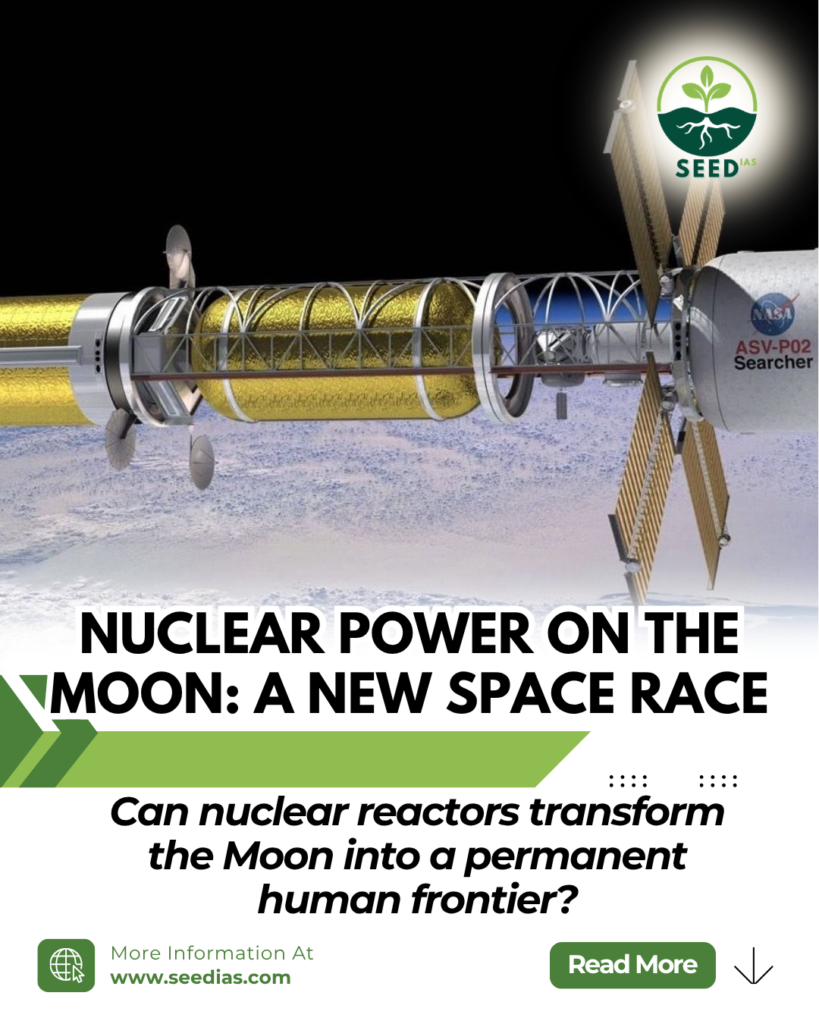
NASA and the U.S. Department of Energy (DOE) are advancing plans to develop a Fission Surface Power (FSP) system for the Moon, with a lunar reactor targeted for 2030 under the Artemis programme.
At the same time, China and Russia are developing the International Lunar Research Station (ILRS), with the first phase of the lunar station planned around 2035.
This marks a shift from short-duration lunar missions towards continuous lunar infrastructure.
It also raises important questions about nuclear safety, lunar resources, environmental protection, strategic competition and international space law.
Background
The Moon has no atmosphere and experiences extremely harsh environmental conditions.
A lunar day-night cycle lasts about 29.5 Earth days, with roughly 14 Earth days of daylight and 14 Earth days of darkness.
This creates a major challenge for solar-powered lunar bases.
A permanent human presence would require an energy source that can operate:
- During the long lunar night.
- In regions where sunlight is unavailable.
- In permanently shadowed regions (PSRs).
- For life-support systems.
- For mining and resource-processing equipment.
- For future lunar fuel production.
Nuclear technology can provide continuous power independent of sunlight.
NASA describes fission surface power as a potential source of continuous electricity for sustained operations on the Moon and Mars.
News Breakdown
What is Fission Surface Power?
Fission Surface Power (FSP) refers to a compact nuclear reactor designed to generate electricity on the surface of another celestial body.
In nuclear fission, energy is released when the nucleus of a heavy atom splits into smaller nuclei.
This heat is then converted into usable electrical power.
NASA and DOE are working together to develop a lunar surface reactor that can provide continuous electrical power for years.
Key features of the proposed system
- NASA and DOE signed a Memorandum of Understanding (MoU) in January 2026 to strengthen cooperation on lunar fission power.
- The planned system is intended for deployment on the Moon by 2030.
- NASA’s government reference design envisages a 40-kilowatt electric (kWe) class system.
- The reference design has a mass goal below 6,000 kg.
- The design uses High-Assay Low-Enriched Uranium (HALEU) fuel.
- The system is intended to operate for about 10 years.
- Its applications include habitats, rovers, scientific equipment and resource-utilisation systems.
What is HALEU?
High-Assay Low-Enriched Uranium (HALEU) is uranium enriched to a higher concentration of uranium-235 than conventional low-enriched uranium, while remaining below the threshold used for highly enriched uranium.
HALEU can allow some advanced reactors to achieve greater energy density and compactness.
Why Does the Moon Need Nuclear Power?
Solar energy is attractive on the Moon, but it has an important limitation: the lunar night.
A lunar base cannot depend entirely on solar panels if it has to operate continuously.
1. Surviving the Lunar Night
The Moon rotates slowly relative to the Sun.
One complete lunar day-night cycle is approximately 29.5 Earth days.
Therefore, a lunar base can experience about 14 days of darkness.
During this period, solar panels cannot generate electricity.
Large batteries could store solar electricity, but providing enough storage for a permanent industrial-scale base would be technically challenging.
A fission reactor can instead provide continuous baseload power.
Baseload power means electricity supplied continuously to meet the minimum or fundamental demand of a system.
2. Exploring Permanently Shadowed Regions
Permanently Shadowed Regions (PSRs) are areas near the lunar poles that receive little or no direct sunlight.
Some of these regions contain water ice.
Water is strategically important because it can potentially provide:
- Drinking water after processing.
- Oxygen for life support.
- Hydrogen and oxygen for rocket propellants.
- Resources for future lunar industrial activity.
The challenge is that these areas are extremely dark and cold.
Therefore, a reliable power source independent of sunlight becomes particularly valuable.
3. Supporting In-Situ Resource Utilisation
In-Situ Resource Utilisation (ISRU) means using resources available at the mission location rather than transporting everything from Earth.
On the Moon, ISRU could involve extracting water ice, producing oxygen and manufacturing useful materials.
For example:
Lunar water ice → Water → Electrolysis → Hydrogen + Oxygen → Potential rocket propellant
Such activities require substantially more power than conventional scientific instruments.
Therefore, nuclear power could support the transition from exploration to lunar industry.
Fission Reactor vs RTG
A major UPSC-relevant distinction is between a fission reactor and a Radioisotope Thermoelectric Generator (RTG).
| Feature | Fission Reactor | RTG |
| Basic principle | Controlled nuclear fission | Radioactive decay |
| Chain reaction | Yes | No |
| Typical role | Higher-power systems | Long-duration, lower-power missions |
| Electricity generation | Heat from fission is converted into electricity | Heat from radioactive decay is converted into electricity |
| Suitable for | Lunar bases and industrial operations | Space probes and scientific instruments |
A Radioisotope Thermoelectric Generator (RTG) produces electricity from the heat released by the natural radioactive decay of an isotope, commonly Plutonium-238.
It does not require a controlled nuclear chain reaction.
NASA notes that the SNAP-27 RTG used on Apollo lunar missions produced about 70 watts of electrical power at the beginning of its mission.
An Important Historical Distinction
The United States has previously operated a nuclear fission reactor in space.
SNAP-10A, launched in April 1965, was the first U.S. nuclear fission reactor to operate in space.
It generated about 500 watts and operated for approximately 43 days before an electrical system failure ended the mission.
However, SNAP-27 on Apollo 12 was not a fission reactor.
It was an RTG.
This distinction is important for UPSC Prelims.
Why the Lunar South Pole Matters
The lunar south pole has emerged as a major area of strategic and scientific interest.
Its importance comes from the combination of:
- Water-ice deposits
- Areas receiving prolonged sunlight
- Permanently shadowed craters
- Potentially useful terrain for future bases
- Strategic value for communication and transportation
This makes the south pole a likely centre of future lunar activity.
As more countries seek access to the same limited favourable locations, infrastructure itself could become a source of strategic influence.
The Geopolitics of Lunar Nuclear Power
The Moon is legally not owned by any country.
However, future lunar operations could create a difficult distinction between legal sovereignty and practical control.
Outer Space Treaty and Lunar Activities
The 1967 Outer Space Treaty (OST) is the foundation of international space law.
Its important provisions include:
- Outer space and celestial bodies are free for exploration and use by all States.
- The Moon and other celestial bodies cannot be subject to national appropriation.
- States cannot establish sovereignty over lunar territory.
- Nuclear weapons and other weapons of mass destruction cannot be placed on celestial bodies.
- States must avoid harmful contamination of celestial bodies.
- States must conduct activities with due regard for the interests of other States.
The key legal issue
A country cannot legally declare:
“This part of the Moon belongs to us.”
But a country could establish a major reactor, power cables, landing infrastructure and resource-processing facilities in a strategically important area.
This creates a potential distinction between:
De jure sovereignty: Legal ownership or territorial sovereignty.
De facto control: Practical influence created through infrastructure and continuous operations.
The Outer Space Treaty prohibits national appropriation, but the growing scale of lunar infrastructure creates new questions about how non-appropriation should work in practice.
What Are Lunar Safety Zones?
A safety zone is an area around space activities where temporary measures may be used to prevent harmful interference.
The concept is particularly relevant when multiple countries or private companies operate close to one another.
However, a safety zone should not become a disguised form of territorial ownership.
The Outer Space Treaty requires States to act with due regard for the interests of other States and to undertake consultations where activities could cause potentially harmful interference.
Therefore, the central challenge is to balance:
Operational safety + Free access + Non-appropriation
China, Russia and the International Lunar Research Station
China and Russia signed an agreement in 2021 to cooperate on the International Lunar Research Station (ILRS).
The proposed station is intended to support long-term lunar scientific research and resource utilisation.
China has stated that the first phase of the ILRS is planned for the lunar south-pole region, with a basic station targeted around 2035.
The development of lunar nuclear power therefore has an important International Relations dimension.
The Moon could increasingly become an arena of cooperation as well as strategic competition.
India’s Position
India is developing technologies relevant to long-duration space exploration and future human spaceflight.
The Indian Space Research Organisation (ISRO) has identified Radioisotope Thermoelectric Generator (RTG) technology as a potential area for deep-space missions.
An ISRO research document identifies RTGs of around 100 watts based on Plutonium-238 as a technology relevant to long-duration missions.
India is also developing the Bharatiya Antariksh Station (BAS) as part of its long-term human-spaceflight programme.
The larger strategic significance is clear:
Reliable space power → Longer missions → More autonomous spacecraft → Greater deep-space capability
For India, developing indigenous space nuclear technologies can strengthen strategic autonomy and reduce dependence on foreign technologies.
Major Challenges of Nuclear Reactors on the Moon
Nuclear power can solve the energy problem, but it creates new technical and governance challenges.
1. Radiation Protection
Astronauts and sensitive equipment must be protected from radiation.
This may require shielding, increasing the overall mass and complexity of the system.
2. Heat Dissipation
The Moon has essentially no atmosphere.
Therefore, conventional atmospheric convection cannot remove waste heat.
The reactor must primarily reject heat through radiation, requiring appropriately designed radiator systems.
3. Power Transmission
A reactor may need to be positioned away from human habitats.
This could require:
- Robotic deployment.
- Power cables.
- Electrical distribution systems.
- Autonomous maintenance systems.
4. Autonomous Operation
A lunar reactor may have to function for years with limited human intervention.
It must withstand:
- Launch vibrations.
- Lunar temperature extremes.
- Radiation.
- Dust.
- Equipment failures.
- Limited maintenance opportunities.
5. Launch Safety
Space nuclear systems must be designed to minimise risks during launch.
One important principle is to prevent an accidental launch failure from releasing radioactive material.
The 1992 UN nuclear-power-source principles emphasise safety assessment and risk reduction for nuclear power sources used in space.
6. Lunar Environmental Contamination
A reactor accident could potentially contaminate scientifically valuable lunar regions.
This is especially significant for areas containing water ice.
Therefore, reactor placement, containment and emergency procedures require international safety standards.
Are Existing International Rules Enough?
The international framework already contains important principles, but technological development is moving rapidly.
The 1992 UN Principles Relevant to the Use of Nuclear Power Sources in Outer Space, adopted through UN General Assembly Resolution 47/68, provide principles for the safe use of nuclear power sources.
However, the framework was developed when space nuclear applications were considerably less ambitious.
The 1992 principles focus on nuclear power sources used for non-propulsive electrical power and themselves recognise the need for future revision as nuclear applications evolve.
This becomes important as humanity moves towards:
Space nuclear power → Lunar reactors → Lunar industries → Nuclear propulsion
What Should Be Done?
1. Strengthen UN-COPUOS Frameworks
The United Nations Committee on the Peaceful Uses of Outer Space (UN-COPUOS) should promote internationally accepted standards for lunar nuclear installations.
2. Develop Common Safety Standards
Countries should agree on:
- Reactor design safety.
- Launch safety.
- Radiation protection.
- Emergency response.
- Environmental monitoring.
- Decommissioning.
- Radioactive waste management.
3. Prevent Safety Zones from Becoming Territorial Claims
Safety zones should remain:
Temporary + Purpose-specific + Non-exclusive
They should not become a mechanism for controlling strategic lunar territory.
4. Improve International Transparency
Countries operating nuclear systems on the Moon should share appropriate information about:
- Reactor location.
- Safety assessments.
- Operational risks.
- Emergency procedures.
- End-of-life plans.
5. Strengthen India’s Space-Nuclear Capability
India should strengthen cooperation among ISRO, the Department of Atomic Energy (DAE), academia and industry to develop indigenous space nuclear technologies.
This would improve India’s:
Technological capability + Strategic autonomy + Negotiating position
Prelims Focus
1. Fission Surface Power
- NASA and DOE are developing Fission Surface Power for sustained lunar and Martian operations.
- NASA’s current reference work describes a 40-kWe class system.
- The government reference design identifies HALEU as fuel and has a mass goal below 6,000 kg.
2. SNAP-10A
- SNAP-10A was launched in April 1965.
- It was a space fission reactor.
- It produced approximately 500 watts and operated for 43 days.
3. SNAP-27
- SNAP-27 was an RTG, not a fission reactor.
- It powered the Apollo Lunar Surface Experiments Package (ALSEP).
- It used Plutonium-238.
- It produced approximately 70 watts electrical power at the beginning of its mission.
4. Outer Space Treaty
The 1967 Outer Space Treaty establishes that:
- Outer space is free for exploration and use by all States.
- Celestial bodies cannot be subject to national appropriation.
- States must avoid harmful contamination.
- States must give due regard to the interests of other States.
5. Nuclear Power Sources Principles
The 1992 UN Principles Relevant to the Use of Nuclear Power Sources in Outer Space were adopted through UN General Assembly Resolution 47/68.
They emphasise safety assessment and risk reduction in the use of nuclear power sources in space.
Conclusion / Way Forward
Lunar nuclear power can enable sustainable exploration, but its deployment must remain guided by safety, non-appropriation, environmental protection and multilateral space governance.
Prelims Check
Question 1
With reference to nuclear power systems used in space, consider the following statements:
- An RTG generates electricity through a controlled nuclear fission chain reaction.
- SNAP-10A was a nuclear fission reactor tested in space.
- SNAP-27 used radioactive decay as its source of heat for electricity generation.
Which of the statements given above is/are correct?
(a) 1 and 2 only
(b) 2 and 3 only
(c) 1 and 3 only
(d) 1, 2 and 3
Question 2
With reference to the Outer Space Treaty, consider the following statements:
- Celestial bodies cannot be appropriated by a State through sovereignty, use or occupation.
- The Treaty prohibits all use of nuclear technology on celestial bodies.
- States are required to conduct space activities with due regard to the interests of other States.
Which of the statements given above is/are correct?
(a) 1 and 2 only
(b) 1 and 3 only
(c) 2 and 3 only
(d) 1, 2 and 3
Question 3
Consider the following pairs:
| Technology/Concept | Characteristic |
| 1. Fission Surface Power | Controlled nuclear fission for continuous electrical power |
| 2. Radioisotope Thermoelectric Generator | Electricity from heat produced by radioactive decay |
| 3. Permanently Shadowed Region | Lunar region receiving continuous direct sunlight |
| 4. In-Situ Resource Utilisation | Use of locally available extraterrestrial resources |
How many of the above pairs are correctly matched?
(a) Only one
(b) Only two
(c) Only three
(d) All four
Answers and Explanations
Question 1 — Answer: (b) 2 and 3 only
- Statement 1 is incorrect: An RTG does not use a controlled nuclear chain reaction. It converts heat from radioactive decay into electricity.
- Statement 2 is correct: SNAP-10A was a nuclear fission reactor launched into space in 1965.
- Statement 3 is correct: SNAP-27 used radioactive Plutonium-238 decay as its heat source.
Question 2 — Answer: (b) 1 and 3 only
- Statement 1 is correct: Article II of the Outer Space Treaty prohibits national appropriation of celestial bodies.
- Statement 2 is incorrect: The Treaty prohibits nuclear weapons and other weapons of mass destruction on celestial bodies; it does not prohibit peaceful nuclear power systems.
- Statement 3 is correct: Article IX requires States to act with due regard for the corresponding interests of other States.
Question 3 — Answer: (c) Only three
- Pair 1 is correctly matched: Fission Surface Power uses nuclear fission to generate continuous electrical power.
- Pair 2 is correctly matched: RTGs use heat from radioactive decay to generate electricity.
- Pair 3 is incorrect: Permanently Shadowed Regions receive little or no direct sunlight, rather than continuous sunlight.
- Pair 4 is correctly matched: ISRU means using resources available at the mission location.
UPSC Takeaway
The future of lunar exploration will depend not only on technology, but also on how effectively nations balance scientific progress, strategic interests, environmental protection and international law.
“The future belongs to those who turn knowledge into responsible action.”