Context of the News
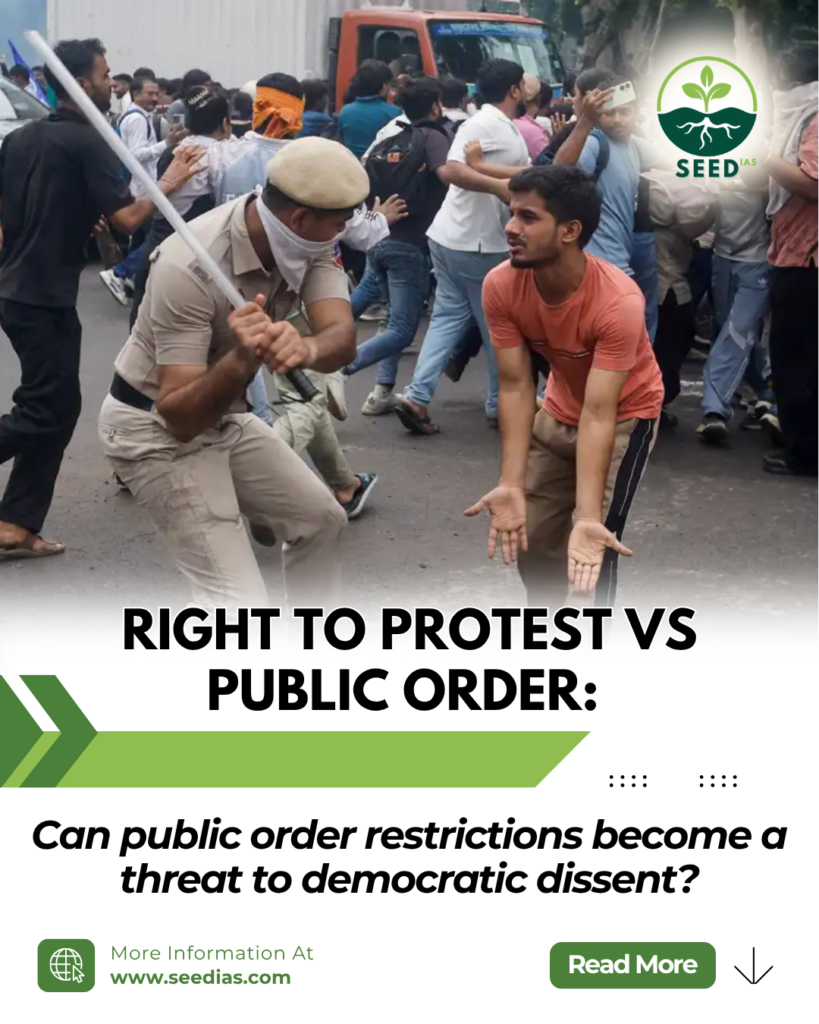
Recent protests in New Delhi, including demonstrations against the Chief Election Commissioner (CEC), led to the detention of young people, journalists and activists. The Delhi Police invoked provisions of the Bharatiya Nagarik Suraksha Sanhita (BNSS), 2023, to regulate assemblies and prevent potential disturbances.
The issue brought renewed attention to the balance between public order, the Right to Protest and personal liberty. Concerns over mass detentions also raised questions about the legality and proportionality of police action.
The Supreme Court’s scrutiny of prohibitory orders and preventive police action has highlighted the need to protect peaceful dissent while preventing genuine threats to public safety.
Background: Why Is the Right to Protest Important?
India is a constitutional democracy in which citizens have the right to express their views and assemble peacefully. These freedoms allow people to question government decisions, demand accountability and participate in public affairs.
However, fundamental rights are not absolute. The State can impose reasonable restrictions when necessary to protect public order and other legitimate interests.
The central constitutional question is: When does a restriction on protest become an arbitrary interference with fundamental rights?
News Breakdown
1. What Is Public Order?
Public order refers to the maintenance of peace and tranquillity within society, particularly when disturbances affect the community at large.
In Ram Manohar Lohia v. State of Bihar (1966), the Supreme Court explained the relationship between law and order, public order and security of the State through the concept of three concentric circles.
| Concept | Meaning | Example |
| Law and order | Covers violations affecting individuals or particular situations | Theft or a minor scuffle |
| Public order | Covers disturbances affecting the normal life of a community | Violent riots or serious communal clashes |
| Security of the State | Covers threats to the existence or security of the nation | Armed rebellion or waging war against India |
Key takeaway: Every law-and-order problem does not amount to a threat to public order. Authorities must establish the nature and seriousness of the disturbance before invoking extraordinary preventive powers.
Constitutional Distribution of Public Order Powers
The Seventh Schedule of the Constitution distributes legislative powers between the Union and the States.
- State List, Entry 1: Public order falls primarily within the legislative jurisdiction of the States.
- State List, Entry 2: Police falls within the State List, subject to constitutional exceptions.
- Concurrent List, Entry 1: Criminal law is included in the Concurrent List, subject to the constitutional provisions governing its scope.
- Concurrent List, Entry 2: Criminal procedure is included in the Concurrent List. The BNSS, 2023, is the principal procedural legislation governing criminal procedure.
Special Position of Delhi
Under Article 239AA, introduced through the 69th Constitutional Amendment Act, 1991, Delhi has an elected Legislative Assembly but does not exercise legislative power over public order, police and land.
These subjects remain under the control of the Union Government, with the Ministry of Home Affairs playing a key role.
2. Section 163 of the BNSS, 2023
Section 163 of the BNSS empowers an Executive Magistrate to issue written directions to prevent immediate danger, public disturbances and other situations covered by the law.
It replaces the earlier Section 144 of the Code of Criminal Procedure (CrPC), 1973.
When Can Section 163 Be Invoked?
The provision may be used when urgent preventive action is necessary to address a threat to human life, public safety or public tranquillity.
An order may direct individuals to abstain from certain acts or regulate the use of property in circumstances covered by the provision.
Key features include:
- Written order: The Magistrate must issue an order stating the material facts and the legal basis for the restriction.
- Urgency: The provision is intended for situations requiring immediate preventive action.
- Assembly restrictions: Orders may restrict gatherings, including assemblies of five or more people, where the circumstances and terms of the order justify such restrictions.
- Ordinary duration: An order ordinarily remains in force for a maximum of two months.
- Extension: The State Government may extend its operation for a further period not exceeding six months from the date the order would otherwise expire, where the statutory conditions are met.
Does Every Gathering of Five or More People Become Illegal?
No. Section 163 does not automatically make every gathering of five or more people unlawful.
The distinction is important because the Bharatiya Nyaya Sanhita (BNS), 2023, separately defines an unlawful assembly under Section 189.
An assembly of five or more persons becomes an unlawful assembly when the statutory requirements, including an unlawful common object, are satisfied. A valid prohibitory order may also impose specific restrictions on gatherings in a particular area.
Therefore, the number of people alone does not establish that an assembly is unlawful in every situation.
Concerns About the Use of Section 163
Prohibitory powers can help prevent violence, but their routine use may weaken democratic freedoms.
- Overuse: Repeated restrictions may prevent peaceful demonstrations even when less restrictive measures are available.
- Lack of proportionality: A blanket prohibition may affect peaceful protesters along with individuals who pose a genuine threat.
- Administrative convenience: Emergency powers should not become routine tools for managing ordinary public activities.
- Accountability: Authorities must be able to explain why restrictions were necessary and why alternative measures were insufficient.
A reported analysis of Delhi’s prohibitory orders cited in the source material found that only 1.5% were used to prevent unlawful assemblies, with many others serving routine administrative purposes. This figure should be treated as a reported finding rather than a verified nationwide statistic.
3. What Is Detention?
Detention means the State’s restriction of a person’s liberty under legal authority. Its legal basis, purpose and safeguards depend on the type of custody involved.
Detention, arrest and imprisonment are not interchangeable terms.
Types of Detention
Preventive detention: Custody intended to prevent a person from engaging in specified activities considered prejudicial to public order, national security or other legally recognised interests. It may occur without a prior criminal conviction.
Punitive detention: Deprivation of liberty as punishment following a criminal conviction and sentence. The term is more commonly described as imprisonment.
Preventive arrest: Police action intended to prevent a cognizable offence where the statutory requirements for such action are met. It is distinct from preventive detention under a special detention law.
Preventive Police Powers Under the BNSS
Section 170 of the BNSS, 2023, authorises a police officer to arrest a person without a warrant or an order from a Magistrate when the officer knows of a design to commit a cognizable offence and believes that the offence cannot otherwise be prevented.
The provision imposes a time limit: a person arrested under Section 170 cannot be detained in custody for more than 24 hours under that section unless further detention is authorised by another legal provision.
Section 172 of the BNSS, 2023, requires people to comply with lawful directions given by police officers in the discharge of their duties. It also empowers police, in the circumstances specified by the provision, to detain or remove a person who resists, refuses or disregards such directions.
Where the person is detained under Section 172, the law provides for production before a Magistrate or release within the prescribed period, depending on the circumstances. Section 172 should not be treated as an unrestricted power to detain peaceful protesters.
Important Distinction
A short preventive arrest under Section 170 of the BNSS is not the same as preventive detention under a special statute such as the National Security Act, 1980.
The legal grounds, duration and procedural safeguards differ.
4. Detention vs Arrest: Key Differences
| Feature | Preventive detention | Ordinary criminal arrest |
| Primary purpose | Prevent specified future threats | Investigate an alleged offence and secure the accused as permitted by law |
| Legal basis | Applicable preventive detention law | Criminal procedure, including the BNSS |
| Prior conviction | Not required | Not required |
| Grounds | Statutory preventive grounds | Suspected involvement in a criminal offence and applicable arrest conditions |
| Safeguards | Special constitutional and statutory safeguards | Arrest safeguards, including applicable rights under Article 22 |
| Judicial oversight | Depends on the applicable law and constitutional safeguards | Includes production before a Magistrate within 24 hours, subject to constitutional exceptions |
Important clarification: Preventive detention is not exempt from constitutional safeguards. Article 22(3) excludes certain protections in Article 22(1) and Article 22(2) for preventive detention, but Article 22(4)–(7) provides a separate framework of safeguards. The precise rights depend on the type of detention.
Under Article 22(2), a person arrested and detained in custody must ordinarily be produced before the nearest Magistrate within 24 hours, excluding the time necessary for the journey. Further detention requires the authority of a Magistrate.
Section 35 of the BNSS and Arrest Safeguards
Section 35 of the BNSS governs police powers of arrest without a warrant in specified circumstances.
For offences punishable with imprisonment of up to seven years, the provision requires the police to assess the statutory conditions for arrest and record reasons where an arrest is necessary. Where arrest is not required, the law provides for a notice directing the person to appear before the police.
This framework seeks to prevent unnecessary arrests and protect personal liberty.
5. Constitutional Safeguards Against Arbitrary Detention
The Constitution protects individual liberty while permitting limited restrictions under law.
Article 14: Equality Before Law
Article 14 prohibits arbitrary State action and guarantees equality before the law and equal protection of the laws.
Relevance: Authorities cannot selectively impose restrictions without a lawful and rational basis.
Article 19: Freedom of Speech and Peaceful Assembly
Article 19(1)(a) protects freedom of speech and expression. Article 19(1)(b) protects the right to assemble peaceably and without arms.
These rights are subject to constitutionally permitted reasonable restrictions.
- Article 19(2): Allows specified reasonable restrictions on freedom of speech and expression.
- Article 19(3): Allows reasonable restrictions on peaceful assembly in the interests of the sovereignty and integrity of India and public order.
Relevance: Peaceful protest is constitutionally protected, but the manner and location of demonstrations may be regulated within constitutional limits.
Article 21: Protection of Life and Personal Liberty
Article 21 states that no person shall be deprived of life or personal liberty except according to procedure established by law.
The procedure must satisfy constitutional standards of fairness and non-arbitrariness.
Relevance: Detention without adequate legal grounds or compliance with mandatory safeguards may violate personal liberty.
Article 22: Protection Against Arrest and Detention
Article 22 establishes safeguards for arrested persons and a separate framework for preventive detention.
Its provisions address matters such as communication of grounds of arrest, access to legal counsel, production before a Magistrate and safeguards governing preventive detention.
Relevance: Preventive powers are constitutionally recognised, but they are not unlimited executive powers.
6. Landmark Supreme Court Judgments
The Supreme Court has developed important principles governing public order, preventive action and peaceful protest.
| Case | Key principle |
| A.K. Gopalan v. State of Madras (1950) | Adopted an early, narrow interpretation of personal liberty and preventive detention. |
| Babulal Parate v. State of Maharashtra (1961) | Upheld the constitutional validity of the predecessor provision to Section 163, subject to legal limits. |
| Ram Manohar Lohia v. State of Bihar (1966) | Distinguished law and order from public order and security of the State. |
| Madhu Limaye v. Sub-Divisional Magistrate, Monghyr (1970) | Emphasised the exceptional nature and urgency required for prohibitory orders. |
| Maneka Gandhi v. Union of India (1978) | Established that procedures affecting personal liberty must be just, fair and reasonable, strengthening the interaction between Articles 14, 19 and 21. |
| Re: Ramlila Maidan Incident (2012) | Examined State action against a gathering and stressed the need for lawful, proportionate crowd control. |
| Mazdoor Kisan Shakti Sangathan v. Union of India (2018) | Addressed the balance between protest rights, public order and the rights of other residents in public spaces. |
| Anuradha Bhasin v. Union of India (2020) | Emphasised proportionality, publication and judicial review of restrictive orders in the context of restrictions on internet services. |
| Amit Sahni v. Commissioner of Police (2020) | Held that public roads cannot be occupied indefinitely in a way that obstructs the rights of others. |
| Rekha v. State of Tamil Nadu (2011) | Warned against using preventive detention as a substitute for ordinary criminal law when ordinary legal processes are sufficient. |
| Pramod Singla v. Union of India (2023) | Reiterated the exceptional nature of preventive detention and the importance of strict compliance with procedural safeguards. |
The Doctrine of Proportionality
Proportionality means that a State restriction must not go further than necessary to achieve a legitimate objective.
A useful way to assess a restriction is to ask:
- Legitimate aim: Is the restriction intended to address a lawful public interest?
- Rational connection: Is the measure reasonably connected to that objective?
- Necessity: Is there a less restrictive measure that could achieve the same objective?
- Balancing: Do the public benefits justify the harm caused to individual rights?
This framework helps distinguish necessary preventive action from disproportionate restrictions on peaceful dissent.
7. What Limits Apply to the Right to Protest?
The Right to Protest is an essential feature of democracy, but it does not create an unrestricted right to occupy every public space or obstruct public life indefinitely.
In Amit Sahni v. Commissioner of Police (2020), concerning the Shaheen Bagh protest, the Supreme Court emphasised that public ways and spaces cannot be occupied indefinitely in a manner that seriously interferes with the rights of other citizens.
Similarly, Mazdoor Kisan Shakti Sangathan (2018) highlighted the need to balance demonstrations with public order and the interests of residents.
A constitutionally sound approach should therefore:
- Protect peaceful assembly and political expression.
- Address specific and credible threats rather than rely on speculation.
- Distinguish peaceful protesters from individuals committing violence.
- Consider regulated protest sites and traffic-management measures.
- Ensure that restrictions are reasoned, proportionate and open to legal scrutiny.
8. Gandhi’s Approach to Civil Disobedience
Mahatma Gandhi’s 1922 sedition trial remains an important episode in the history of political dissent in India.
Gandhi defended the principle that citizens should be able to express disagreement with authority without resorting to violence.
His approach to non-violent civil disobedience emphasised peaceful resistance, personal responsibility and willingness to accept the legal consequences of one’s actions.
After Independence, constitutional protections for freedom of expression and peaceful assembly provided a legal framework for democratic dissent.
The important distinction is that peaceful criticism of government is not, by itself, equivalent to a threat to public order. Any restriction must be justified under the applicable law.
9. How Can India Protect Protest Rights While Maintaining Public Order?
Adopt Proportionate Restrictions
Authorities should impose restrictions only when supported by the facts and the law. Blanket prohibitions should not replace an assessment of the specific situation.
Facilitate Peaceful Assemblies
Police should help peaceful demonstrations take place safely through communication, traffic planning and appropriate crowd-management arrangements.
Apply the Principle of Differentiation
The principle of differentiation means distinguishing peaceful participants from individuals who engage in violence or other unlawful acts.
The conduct of a few individuals should not automatically justify indiscriminate action against an entire gathering.
Ensure Accountable Policing
Visible identification, appropriate documentation, operational body-worn cameras where feasible, and clear reporting procedures can strengthen accountability during crowd-control operations.
Strengthen Judicial Oversight
Courts should be able to examine the legality, necessity and proportionality of restrictive orders and detentions.
Follow International Human Rights Standards
The United Nations Human Rights Committee’s General Comment No. 37 explains the right of peaceful assembly under Article 21 of the International Covenant on Civil and Political Rights (ICCPR).
It emphasises that authorities should facilitate peaceful assemblies and that restrictions and the use of force must comply with applicable legal standards.
These principles support an approach based on necessity, proportionality, accountability and respect for peaceful dissent.
Prelims Focus: Important Facts
- Article 19(1)(a): Freedom of speech and expression.
- Article 19(1)(b): Right to assemble peaceably and without arms.
- Article 19(2): Permits specified reasonable restrictions on freedom of speech and expression.
- Article 19(3): Permits specified reasonable restrictions on peaceful assembly.
- Article 21: Protection of life and personal liberty.
- Article 22: Safeguards relating to arrest and preventive detention.
- Article 239AA: Special constitutional provisions governing the National Capital Territory of Delhi.
- Seventh Schedule, State List, Entry 1: Public order.
- Seventh Schedule, State List, Entry 2: Police.
- Seventh Schedule, Concurrent List, Entry 1: Criminal law.
- Seventh Schedule, Concurrent List, Entry 2: Criminal procedure.
- BNSS Section 163: Urgent orders in cases of nuisance or apprehended danger; predecessor to CrPC Section 144.
- BNSS Section 170: Preventive action by arrest to stop a cognizable offence where the statutory conditions are met.
- BNSS Section 172: Duty to conform to lawful police directions.
- BNS Section 189: Unlawful assembly.
- Article 22(2): Ordinarily requires production of an arrested person before a Magistrate within 24 hours, excluding necessary journey time.
- Article 22(4)–(7): Constitutional provisions governing preventive detention safeguards.
- International Covenant on Civil and Political Rights, Article 21: Right of peaceful assembly.
Conclusion / Way Forward
India must ensure that preventive powers remain lawful, necessary and proportionate while protecting peaceful protest, personal liberty and democratic accountability.
Prelims Check: Test Your Understanding
Question 1
With reference to the right to peaceful assembly in India, consider the following statements:
- Article 19(1)(b) guarantees the right to assemble peaceably and without arms.
- The right to peaceful assembly is absolute and cannot be restricted by the State.
- Article 19(3) permits reasonable restrictions on the right to assemble in the interests of public order.
Which of the statements given above are correct?
(a) 1 and 2 only
(b) 1 and 3 only
(c) 2 and 3 only
(d) 1, 2 and 3
Question 2
Consider the following pairs:
| Legal provision | Subject |
| 1. Article 239AA | Special constitutional provisions for Delhi |
| 2. BNSS Section 163 | Urgent orders in cases of apprehended danger |
| 3. BNS Section 189 | Unlawful assembly |
| 4. Article 21 | Preventive detention safeguards exclusively |
How many of the above pairs are correctly matched?
(a) Only one
(b) Only two
(c) Only three
(d) All four
Question 3
With reference to preventive detention and constitutional safeguards in India, consider the following statements:
- Preventive detention necessarily requires a prior criminal conviction.
- Article 22 provides specific constitutional safeguards relating to preventive detention.
- Under Article 22(2), every person arrested and detained in custody must ordinarily be produced before the nearest Magistrate within 24 hours, excluding the time necessary for the journey.
Which of the statements given above are correct?
(a) 1 and 2 only
(b) 2 and 3 only
(c) 1 and 3 only
(d) 1, 2 and 3
Answers and Explanations
Question 1: Answer — (b) 1 and 3 only
- Statement 1 is correct: Article 19(1)(b) protects the right to assemble peaceably and without arms.
- Statement 2 is incorrect: The right is subject to reasonable restrictions permitted under Article 19(3), including restrictions in the interests of public order.
- Statement 3 is correct: Article 19(3) expressly permits reasonable restrictions on peaceful assembly in the interests of public order and the sovereignty and integrity of India.
Question 2: Answer — (c) Only three
- Pair 1 is correct: Article 239AA provides the constitutional framework for the National Capital Territory of Delhi.
- Pairs 2 and 3 are correct: Section 163 of the BNSS concerns urgent preventive orders, while Section 189 of the BNS defines unlawful assembly.
- Pair 4 is incorrect: Article 21 protects life and personal liberty. Preventive detention is addressed specifically through Article 22, particularly clauses (4)–(7).
Question 3: Answer — (b) 2 and 3 only
- Statement 1 is incorrect: Preventive detention is intended to prevent specified future threats and does not require a prior criminal conviction.
- Statement 2 is correct: Article 22 establishes safeguards for arrest and a separate constitutional framework for preventive detention.
- Statement 3 is correct: Article 22(2) ordinarily requires production before a Magistrate within 24 hours, excluding the time necessary for the journey. This provision is subject to the constitutional exceptions specified in Article 22(3).
Quote to Remember
“Eternal vigilance is the price of liberty.”
— Wendell Phillips