Context of the News
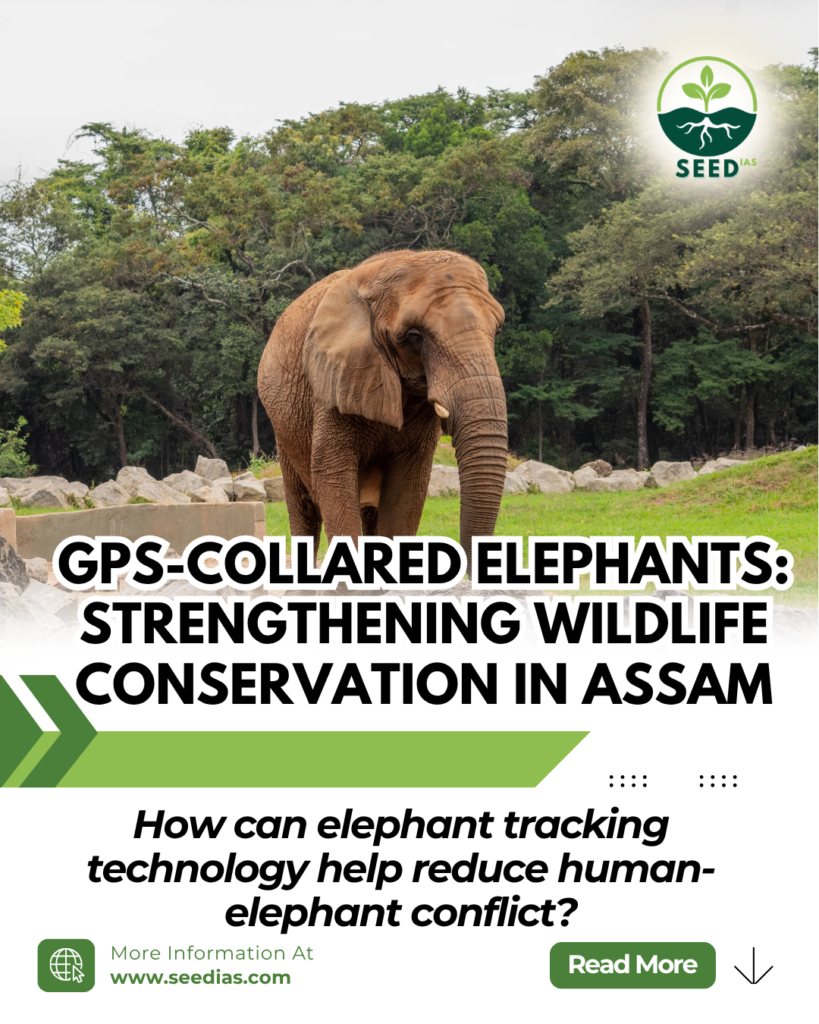
The Assam Forest Department and World Wide Fund for Nature–India (WWF-India) released a study titled Tracking the Giants: Movement and Habitat-Use Patterns of GPS-Collared Elephants in Assam during the 72nd Wildlife Week.
The study highlights the importance of understanding elephant movements and habitat use to strengthen conservation efforts amid increasing habitat fragmentation and human-elephant conflict (HEC).
Background: Understanding Elephant Conservation in India
The Asian elephant is an important component of India’s natural heritage. Its survival depends on suitable habitats, connected migration corridors and effective protection from human-related threats.
- Habitat fragmentation means the division of a large, continuous habitat into smaller, isolated patches. Roads, railways, settlements and other infrastructure can contribute to this process.
- Human-elephant conflict (HEC) refers to harmful interactions between people and elephants. These may include crop damage, property destruction, injuries and loss of human or elephant life.
- Wildlife tracking involves monitoring animal movements to understand their behaviour, habitat requirements and interactions with human settlements.
GPS-based tracking can help researchers identify movement patterns and areas frequently used by elephants. This information can support better habitat management and conflict mitigation.
News Breakdown: What the Study Means for Elephant Conservation
1. GPS Tracking and Its Conservation Value
GPS (Global Positioning System) tracking uses location data to monitor the movements of animals fitted with tracking collars.
The Assam study focuses on the movement and habitat-use patterns of GPS-collared elephants. Its subject is particularly relevant because elephants need large, connected landscapes to move between feeding, watering and resting areas.
GPS tracking can help conservation managers:
- Map elephant movement routes and identify frequently used areas.
- Understand habitat use by examining where elephants travel and spend time.
- Identify potential conflict hotspots near farms, villages, roads and railway lines.
- Improve conservation planning by identifying areas where habitat connectivity needs protection.
- Support evidence-based decisions on wildlife corridors and conflict mitigation.
These are potential applications of movement data; the supplied news brief does not specify the study’s individual findings, mapped routes or numerical results.
2. Asian Elephants: Population and Distribution in India
India is a major stronghold of the Asian elephant (Elephas maximus), accounting for more than 60% of the global wild Asian elephant population, according to the supplied material.
Key facts include:
- Global significance: India supports a major share of the world’s wild Asian elephants.
- Western Ghats: More than half of India’s elephants are reported to reside in this landscape in the supplied brief.
- State-wise distribution: Karnataka has the highest elephant population, followed by Assam and Tamil Nadu, as stated in the supplied material.
- Scientific estimation: India has introduced a DNA-based All India Elephant Estimation (SAIEE) as a shift away from traditional visual counting methods.
Why is DNA-based estimation important?
DNA-based estimation uses genetic material collected from sources such as elephant dung to help identify and estimate elephant populations. Unlike simple visual counts, genetic methods can help distinguish individuals and reduce the risk of counting the same animal more than once.
The precise methodology and the latest official population figures should be checked against the relevant government report before publication.
3. Legal Protection of the Asian Elephant
The Asian elephant receives legal protection under Indian law and international conservation frameworks.
| Legal framework | Key provision | Significance |
|---|---|---|
| Wild Life (Protection) Act, 1972 | The Indian elephant is listed in Schedule I under the original schedule framework. | Provides a high level of legal protection. |
| Convention on the Conservation of Migratory Species of Wild Animals (CMS) | The mainland Asian elephant was included in Appendix I at CMS COP13 in 2020. | Strengthens international attention to the conservation of this migratory species. |
| Convention on International Trade in Endangered Species of Wild Fauna and Flora (CITES) | The Asian elephant is listed in Appendix I. | Restricts international commercial trade in the species and its specimens, subject to the Convention’s rules. |
Important distinction for Prelims: CMS and CITES are separate international conventions. CMS focuses on the conservation of migratory species and their habitats, while CITES regulates international trade in listed wildlife species.
4. Major Conservation Initiatives in India
India has adopted several programmes to protect elephants, conserve their habitats and address threats arising from human activities.
Project Elephant
Project Elephant is a centrally supported conservation initiative launched in 1992 by the Government of India.
Its major objectives include:
- Protecting wild elephants and their natural habitats.
- Conserving elephant corridors that connect fragmented habitats.
- Addressing human-elephant conflict.
- Supporting elephant conservation planning across elephant-range states.
- Promoting the welfare of captive elephants.
The programme recognises that elephant conservation requires a landscape-level approach, rather than protection limited to isolated forest patches.
MoEFCC
Elephant Reserves
An Elephant Reserve is a designated landscape used for planning and coordinating elephant conservation. It may include multiple types of forests and protected areas.
According to the Ministry of Environment, Forest and Climate Change’s elephant reserve atlas, India had 33 notified Elephant Reserves across 14 states following the additions of Terai and Agasthyamalai in 2022–23.
MoEFCC
| Elephant Reserve | State | Important fact |
|---|---|---|
| Singhbhum Elephant Reserve | Jharkhand | Notified in 2001; identified as India’s first Elephant Reserve in the supplied material. |
| Terai Elephant Reserve | Uttar Pradesh | Notified in 2022–23 in the Dudhwa landscape. |
| Agasthyamalai Elephant Reserve | Tamil Nadu | Notified in 2022–23 in the southern Western Ghats. |
Why are elephant corridors important?
An elephant corridor is a stretch of land that allows elephants to move between otherwise separated habitats.
- Corridors provide access to food, water and seasonal habitats.
- They help maintain connectivity between elephant populations.
- They can reduce encounters with people when properly protected and managed.
- Their loss can isolate populations and increase the likelihood of conflict.
Monitoring the Illegal Killing of Elephants (MIKE)
MIKE is a programme established under the framework of CITES to monitor illegal elephant killings.
Its main purposes include:
- Collecting information on elephant carcasses and illegal killings.
- Monitoring trends in illegal killing over time.
- Helping assess the relationship between illegal killing and elephant population status.
- Supporting conservation and enforcement decisions with monitoring data.
MIKE is a monitoring programme, not a GPS-tracking system for individual elephant movements.
CITES
Gajraj: Technology for Railway Safety
Gajraj refers to an artificial intelligence (AI)-based system designed to help detect elephants near railway tracks and reduce the risk of train-elephant collisions.
Its relevance to elephant conservation lies in the use of technology to identify potential danger and support timely alerts.
GPS tracking and railway-detection systems serve different purposes: GPS collars monitor the movements of tagged elephants, whereas railway-detection systems focus on identifying elephants near railway infrastructure.
5. Ecological Importance of the Asian Elephant
The Asian elephant is a keystone species and an ecosystem engineer.
- A keystone species has an ecological impact that is disproportionately large relative to its abundance.
- An ecosystem engineer is an organism that changes the physical environment and influences the availability of habitats and resources for other species.
Elephants support ecosystem health in several ways:
- Seed dispersal: They consume fruits and transport seeds over considerable distances, helping plants regenerate.
- Vegetation management: Their feeding and movement can open dense vegetation and create structural variation in habitats.
- Water access: Their digging and other activities can expose water in some dry habitats.
- Habitat modification: Their movement and feeding create conditions that may benefit other organisms.
- Ecosystem connectivity: Their use of large landscapes highlights the importance of maintaining connected habitats.
Therefore, conserving elephants can also help maintain the ecological processes that support other plants and animals.
Prelims Focus: High-Value Facts
The following facts are useful for UPSC Prelims. Legal and programme details are supported by official government or convention sources.
Quick Revision
Wild Life (Protection) Act, 1972
The Indian elephant is listed in Schedule I of the Act’s original schedule framework. Refer to the current amended Act when checking legal provisions.
India Code
CMS COP13
The 13th Conference of the Parties was held in Gandhinagar, India, in February 2020. The mainland Asian elephant was included in Appendix I.
CMS Conservation
+1
Project Elephant
Launched in 1992, it supports elephant conservation, habitat and corridor protection, and human-elephant conflict management.
MoEFCC
Elephant Reserves
The official 2023 atlas recorded 33 Elephant Reserves across India, covering approximately 80,777 square kilometres.
MoEFCC
MIKE Programme
Monitoring the Illegal Killing of Elephants is associated with CITES and tracks trends in illegal elephant killings.
CITES
Important Prelims Distinctions
| Concept | Remember |
|---|---|
| CMS | Conservation of migratory species and their habitats. |
| CITES | International trade in listed wild animals and plants. |
| GPS collar | Tracks the location and movement of a tagged animal. |
| DNA-based estimation | Uses genetic evidence to help estimate animal populations. |
| Elephant corridor | Connects habitats and enables elephant movement. |
| Keystone species | Has a disproportionately large ecological influence. |
| Ecosystem engineer | Modifies the environment and influences habitat conditions. |
Conclusion / Way Forward
Combining scientific tracking, habitat connectivity, community participation and effective enforcement can strengthen elephant conservation while reducing human-elephant conflict.
Prelims Check: UPSC-Style Practice Questions
Try all three questions before checking the answer key at the end.
Question 1
With reference to elephant conservation in India, consider the following statements:
- Project Elephant was launched in 1992.
- The MIKE programme monitors trends in illegal elephant killings.
- Elephant corridors are intended primarily to restrict elephants to individual protected areas.
Which of the statements given above are correct?
(a) 1 and 2 only
(b) 2 and 3 only
(c) 1 and 3 only
(d) 1, 2 and 3
Question 2
Consider the following pairs:
| International convention or programme | Primary purpose |
|---|---|
| 1. CMS | Conservation of migratory species |
| 2. CITES | Regulation of international wildlife trade |
| 3. MIKE | Monitoring illegal elephant killings |
How many of the above pairs are correctly matched?
(a) Only one
(b) Only two
(c) All three
(d) None
Question 3
With reference to GPS-based elephant tracking, consider the following statements:
- GPS collars can help identify the movement patterns of tagged elephants.
- Movement data can support the identification of potential human-elephant conflict hotspots.
- GPS tracking alone can eliminate habitat fragmentation and human-elephant conflict.
Which of the statements given above are correct?
(a) 1 only
(b) 1 and 2 only
(c) 2 and 3 only
(d) 1, 2 and 3
Answer Key and Explanations
Question 1 — Correct Answer: (a) 1 and 2 only
- Statement 1 is correct: Project Elephant was launched by the Government of India in 1992 to support elephant conservation.
- Statement 2 is correct: MIKE monitors illegal elephant killings and changes in their trends.
- Statement 3 is incorrect: Corridors facilitate movement between habitats; they are not intended to confine elephants to individual protected areas.
Question 2 — Correct Answer: (c) All three
- CMS focuses on the conservation of migratory species and their habitats.
- CITES regulates international trade in listed wild animals and plants.
- MIKE is a CITES-linked monitoring programme that assesses trends in illegal elephant killings.
Question 3 — Correct Answer: (b) 1 and 2 only
- Statement 1 is correct: GPS collars record location information that helps researchers study the movements of tagged elephants.
- Statement 2 is correct: Movement patterns can help identify areas where elephants and people are more likely to encounter one another.
- Statement 3 is incorrect: Tracking provides information for conservation decisions, but resolving habitat fragmentation and conflict also requires habitat protection, connected corridors, planning and community participation.
“The future of wildlife depends on the choices we make to protect nature today.”