Context of the News
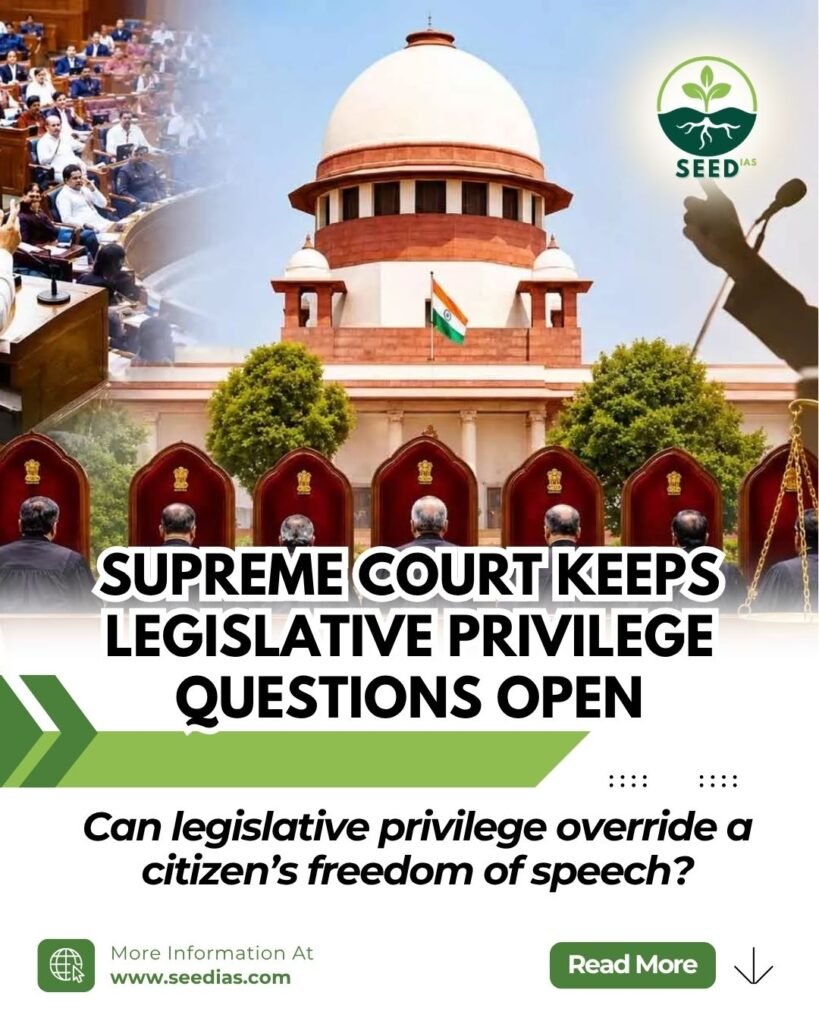
A seven-judge Constitution Bench of the Supreme Court has closed the long-pending N. Ravi and Others v. Speaker, Legislative Assembly, Chennai and Others reference as “infructuous”.
The case originated from the Tamil Nadu Legislative Assembly’s 2003 action against journalists of The Hindu. The Court had been expected to examine the relationship between legislative privileges, freedom of speech and expression, and personal liberty.
However, the Assembly had already withdrawn the 2003 resolution in 2004. Therefore, the immediate dispute no longer survived. The Court kept the larger questions of law open for consideration in an appropriate future case.
Background
How did the case begin?
In 2003, the Tamil Nadu Legislative Assembly initiated privilege proceedings against journalists following publications critical of the State government and proceedings of the Assembly.
The Assembly passed a resolution sentencing journalists to 15 days’ imprisonment for alleged breach of privilege and contempt. The journalists approached the Supreme Court, which stayed the execution of the arrest warrants.
The case subsequently raised a much larger constitutional question.
The Supreme Court noticed differing judicial approaches regarding the relationship between legislative privileges and Fundamental Rights. This led to the matter being considered for authoritative determination by a seven-judge Constitution Bench.
What does “infructuous” mean?
Infructuous means that the original dispute no longer requires adjudication because the circumstances giving rise to it have changed or the relief sought has lost practical significance.
In this case, the Tamil Nadu Assembly had withdrawn the disputed 2003 resolution in 2004. Therefore, the immediate cause of action no longer survived.
What Are Legislative Privileges?
Legislative privileges are special rights, immunities and powers available to Parliament, State Legislatures, their committees and their members.
Their purpose is to enable legislatures to function independently and effectively, without undue external interference.
Constitutional Provisions
| Provision | What it deals with |
|---|---|
| Article 105 | Powers, privileges and immunities of Parliament and its members |
| Article 194 | Powers, privileges and immunities of State Legislatures and their members |
| Article 122 | Courts cannot question parliamentary proceedings merely on grounds of procedural irregularity |
| Article 212 | Similar protection for proceedings of State Legislatures |
| Article 118 | Parliament’s power to make rules for regulating its procedure and conduct of business |
| Article 121 | Restricts discussion in Parliament on the conduct of Supreme Court or High Court judges, except during a removal motion |
The Constitution itself provides for freedom of speech in Parliament under Article 105(1) and protection from court proceedings for anything said or any vote given by an MP in Parliament or its committees under Article 105(2).
Important distinction
The freedom of speech of legislators inside the House should not be confused with the general Fundamental Right to freedom of speech and expression under Article 19(1)(a).
The Supreme Court has explained that these operate in different constitutional contexts.
Types of Legislative Privileges
Legislative privileges can broadly be understood as collective privileges and individual privileges.
1. Collective Privileges
These belong to the House as a whole.
They include powers relating to:
- Regulation of internal proceedings.
- Publication of reports and proceedings.
- Exclusion of strangers from the House in appropriate circumstances.
- Protection of the House against contempt and breach of privilege.
- Taking action against members or outsiders for conduct that amounts to a breach of privilege.
2. Individual Privileges
These are available to individual legislators because they are members of the House.
Important examples include:
- Freedom of speech within the legislature, subject to constitutional provisions and House rules.
- Protection from court proceedings for anything said or any vote given in Parliament or a parliamentary committee.
- Certain protections relating to arrest in civil cases, arising from parliamentary privilege and established practice.
Key point: Legislative privilege is intended primarily to protect the functioning of the legislature, rather than to provide personal protection to legislators for unrelated conduct.
Are Legislative Privileges Codified?
Codification means clearly defining rights, powers and limitations through legislation.
India has not comprehensively codified parliamentary privileges through a specific law.
Article 105(3) allows Parliament to define its privileges by law. Article 194(3) provides a corresponding framework for State Legislatures.
Until such privileges are defined by law, the Constitution preserves the relevant privileges existing immediately before the commencement of the specified provision of the 44th Constitutional Amendment Act, 1978.
Why is codification important?
Clear codification could:
- Define the scope of legislative privilege.
- Establish safeguards against arbitrary use.
- Clarify the position of non-members and journalists.
- Reduce uncertainty regarding the boundary between privilege and Fundamental Rights.
- Make the exercise of privilege more predictable.
What Is a Privilege Notice?
A Privilege Notice is a formal notice given by a legislator alleging that a breach of legislative privilege has occurred.
It may concern conduct such as:
- Misleading the House.
- Obstructing legislative proceedings.
- Withholding relevant information.
- Acts that allegedly undermine the dignity or functioning of the House.
The matter may be examined through the Committee of Privileges, depending on the rules and decision of the presiding officer.
Committee of Privileges
The Committee of Privileges examines cases involving alleged breaches of privilege.
| House | Composition |
|---|---|
| Lok Sabha | 15 members nominated by the Speaker |
| Rajya Sabha | 10 members nominated by the Chairman |
The Committee examines the facts and submits its recommendations to the House.
Possible parliamentary responses can include reprimand, admonition or other action permitted under parliamentary rules and practice.
Why Is the Issue Constitutionally Important?
The N. Ravi reference became important because it brought several constitutional provisions into direct interaction.
Article 194(3) vs Article 19(1)(a)
Article 194(3) concerns the privileges of State Legislatures.
Article 19(1)(a) guarantees citizens the Fundamental Right to freedom of speech and expression.
The constitutional question is particularly significant when legislative privilege is invoked against a person who is not a member of the House, such as a journalist or citizen.
The Supreme Court’s own later judgments have identified the N. Ravi reference as involving the interplay between Article 194(3), Article 19(1)(a) and Article 21.
Article 21 and Personal Liberty
Article 21 protects life and personal liberty.
If the exercise of legislative privilege results in detention or imprisonment of a person outside the House, the action can raise questions concerning constitutional protection of personal liberty.
This makes the issue wider than a dispute between a legislature and a journalist.
It becomes a question of how different parts of the constitutional scheme interact.
Why Is Judicial Review Relevant?
Judicial review is the power of constitutional courts to examine whether governmental or public authority action conforms to the Constitution.
Articles 122 and 212 provide protection to legislative proceedings against judicial questioning merely on the ground of procedural irregularity.
However, this does not create an absolute constitutional immunity.
The Supreme Court has held that Article 212 does not exclude judicial review for substantive or gross illegality.
Therefore, legislative privilege and judicial review operate within the broader framework of constitutional supremacy.
Important Supreme Court Precedents
| Case | Key Principle |
|---|---|
| Pandit M.S.M. Sharma v. Sri Krishna Sinha (1959) | Examined the relationship between legislative privilege and Article 19 freedom of speech. |
| Special Reference No. 1 of 1964 — Keshav Singh Case | Considered the relationship between legislative privilege and judicial review. |
| Raja Ram Pal v. Speaker, Lok Sabha (2007) | Established that exercise of parliamentary privilege is not completely beyond judicial review. |
| Amarinder Singh v. Special Committee, Punjab Vidhan Sabha (2010) | Examined the limits of legislative privilege in relation to conduct not sufficiently connected with the functioning of the House. |
| Alagaapuram R. Mohanraj v. Tamil Nadu Legislative Assembly (2016) | Emphasised the distinction between legislative freedom of speech and the Fundamental Right under Article 19(1)(a). |
| Sita Soren v. Union of India (2024) | Held that lawmakers cannot claim constitutional immunity from criminal prosecution for bribery connected with legislative acts. |
The Supreme Court’s 2024 Sita Soren judgment also clarified the distinction between the legislative freedom of speech under Articles 105/194 and the citizen’s Fundamental Right under Article 19(1)(a).
Sita Soren Judgment: Why Is It Relevant?
In Sita Soren v. Union of India (2024), a Constitution Bench unanimously rejected the earlier understanding that parliamentary privilege could provide immunity from criminal prosecution for accepting a bribe in connection with a legislative vote.
The Court held that bribery is not protected as part of the legislative function.
This illustrates an important constitutional principle:
Legislative privilege exists to protect legislative functions, not to create a general personal immunity for legislators.
Major Concerns Around Legislative Privileges
1. Scope Against Non-Members
The most important concern is whether a legislature can use its privilege powers against citizens, journalists or other persons outside the House.
This question remains particularly significant because the N. Ravi reference has not finally answered the larger constitutional issues.
2. Freedom of the Press
The press plays an important role in informing citizens about legislative functioning.
If privilege proceedings are used against critical reporting, questions may arise regarding the balance between:
- Legislative dignity
- Freedom of speech
- Freedom of the press
- Right to information
- Constitutional accountability
3. Privilege as a Shield, Not a General Immunity
The underlying purpose of privilege is to ensure that legislators can perform their constitutional functions without improper interference.
Therefore, a key constitutional question is whether a particular exercise of privilege is genuinely connected with protecting legislative functioning.
4. Constitutional Supremacy
India follows the principle of constitutional supremacy.
This means that all organs of the State, including legislatures, function within the framework of the Constitution.
Therefore, legislative privilege cannot automatically be treated as an unlimited power outside constitutional scrutiny.
What Did the Supreme Court Decide in N. Ravi?
The Court did not decide the larger constitutional question of whether legislative privileges prevail over Fundamental Rights.
Instead, it held that the particular proceedings had become infructuous because the Tamil Nadu Legislative Assembly had already withdrawn the resolution that had triggered the dispute.
The Court therefore:
- Closed the pending reference.
- Did not adjudicate the larger questions of law.
- Kept those questions open for consideration in an appropriate future case.
UPSC Takeaway
The most important point is:
The Supreme Court has not settled the general constitutional relationship between legislative privilege and Fundamental Rights through the disposal of the N. Ravi reference.
Way Forward
Codified privileges, constitutional safeguards and limited judicial review can balance legislative autonomy with free speech, personal liberty and constitutional supremacy.
Prelims Focus
High-Value Constitutional Facts
- Article 105 → Parliamentary privileges.
- Article 194 → State Legislative privileges.
- Article 105(1) → Freedom of speech in Parliament.
- Article 105(2) → Protection from court proceedings for anything said or any vote given in Parliament or its committees.
- Article 118 → Rules of procedure of Parliament.
- Article 121 → Restrictions on discussion concerning the conduct of Supreme Court and High Court judges.
- Article 122 → Courts and parliamentary proceedings.
- Article 212 → Courts and State Legislative proceedings.
- Article 19(1)(a) → Freedom of speech and expression.
- Article 21 → Protection of life and personal liberty.
- Article 194(3) → Other powers, privileges and immunities of State Legislatures.
- Committee of Privileges, Lok Sabha → 15 members.
- Committee of Privileges, Rajya Sabha → 10 members.
- N. Ravi case → Originated from the 2003 Tamil Nadu Legislative Assembly privilege proceedings against journalists.
- 2026 development → Supreme Court closed the reference as infructuous, while keeping the larger questions of law open.
Prelims Check
Question 1
With reference to legislative privileges in India, consider the following statements:
- Article 105 deals with the privileges of Parliament, while Article 194 deals with the privileges of State Legislatures.
- Article 122 completely excludes judicial review of all actions taken by Parliament.
- The Constitution requires Parliament to codify all parliamentary privileges through a law.
Which of the statements given above is/are correct?
(a) 1 only
(b) 1 and 2 only
(c) 2 and 3 only
(d) 1, 2 and 3
Question 2
Consider the following pairs:
| Case | Principle associated with the case |
|---|---|
| 1. Raja Ram Pal v. Speaker, Lok Sabha | Judicial review of parliamentary privilege |
| 2. Sita Soren v. Union of India | Legislative immunity for bribery |
| 3. Alagaapuram R. Mohanraj v. Tamil Nadu Legislative Assembly | Distinction between legislative freedom of speech and Article 19(1)(a) |
How many of the above pairs are correctly matched?
(a) Only one
(b) Only two
(c) All three
(d) None
Question 3
Consider the following statements regarding the N. Ravi and Others v. Speaker, Legislative Assembly, Chennai and Others case:
- The dispute originated from privilege proceedings initiated by the Tamil Nadu Legislative Assembly against journalists.
- The Supreme Court finally held that legislative privileges always prevail over the Fundamental Right to freedom of speech and expression.
- The Supreme Court closed the reference after the disputed legislative resolution had already been withdrawn.
- The larger constitutional questions concerning legislative privileges and Fundamental Rights were kept open.
Which of the statements given above are correct?
(a) 1 and 3 only
(b) 1, 3 and 4 only
(c) 2 and 4 only
(d) 1, 2, 3 and 4
Answers and Explanations
Question 1 — Answer: (a) 1 only
- Correct: Article 105 concerns Parliament, while Article 194 concerns State Legislatures.
- Incorrect: Articles 122 and 212 primarily bar judicial questioning on the ground of procedural irregularity; they do not create an absolute bar against judicial review.
- Incorrect: Articles 105(3) and 194(3) enable the respective legislatures to define privileges by law, but the Constitution does not require comprehensive codification.
Question 2 — Answer: (b) Only two
- Correct: Raja Ram Pal recognised that parliamentary privilege is not completely immune from judicial review.
- Incorrect: Sita Soren held that lawmakers do not receive constitutional immunity from criminal prosecution for bribery connected with legislative acts.
- Correct: Alagaapuram R. Mohanraj distinguished legislative freedom of speech under Articles 105/194 from the Fundamental Right under Article 19(1)(a).
Question 3 — Answer: (b) 1, 3 and 4 only
- Correct: The case arose from privilege proceedings against journalists following publications concerning the Tamil Nadu Assembly and State government.
- Incorrect: The Supreme Court did not decide that legislative privileges always prevail over Fundamental Rights.
- Correct: The disputed Tamil Nadu Assembly resolution had already been withdrawn, making the proceedings infructuous.
- Correct: The Court expressly kept the larger questions of law open for an appropriate future case.
Conclusion
The N. Ravi case highlights the need to balance legislative autonomy, constitutional supremacy, free speech and personal liberty without weakening democratic institutions.
“Constitutional democracy grows stronger when institutions protect both their authority and the rights of citizens.”